Category Archives: Financial

13 Hours and $240 Later

Did you file your tax return? Are you getting a refund or do you owe money? Did you fill out the form yourself? Did you use tax software? Did you hire an accountant?

Each year we spend an average of $240 to prepare and file our annual tax returns, according to the IRS Taxpayer Advocate Service. We spend on average thirteen hours filling out the forms. People in other countries think we’re nuts.

While the U.S. requires taxpayers calculate their own liability, in approximately 36 countries the government provides a pre-filled statement of income and tax due based on third-party data.

How do other countries do it?

Denmark, Norway, and Sweden use Tax Agency Reconciliation: In this system, the tax authority generates a fully completed return. Citizens simply review it online and click “confirm” if they agree or submit amendments if they have additional deductions or income. The process can take as little as fifteen minutes and cost taxpayers nothing.

The United Kingdom and Japan use Exact Withholding: The system aims to withhold the exact amount of tax from paychecks throughout the year. For many salaried workers, this eliminates the need to file a year-end return entirely.

In Australia and France, the process is called Partial Pre-filling: The government fills in common data like salary and bank interest, but the taxpayer must still add more complex information manually.

Why doesn’t the United States use one of these methods?

Tax Code Complexity: The U.S. tax code is heavily reliant on individual-specific deductions and credits (like dependents or business expenses) that the IRS cannot easily predict without taxpayer input.

Reporting Lag: The IRS often doesn’t receive third-party W-2 and 1099 data until mid-year, long after the April filing deadline has passed.

Industry Lobbying: The multi-billion-dollar tax prep industry has historically lobbied against government-run filing tools to protect their market share.

The first item can be solved with a simplification of the U.S. Tax Code, which runs a whopping 6,871 pages (more than 75,000 if you add the IRS regulations, a 14-week reading assignment). The complexity of the code reeks of special provisions designed to serve special interests. It is why the average taxpayer believes, with justification, that the tax code is rigged against them and in favor of the rich and powerful individuals and corporations. See Senator Bernie Sanders’ (I-Vt) Corporate Tax Dodging Prevention Act.

The second item can also be handled with changes to IRS procedures. Already, third-party data must be filed with the IRS before the tax filing deadline. There are penalties if they are not. These penalties, which are money fines, can be raised and enforcement diligently applied. The late filings will undoubtedly be greatly reduced.

And then we come to the third item on my list. Like everything else in the good old U S of A, industry lobbying is the juggernaut elected officials at all levels of government, in desperate need of money to finance their elections, cannot resist.

For the 2026 tax filing season, the IRS expects to receive approximately 164 million individual income tax returns. Filing trends show a nearly even split between those who self-prepare using digital tools and those who hire professional assistance.

As of March 27, 2026, filing broke down like this:

2026 Count% Change from 2025
Total Returns Received88,424,000-1.3%
Returns from Tax Pros45,854,000-1.1%
Self-Prepared Returns41,017,000+1.4%
Average Refund Amount$3,521+11.1%

The DYI Market

The do-it-yourself tax preparation landscape is primarily divided among a few major players:

  • Intuit (TurboTax): Dominates with 60% of the market.
    • While its overall unit count for lower-revenue filers declined by 2% in 2025, its total consumer revenue grew by 10% ($4.9 billion) as it successfully pivoted toward higher-income filers and more complex returns.
  • H&R Block: Holds the second-largest position in the digital space.
    • In the broader digital and accounting landscape, H&R Block often competes head-to-head for visibility, capturing a 35.8% click share in paid search (PPC) compared to TurboTax’s 32.17%.
  • FreeTaxUSA: Emerged as a significant challenger for budget-conscious filers, capturing roughly 14.5% of recent search interest.

Lobbying Surge and Industry Influence

Now… look at the lobbying by tax providers:

  • Record Spending: In 2025, Intuit (TurboTax) and H&R Block spent a combined $7.1 million on federal lobbying—the highest annual total on record for these two firms.
  • Long-term Investment: Since 2003, these companies have invested more than $103 million in federal lobbying, frequently targeting efforts to prevent the IRS from developing its own tax preparation software.
  • Political Contributions: Intuit alone contributed $1 million to President Trump’s inaugural committee and distributed approximately $1.8 million to Republican members of Congress in 2024 to solidify opposition to free government filing.
  • Revolving Door Strategy: Nearly 70% of Intuit’s 84 lobbyists in 2025 were former government employees, many of whom previously served on key tax-writing committees in Congress.

The Death of Direct File

The IRS did have a pilot program to allow taxpayers to file returns directly with an online site. It was called Direct File. The Biden administration pushed for it, fighting against industry lobbying. It served 141,000 taxpayers with virtually no promotion in 2024. The Trump administration killed it.

The U.S. Department of the Treasury cited high operational costs ($138 per return in the pilot year) and limited participation as the primary reasons for shuttering the program. Despite the “limited use” claim, participation actually doubled from approximately 141,000 users in 2024 to nearly 300,000 users in 2025 before the program was cut. The Trump administration’s explanation was like any of the other lies to come out of this pay-as-you-go administration.

Intuit and H&R Block stocks soared on the news.

Think about the cost in time and money the next time you vote.

#####

Let’s See…..

Let’s see if I have this straight.

Donald Trump set a deadline of 8pm April 7 for Iran to stop attacking ships passing through the Strait of Hormuz. Over the Easter weekend, Trump posted an obscene threat to Iran promising Iranians will be “living in hell” if they do not comply by the deadline. On the morning of April 7, Trump posted another threat, promising, “A whole civilization will die tonight, never to be brought back again.”

A little more than an hour before the deadline, with some reports saying that long-range bombers were already enroute to the Middle East from their bases in the United States, Trump announced an agreement for a two-week ceasefire.

Trump and his supporters see this as an example of superior deal-making. Keep your opponent under pressure and uncertain of your next step.

Critics see it as just another example of what they call Trump’s TACO tendency, as in, “Trump Always Chickens Out.”

The whiplash alone will kill us.

Trump justified his attack on Iran with the claim that the country was very close to having a nuclear warhead and the missiles to deliver it. Nothing has been released to back up that claim. Jonathan Swan and Maggie Haberman have reported in The New York Times details about Trump’s decision-making process. They say their information comes from reporting for their forthcoming book, “Regime Change: Inside the Imperial Presidency of Donald Trump.” The article indicates there was considerable skepticism from most of Trump’s national security staff about the decision. Strong support came only from Secretary of Defense Pete Hegseth. Hegseth has argued that the sole purpose of the military is “lethality,” specifically, the efficient killing of enemies to break their will. Hegseth has also characterized the conflict with Iran as a religious battle.

There is no mention of these arguments in Trump’s post announcing the cease fire. There is a reference to the “COMPLETE, IMMEDIATE, and SAFE OPENING of the Strait of Hormuz….” From that it is clear Trump’s mind is now focused on the price of gasoline, soaring to well over four dollars a gallon on average and as high as five dollars a gallon in some parts of the United States.

It is the price at the pump that will have the greatest impact on voters in November. Trump clearly fears he and his Republican enablers will suffer. History says he will be right. So now, and only now, the closing of the shipping lane which transports twenty percent of the world’s energy supply is of concern. Ben Rhodes, a deputy national security advisor to President Barak Obama, observes that Trump’s newly announced deal is a move to “reopen a Strait that was open before the pointless war he started”.

It is not clear that Trump’s two-week cease fire has even accomplished that goal. Iran’s response, which Trump himself posted, says “safe passage through the Strait of Hormuz will be possible via coordination with Iran’s Armed Forces and with due consideration of technical limitations.

Those “technical limitations” appear to include forcing ships to travel within Iran’s territorial waters and reportedly will include the payment of a toll to Iran. Trump has stated that perhaps the answer is for the United States and Iran to share that toll for passage.

In any event, Iran has kept the Strait closed, claiming it predicated opening the Strait on Israel ending its military action in Lebanon. Trump has denied any such promise was even discussed, let alone part of the agreement.

More negotiations are planned.

The Strait of Hormuz is not like the Suez Canal, or the Erie Canal, or the St. Lawrence Seaway. Those are manmade structures located completely within a sovereign nation. The Strait of Hormuz is a natural waterway, connecting the Persian Gulf to the Gulf of Oman. It is bordered not only by Iran, but also by Oman and the United Arab Emirates. As such it is an international waterway. There is an established route in its center. No tolls are charged and interfering with the right of passage violates international law.

Not that Iran cares about any of that. As for Trump, he has admitted that he “goes with his gut.” He doesn’t take advice because he believes he is always the smartest person in the room. He also knows or cares little about history or he would know Iran has blocked or threatened to block the Strait many times before. Only now, with his MAGA acolytes screaming to their congressmen, is he paying attention.

Who benefits from Trump’s actions? Believe it or not, Iran and Russia. In an attempt to push gas prices down, Trump is temporarily lifting sanctions on Russian oil that is currently at sea, allowing it to be shipped to buyers around the world. The sanctions were designed to pressure Russia into ending its military campaign in Ukraine. Oil and gas exports are Russia’s primary source of revenue. Russian will rake in the profits, which it will use to further the war it is fighting with Ukraine.

As incredible as that seems, for his next act Trump waived sanctions on Iranian oil purchases at sea for 30 days. This will pour hundreds of millions of dollars into Iran’s treasury. Which they can use to buy and build more missiles, drones, and bombs to fire on America soldiers and bases in the region. And, naturally, at Israel. All to ease surging oil prices in the US.

You can’t make this stuff up.

#####

Trump’s Economy

The charts above are certainly things Donald Trump did not want to see. Unemployment rate up. Total employment down. They come from the Bureau of Labor Statisticsreport on employment in the United States for August. Just last month the July report, showing a slowing economy, led Trump to fire BLS Commissioner Erika McEntarfer. I wrote a few weeks ago that it was a case of shooting the messenger. Trump falsely claimed downward revisions in the August report were “rigged” to make Republicans look bad. BLS revisions are routine and based on updated employer data. It would be nearly impossible to “rig.”

Just 22,000 nonfarm payroll jobs were added in August. That was below expectations and continued the summer slowdown. The Unemployment Rate rose slightly to 4.3%, up from 4.2% in July. Long-Term Unemployment held steady at 1.93 million, now representing over 25% of all unemployed individuals.

Read more

The Trump Recession

The Trump Recession is upon us. Not officially, that could take months. But the handwriting is on the wall. Just as clear as it was one year ago when every creditable economist warned Donald Trump’s plans for trade tariffs and government layoffs would knock the Goldilocks economy of Joe Biden off its feet. Seventy-seven million voters didn’t believe it. Or didn’t care. Now they can care. Or not. It’s hard to tell.

The latest GDP report shows that the U.S. economy contracted by 0.3% in the first quarter of 2025, marking a sharp downturn from the 2.4% growth in the final quarter of 2024. This decline was largely driven by a surge in imports ahead of Trump’s newly announced tariffs, which widened the trade deficit and negatively impacted GDP calculations.

Read more

Here We Go Again

It was about 3:00am the day after the election in 2016 when I came to the conclusion that Donald Trump would win, beating Hillary Clinton. This time, I knew it at midnight.

Read more

It’s Still the Economy, Stupid

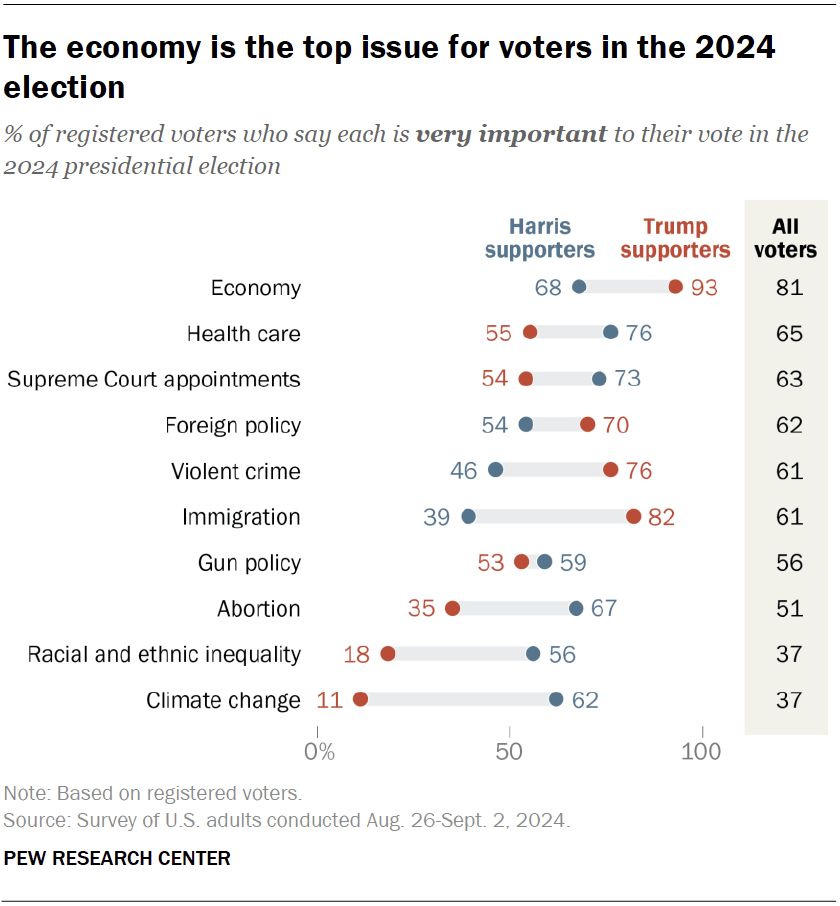
One thing the political polls agree on is the number one concern on the minds of voters. It’s the economy. It is ALWAYS the economy.

The problem, at least for Vice President Harris, is that what voters call the economy is not what economists call the economy. What voters mean when they say economy is prices as in, the price of a gallon of gasoline, the price of a bottle of milk, the price of a dozen eggs. Those prices are up. And as is usual, the incumbent gets the blame.

Read more

Pay to Play: The American Way

Money has always been a big factor in American politics. You can’t outright pay politicians in return for their vote on an issue of interest to you. That’s bribery and it’s a crime. 18 U.S. Code § 201. But you can come very close. That’s because it costs a tremendous amount of money to run for public office and we leave it to the politicians to raise their own funds.

State-wide races for governor, state legislator, or U.S. House or Senate seats can cost hundreds of thousands or millions of dollars. A major state-wide campaign requires a hefty advertising budget and paid staff to handle things like communications, strategic planning, finances, and legal compliance.

Read more
« Older Entries