Category Archives: economics

That Damn Debt

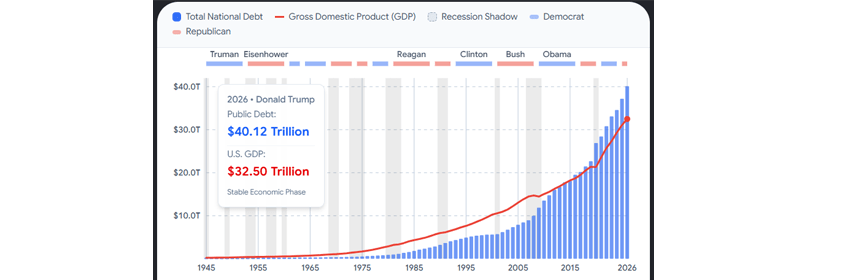
The official U.S. total public debt outstanding breached $40 trillion for the first time in history. It stands at $40,047,426,000,000 according to data released by the U.S. Department of the Treasury. It has increased by about three trillion dollars since January 20, 2025, when the current administration took office.

Considering how much he likes to brag about setting records you’d think Donnie Trump would be in front of the cameras proclaiming, “Biggest debt in history! No one has ever seen a debt as big as this. America is first! We’re winning.”

Instead, fearless leader is attending auto races and showing off his new helipad, $5 million dollars’ worth of big, ugly, granite adorned with his name and sitting on the White House lawn. Something else a future president will have to remove.

Trump left it to Treasury Secretary Scott Bessent to downplay the event, blame the record debt on Joe Biden, and insist the economy will “grow” out of it. The problem with that is obvious. The economy is growing at a rate of about 2%. The debt is growing at the rate of about 6%. As they say, the math ain’t mathin’.

To be fair, as the graph above makes clear, the debt has been growing steadily for decades under both Republican and Democratic administrations. Some of that is growth. Some of that is inflation. The key to watch is not the total debt amount but the ratio of debt to the nation’s total economic output, the GDP. The debt-to-GDP ratio compares a country’s total government debt to its gross domestic product (GDP). It shows a country’s ability to pay back its debts. The U.S. debt-to-GDP ratio is now roughly 124% to 125%.

Trump has stated dozens of times across his campaigns and presidencies that he would control, reduce, or completely eliminate the national debt and federal deficit, famously vowing during his 2016 campaign to wipe out the entire national debt within eight years. Despite these promises, Trump legislative actions, such as the 2017 and 2025 tax cuts, caused substantial increases in annual budget deficits and the overall national debt.

As this graph shows, there is a pattern which began in the Reagan years. The Republicans cut taxes without cutting spending. That increases the annual budget deficit and accelerates increases in the debt. Democrats take control and reduce the deficit, only to have the Republicans repeat the trend the next time they get in control. (By the way, I had AI assistance in doing the actual drawing, but I am responsible for finding the numbers and designing both graphs. The numbers come from the Federal Reserve and the Department of Commerce.).
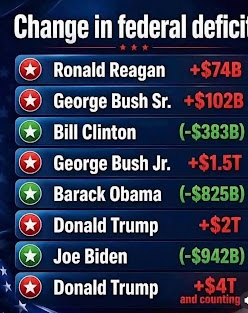
While Republicans like to blame Democrats for the debt, the facts don’t bear that out.

This graphic summarizes the changes in the total debt going all the way back to the Reagan administration. It was then that I first heard the term “trickle-down economics.” The idea was that if you cut taxes for the top backets, they will spend more money, and the effects will pass down to the people in lower brackets. It sounded good to me at the time. But the evidence since has shown it doesn’t work. Nothing trickles. The rich just get richer and the gap between the rich and the rest of us grows larger.

To finance the debt the government borrows money., It does that by issuing securities, Treasury Notes and Bonds. The interest rate it pays is the “cost” of borrowing. More borrowing, more securities. To convince investors to keep buying trillions of dollars in new debt, the U.S. government must offer competitive interest rates. The 10-year treasury yield is currently about 4.7%. The bond market is struggling to meet the demand.

Bessent is doubling long-term government bond buybacks to curb rising rates and inject liquidity into the debt market. On August 19, 2026, the Treasury Department shocked Wall Street by announcing it will increase its buyback operations for 10-year to 30-year bonds to at least $4 billion per operation, up from the previous $2 billion cap. Bessent is executing a strategy he calls a “Treasury Twist“. By purchasing less-liquid, older (“off-the-run”) long-term bonds, the Treasury removes overall duration from the market. To fund these purchases, the Treasury issues short-term bills. This shifts supply to parts of the yield curve better equipped to absorb it. Critics argue that the sudden, unscheduled policy shift disrupts the Treasury’s traditional framework of being regular and predictable, causing further investor anxiety.

Bessent’s action is like putting a Band-Aid on a wound that needs a torniquet. He has joined Trump in an alternate reality. The market isn’t buying it.

When the government borrows hundreds of billions each month, it competes directly with private borrowers for capital. The massive government demand can push up overall interest rates across the entire economy. This means Americans end up paying significantly more for mortgages, auto loans, credit cards, and business loans.

And just like a household credit card, a larger balance means a larger monthly minimum payment. Net interest payments are quickly becoming one of the largest single components of the federal budget. Every dollar spent on interest is a dollar that cannot be spent on infrastructure, national defense, scientific research, tax cuts, or programs like Social Security and Medicare.

If investors eventually begin to worry that the U.S. will never be able to pay back its debt through normal revenues (taxes), they may fear that the government will simply print more money to cover the gap. Flooding the global economy with dollars to inflate away the debt devalues the currency. For us everyday Americans, this manifests as persistent, long-term inflation, reducing the purchasing power of our hard-earned savings and wages.

Time for Donnie and Bessent to play another round of golf.

#####

The Supremes 2026

The Supreme Court wrapped up its 2025-2026 term with a flood of high-profile decisions announced on June 26, 29, and 30th. The usual end of the session reviews quickly flooded the media. Most watchers of the Supremes tried to frame the session as a win or loss for Donald Trump. Or at least a win or loss for the conservation majority which has dominated the Court in recent years.

I see the term as a continuation of the conservative drive to remake, or at least change the direction, of constitutional interpretation in the United States. It featured major rulings on birthright citizenship, tariffs, transgender school sports, independent agencies, and election rules, while also producing some surprising coalitions in the final week of the term. The great online court watching service, scotusblog, has the numbers.

The term was more polarized than the one before it. The share of decisions that were 6-3 rose from 15.2% last term to 28.8% this term and ideologically split 6-3 decisions rose from 9% to 22.7%. Liberal justices also dissented together more often than before. The Court still had a conservative center, with Chief Justice John Roberts, Justice Brett Kavanaugh, and Justice Amy Coney Barrett frequently in the majority. Yet some headline cases ended with the liberal justices in the majority. Although I would not make as much of that as some other commentators have done. I think their wishful thinking is not justified.

Major rulings

One of the term’s defining cases was the birthright-citizenship dispute, Trump v. Barbara. The outcome was expected, but the voting alignment was not. Roberts wrote the opinion, joined by Justices Sonia Sotomayor, Elena Kagan, Barrett, and Ketanji Brown Jackson, while Justices Clarence Thomas, Samuel Alito, and Neil Gorsuch dissented. That made it a major case in which the liberal justices were part of the prevailing coalition rather than the dissent.

The New York Times wrote the decision “capped a more than decade-long effort by Mr. Trump to use the issue as a political tool.” A relief, to be sure, but no cause for celebration. A plain reading of the 14th Amendment would bring anyone to the same decision. The court was split, however, with some justices unable to resist the temptation to dehumanize immigrants by calling them “foreign birth tourists.”

The outlier was conservative Justice Brett Kavanaugh, who concurred in the outcome but dissented as to the reason. The five justices in the majority cited the amendment. Justice Kavanaugh said current immigration law grants citizenship to anyone born on U.S. soil, implying that Trump can have his way if he can get Congress to change the law. As for Alito and Thomas, they dissented with their usual outrage at any decision which upholds the rights and dignity of groups that they see as fundamentally less deserving of rights and dignity than themselves.

Another major case was Learning Resources v. Trump, the tariffs case. The Court rejected the administration’s tariff position, and the decision reflected the Court’s willingness to police the limits of presidential power where statutory authority is unclear.

Executive Power

The term also produced an important executive power ruling in Trump v. Slaughter, involving the president’s power to remove the head of the Federal Trade Commission. The Court overturned, in the majority’s words, whatever is left of Humphrey’s Executor, the 1935 precedent protecting some independent agencies from at-will presidential removal. SCOTUSblog described it as the term’s major overruling, because the Court made explicit a direction it had been moving toward in earlier removal-power cases.

While Slaughter seems to imply Congress cannot put any restraints on the president when it comes to firing officers of the executive branch, a majority did make an exception, for now, in the case of Federal Reserve Governor Lisa Cook. In Trump v. Cook, Trump had fired Cook, citing accusations regarding a home mortgage. The Court rejected that effort by a 5-4 vote, with Roberts joined by Sotomayor, Kagan, Kavanaugh, and Jackson.

The case was sent back to the district court, where Cook will be given an opportunity to contest the allegations. I see this as only a temporary victory, because the president can fire Cook again without cause, as he did in the case of Slaughter.

In Slaughter, Chief Justice Roberts ruled that because the FTC exercises executive power, its commissioners must be removable at will. The statute governing the FTC allowed removal only for “inefficiency, neglect of duty, or malfeasance”. The Federal Reserve Act (12 U.S.C. § 242) uses the exact same core standard, stating that governors may be removed “for cause by the President”. I don’t see how the Court can differentiate the two cases, should Cook come back before it.

Voting and social issues

In Louisiana v. Callais, Louisiana urged the Court to rethink Section 2 of the Voting Rights Act, and the case raised the possibility of further narrowing race-conscious redistricting rules. The Court continued its campaign to neuter the VRA, a lifelong goal of Chief Roberts, allowing Louisiana to redraw its Congressional districts to eliminate a Democratic seat, not caring that it also cut down minority representation from the state.

In Watson v. Republican National Committee, a 5-4 decision in which Barrett and Roberts joined the liberal wing, the Court rejected a position on late-arriving ballots that had been strongly supported by the Trump administration. The ruling allows Mississippi to continuing counting ballots which arrive by mail for five days after the date of an election, as long as the ballots are postmarked on or before election day.

The Court also dealt with transgender school sports litigation, including West Virginia v. B.P.J. and Little v. Hecox, decided together, the Court held that schools can separate women’s and men’s sports teams defined by biological sex. Those cases fit the Court’s broader recent pattern of closely watched disputes over gender identity, education, and equal-protection claims. Taken together with prior terms, they showed that the Court continues to use these cases to define the legal boundaries of state regulation in culture-war conflicts.

While progressives are beginning to believe there is a future down the road with a Democratic president arriving in two years, it will not be sufficient to change the direction of law in the nation. He, or she, will be up against a Supreme Court which continues to reenforce a conservative rule of law, empowering a president now with no promise it will continue to do so if a progressive occupies the Oval.

####

Up, Up, and Away

Space X Launch

I have not held back on my feelings for Elon Musk. But his persona and his work for the Trump administration notwithstanding, I will concede that he is the greatest marketer since P. T. Barnum. Barnum was a 19th century showman, self-made entrepreneur, and co-founder of the Barnum & Bailey Circus. He is often credited for coining the phrase, “There’s a sucker born every minute” although there is no evidence that he actually said it. Elon Mush might have been able to sell shares in his company, SpaceX (Ticker: SPCX), to Barnum. He did manage to sell shares to millions of retail investors.

Read more

Inflation!

Grocery prices

Go ahead. Tell me the higher prices we see staring back at us every day at the grocery store and the gas pump are just a temporary thing. I dare you.

The latest inflation report shows that price pressures heated up again in May, with the Consumer Price Index rising 0.5% month‑over‑month and 4.2% year‑over‑year, the highest annual rate since April 2023. That 4.2% figure matched economists’ expectations, but it still marks a clear acceleration from April’s 3.8% pace. The monthly increase was driven heavily by energy costs, which jumped 3.9% in May and are up 23.5% over the past year, reflecting the ongoing impact of the Iran conflict on global oil markets. Gasoline alone surged 7% in May and more than 40% compared with a year ago, accounting for the majority of the overall CPI increase.

Read more

Economic Conundrum

The May Employment Situation Report released by the Bureau of Labor Statistics (BLS) handily beat expectations, with the U.S. economy adding 172,000 nonfarm payroll jobs. Economists had forecasted a much more modest gain of roughly 80,000 to 85,000 jobs, making this a significant upside surprise.

Read more

13 Hours and $240 Later

Did you file your tax return? Are you getting a refund or do you owe money? Did you fill out the form yourself? Did you use tax software? Did you hire an accountant?

Each year we spend an average of $240 to prepare and file our annual tax returns, according to the IRS Taxpayer Advocate Service. We spend on average thirteen hours filling out the forms. People in other countries think we’re nuts.

Read more

Let’s See…..

Let’s see if I have this straight.

Donald Trump set a deadline of 8pm April 7 for Iran to stop attacking ships passing through the Strait of Hormuz. Over the Easter weekend, Trump posted an obscene threat to Iran promising Iranians will be “living in hell” if they do not comply by the deadline. On the morning of April 7, Trump posted another threat, promising, “A whole civilization will die tonight, never to be brought back again.”

Read more
« Older Entries