Category Archives: Foreign Policy

Mayor Mamdani of Hamas
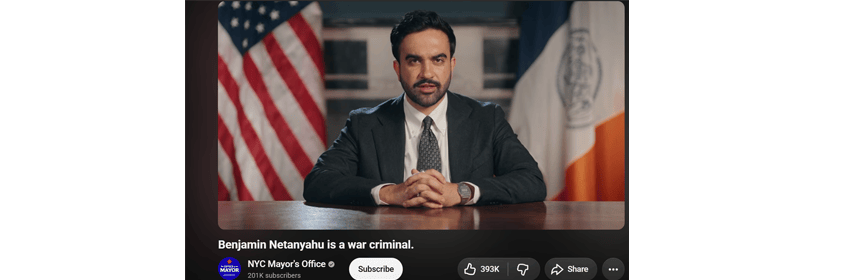
There he is, Zohran Mamdani, Mayor of New York City, appearing in a video produced with all the trappings of a State of the City address or another important civic event and at taxpayer expense.

If Mamdani looks annoyed, it is probably because he is. He found himself forced to admit one of his major campaign issues was a promise that he could never deliver. In other words, he had to admit he lied. Throughout his campaign Mamdani promised voters he would arrest Benjamin Netenyahu, Prime Minister of Israel, should he ever have the temerity to show up in New York City. Netenyahu is expected to do just that to make his annual speech to the United Nations General Assembly in September.

In his high-profile video address, Mamdani admitted that New York City lacks the legal authority to arrest Netanyahu. That is true and was well known even while Mamdani was scoring political points with his pledge. When he threatens the Israeli prime minister, Mamdani references an arrest warrant issued for Netanyahu by the International Criminal Court. But the United States is not a party to the ICC and does not recognize its jurisdiction, a fact which makes the warrant worthless in the U.S. The ICC’s selection of targets to investigate is demonstrably political and biased. And its leadership faces severe allegations of sexual assault and misconduct. A 2002 law broadly prohibits US cooperation with the ICC.

In addition, the United States is a signatory of the United Nations Charter, and to the “host country agreement,” No. 147 in the United Nations Treaty Series. The charter and the agreement guarantee access by diplomats to the UN Headquarters in New York City. Delegates to the UN also enjoy diplomatic status and diplomatic immunity. This is binding under federal law. Heads of state visiting the US are under protection of the Secret Service. Did Mayor Mamdani imagine that when Mr. Netanyahu’s motorcade leaves the UN, the NYPD can pull it over and kidnap a head of state? The idea is preposterous.

So why did Mamdani make his promise?

It might be that the new mayor of the nation’s most populous city is just ignorant of these details. A New York City mayor need not be schooled in the art of foreign policy. But Mamdani is an intelligent man. He is well-schooled. He is a charismatic speaker. His words are well chosen.

No, ignorance does not explain this. The explanation is much simpler. Mamdani is obsessed with Jews. His head is filled with Jews. Mamdani hates Jews. He has, in fact, made a career out of exploiting his hatred of Jews before, during, and after his election. And he channeled his hostility toward Israel and its people by attacking Netanyahu in front of the world.

His video statement makes his position clear. Mamdani called the Israeli Prime Minister a “war criminal” and “the architect of a horrific genocide against the Palestinian people”. He accused Netanyahu of the deaths of over 73,000 people, targeting hospitals, blocking humanitarian aid, and starving civilians. He demanded that the United States federal government step in, join the ICC, and execute the arrest warrant itself.

“Benjamin Netanyahu is not welcome in New York City, nor is any other war criminal at large,” Mamdani said. “While we cannot end the genocide on our own, we can decide whether our silence will become another weapon, and we can examine every tool we have to defend the humanity and dignity of all people.”

Each claim is simply the reiteration of the antisemitic tropes Jews have been subjected to for millenniums. And by far better men than Zohran Mamdani. Mamdani tries to make a distinction between Jew, Israeli, Zionism, and antisemitism. Those who believe that is possible have a fundamental misunderstanding of what each term means.

I have generally avoided getting into the discussion of those tropes mainly because I have found that people who repeat them are not willing to discuss history, facts, or even grammar. They have a view that rejects civilized debate. I should probably knock them down in future posts. For this post I’m going to stick with what Mamdani says and does. His words and actions show what he is and has always been.

Mamdani took office on January 1, 2026. You might think he would address New York City’s challenges. Housing affordability is a real issue with market-rate rents near historic highs. The rising cost of living is squeezing families, small businesses continue to struggle, and public safety concerns are on the rise, including an increase in reported sexual assaults. These are the things a mayor should focus on.

Instead, on that first day, he found it necessary to officially revoke Executive Order 52, which had formally adopted the International Holocaust Remembrance Alliance (IHRA) definition of antisemitism. That stripped away key protections for Jewish New Yorkers amidst rising hate crimes. He has since boycotted cultural events involving his Jewish constituents like the city’s Israel Day Parade.

In July Mamdani announced appointments to an 18-member Advisory Committee on the Judiciary, which screens and recommends judicial candidates for local courts. Mamdani did not appoint a single Jewish lawyer to the committee. He apparently could not a Jewish lawyer he felt was qualified. He did find Muslims to appoint.

Hate crimes against Jews have risen on Mamdani’s watch. NYPD officials reported 205 confirmed hate crimes against Jews between January and July 2026, up from 189 during the same period last year. Jews were targeted in more than half of all hate crimes, or 57%.

On August 14, 2026, a 46-year-old man named Larry Montes violently disrupted a Friday night Shabbat service at Central Synagogue in Manhattan. He shouted antisemitic slurs, struck a 63-year-old female congregant in the face, and assaulted a security guard. On July 23, 2026, a 51-year-old man named Raul Morales targeted and stabbed a Jewish man wearing a yarmulke near a synagogue on the Upper West Side. The attacker shouted “Allahu Akbar” during the violent episode.

Yet Mamdani issued his first mayoral veto against a bipartisan City Council bill intended to combat antisemitism by expanding protest security around schools. He argued the bill would suppress free speech and harm labor, reproductive rights, and pro-Palestinian student demonstrations. He lifted the restriction on boycotting Israel. Nothing had happened yet. No crisis had landed on his desk. He walked in, and this is what he reached for first.

Manmdani has always had a perverse definition of “genocide.” While quick to apply the term to Israel, during a July 2026 press conference, he explicitly declined to label the Hamas-led attacks of October 7, 2023, as a genocide. As a New York State legislator, he formalized his alignment with the Boycott, Divestment, and Sanctions (BDS) movement and openly accused Israel of genocide in Gaza. He has denied Israel’s right to exist as a specifically Jewish state.

Mamdani’s wife, Rama Duwaji, has been active on social media since she was a teenager posting in 2015, “Tel Aviv shouldn’t exist in the first place.” She apologized when those posts resurfaced. Watchdog groups and publications like Jewish Insider reported that Duwaji’s personal account had “liked” multiple Instagram posts that appeared to cheer on or celebrate the Hamas attacks on Israel in which 1,200 Israeli civilians were slaughtered, and 251 hostages were abducted and taken into the Gaza Strip.

Mamdani’s father, Mahmood Mamdani, is a academic whose work on colonialism and Israel has faced severe allegations of antisemitism. A Columbia University professor, Mahmood Mamdani’s academic writings, which his son Zohran has credited as a major influence on his own political worldview, frequently center on the Israeli Palestinian conflict.

We are not asked our ethnicity or religion when we vote in the United States. But exit polls consistently showed roughly 33% of Jewish voters supported Mamdani in the November 2025 election, with 63% supporting independent Andrew Cuomo, and about 3% for Republican Curtis Sliwa.

Go figure.

####

The Supremes 2026

The Supreme Court wrapped up its 2025-2026 term with a flood of high-profile decisions announced on June 26, 29, and 30th. The usual end of the session reviews quickly flooded the media. Most watchers of the Supremes tried to frame the session as a win or loss for Donald Trump. Or at least a win or loss for the conservation majority which has dominated the Court in recent years.

I see the term as a continuation of the conservative drive to remake, or at least change the direction, of constitutional interpretation in the United States. It featured major rulings on birthright citizenship, tariffs, transgender school sports, independent agencies, and election rules, while also producing some surprising coalitions in the final week of the term. The great online court watching service, scotusblog, has the numbers.

The term was more polarized than the one before it. The share of decisions that were 6-3 rose from 15.2% last term to 28.8% this term and ideologically split 6-3 decisions rose from 9% to 22.7%. Liberal justices also dissented together more often than before. The Court still had a conservative center, with Chief Justice John Roberts, Justice Brett Kavanaugh, and Justice Amy Coney Barrett frequently in the majority. Yet some headline cases ended with the liberal justices in the majority. Although I would not make as much of that as some other commentators have done. I think their wishful thinking is not justified.

Major rulings

One of the term’s defining cases was the birthright-citizenship dispute, Trump v. Barbara. The outcome was expected, but the voting alignment was not. Roberts wrote the opinion, joined by Justices Sonia Sotomayor, Elena Kagan, Barrett, and Ketanji Brown Jackson, while Justices Clarence Thomas, Samuel Alito, and Neil Gorsuch dissented. That made it a major case in which the liberal justices were part of the prevailing coalition rather than the dissent.

The New York Times wrote the decision “capped a more than decade-long effort by Mr. Trump to use the issue as a political tool.” A relief, to be sure, but no cause for celebration. A plain reading of the 14th Amendment would bring anyone to the same decision. The court was split, however, with some justices unable to resist the temptation to dehumanize immigrants by calling them “foreign birth tourists.”

The outlier was conservative Justice Brett Kavanaugh, who concurred in the outcome but dissented as to the reason. The five justices in the majority cited the amendment. Justice Kavanaugh said current immigration law grants citizenship to anyone born on U.S. soil, implying that Trump can have his way if he can get Congress to change the law. As for Alito and Thomas, they dissented with their usual outrage at any decision which upholds the rights and dignity of groups that they see as fundamentally less deserving of rights and dignity than themselves.

Another major case was Learning Resources v. Trump, the tariffs case. The Court rejected the administration’s tariff position, and the decision reflected the Court’s willingness to police the limits of presidential power where statutory authority is unclear.

Executive Power

The term also produced an important executive power ruling in Trump v. Slaughter, involving the president’s power to remove the head of the Federal Trade Commission. The Court overturned, in the majority’s words, whatever is left of Humphrey’s Executor, the 1935 precedent protecting some independent agencies from at-will presidential removal. SCOTUSblog described it as the term’s major overruling, because the Court made explicit a direction it had been moving toward in earlier removal-power cases.

While Slaughter seems to imply Congress cannot put any restraints on the president when it comes to firing officers of the executive branch, a majority did make an exception, for now, in the case of Federal Reserve Governor Lisa Cook. In Trump v. Cook, Trump had fired Cook, citing accusations regarding a home mortgage. The Court rejected that effort by a 5-4 vote, with Roberts joined by Sotomayor, Kagan, Kavanaugh, and Jackson.

The case was sent back to the district court, where Cook will be given an opportunity to contest the allegations. I see this as only a temporary victory, because the president can fire Cook again without cause, as he did in the case of Slaughter.

In Slaughter, Chief Justice Roberts ruled that because the FTC exercises executive power, its commissioners must be removable at will. The statute governing the FTC allowed removal only for “inefficiency, neglect of duty, or malfeasance”. The Federal Reserve Act (12 U.S.C. § 242) uses the exact same core standard, stating that governors may be removed “for cause by the President”. I don’t see how the Court can differentiate the two cases, should Cook come back before it.

Voting and social issues

In Louisiana v. Callais, Louisiana urged the Court to rethink Section 2 of the Voting Rights Act, and the case raised the possibility of further narrowing race-conscious redistricting rules. The Court continued its campaign to neuter the VRA, a lifelong goal of Chief Roberts, allowing Louisiana to redraw its Congressional districts to eliminate a Democratic seat, not caring that it also cut down minority representation from the state.

In Watson v. Republican National Committee, a 5-4 decision in which Barrett and Roberts joined the liberal wing, the Court rejected a position on late-arriving ballots that had been strongly supported by the Trump administration. The ruling allows Mississippi to continuing counting ballots which arrive by mail for five days after the date of an election, as long as the ballots are postmarked on or before election day.

The Court also dealt with transgender school sports litigation, including West Virginia v. B.P.J. and Little v. Hecox, decided together, the Court held that schools can separate women’s and men’s sports teams defined by biological sex. Those cases fit the Court’s broader recent pattern of closely watched disputes over gender identity, education, and equal-protection claims. Taken together with prior terms, they showed that the Court continues to use these cases to define the legal boundaries of state regulation in culture-war conflicts.

While progressives are beginning to believe there is a future down the road with a Democratic president arriving in two years, it will not be sufficient to change the direction of law in the nation. He, or she, will be up against a Supreme Court which continues to reenforce a conservative rule of law, empowering a president now with no promise it will continue to do so if a progressive occupies the Oval.

####

Trump is Fired-Up

Fresh from his attempt to convince the American people that the election of 2020, yes, that one, was rigged, fearless leader was up early to attack another whipping boy, our neighbor to the north.

Donald Trump threatened to impose additional tariffs on Canada, accusing the country’s government of “willful negligence” in its handling of massive wildfires that have wafted heavy smoke and worsened air quality in parts of the Midwest and East Coast.

Read more

Memorial Day

Memorial Day is a day for reflection. The day honors the men and women who died while serving in the U.S. military. Observed every year on the last Monday of May, Memorial Day was originally called Decoration Day in a nod to the tradition of placing flowers or other decorative displays at gravesites.

Read more

Let’s See…..

Let’s see if I have this straight.

Donald Trump set a deadline of 8pm April 7 for Iran to stop attacking ships passing through the Strait of Hormuz. Over the Easter weekend, Trump posted an obscene threat to Iran promising Iranians will be “living in hell” if they do not comply by the deadline. On the morning of April 7, Trump posted another threat, promising, “A whole civilization will die tonight, never to be brought back again.”

Read more

Rubio’s Woke War

The Secretary of State is considered the senior advisor to the president. Dean of the cabinet. He is fourth in the line of succession to the presidency. The first Secretary of State was none other than Thomas Jefferson.

The current holder of this key office is Marco Rubio, the 72nd secretary. He used to represent Florida in the U.S. Senate from 2011 to 2025 and has long been a prominent figure in Republican politics. You would think his hands were full. His State Department is grappling with major foreign policy challenges like deterring China’s influence in the Western Hemisphere, managing migration pressures from Latin America, the ongoing war between Ukraine and Russia, negotiating peace efforts in the Middle East, and handling military against Venezuela.

But Rubio, or as Donald Trump used to call him, “Little Marco,” has something else on his mind. Fonts. Specifically, the typeface used by America’s diplomats on documents. Rubio has ordered diplomats to stop using the Calibri font and return to the more traditional Times New Roman.

Against the backdrop of all the crisis the nation is facing, the font edict looks less like a matter of professionalism and more like a symbolic skirmish. A way to score points in domestic culture battles while the department wrestles with urgent global crises.

The story behind the memo is made clear when you consider the order reverses a shift by President Joe Biden’s administration to the less formal typeface that Rubio called wasteful, confusing and unbefitting the dignity of US government documents. In other words, if Biden did it, it must be reversed. We already know Trump is obsessed with Biden. Now we know Rubio shares the syndrome.

Experts say Calibri is modern, clean, and screen-friendly, while Times New Roman is traditional, formal, and optimized for dense print text. The choice between them often depends on whether you want readability on digital displays or a classic, authoritative look in print. So, this is a judgment call.

But more telling, the Biden administration’s decision to switch fonts originated in the Diversity, Equity, and Inclusion office. DEI is the number one boogeyman for the Trump administration. The Biden administration had made the switch because Calibri is generally considered to be more accessible for people with reading challenges due to the font’s simpler shapes and wider spacing, which make its letters easier to distinguish.

“Typography shapes how official documents are perceived in terms of cohesion, professionalism and formality,” Rubio said in a cable sent to all US embassies and consulates abroad. In it, he said the 2023 shift to the sans serif Calibri font emerged from misguided diversity, equity and inclusion policies pursued by his predecessor, Antony Blinken.

Anything that helps people with disabilities access government documents is not on the Trump agenda. Since taking over the State Department in January, Rubio has systematically dismantled DEI programs in line with President Donald Trump’s broader instructions to all federal agencies. Rubio has abolished offices and initiatives that had been created to promote and foster diversity and inclusion, including in Washington and at overseas embassies and consulates, and also ended foreign assistance funding for DEI projects abroad.

“Although switching to Calibri was not among the department’s most illegal, immoral, radical or wasteful instances of DEI it was nonetheless cosmetic,” according to Rubio’s cable obtained by the Associated Press and first reported by The New York Times.

Americas can rest easy. The world may be going to hell but at least the nation’s chief foreign policy expert has his fonts under control.

#####

Bombing Iran

It has become routine. Every two- or three-days Donald Trump does something more atrocious than before and it interrupts whatever I was doing and prompts a cycle of disgust, fear, and rage and often provokes one of these blogs, forcing me to put side something I thought was more interesting. I have come to hate the fact that he sucks all the oxygen out of the room.

But despite that, I find myself unable to get upset about Trump’s recent decision to bomb Iran‘s nuclear facilities. In fact, my initial thought was simply, why did it take so long?

Read more
« Older Entries