Category Archives: commentary

The Supremes 2026

The Supreme Court wrapped up its 2025-2026 term with a flood of high-profile decisions announced on June 26, 29, and 30th. The usual end of the session reviews quickly flooded the media. Most watchers of the Supremes tried to frame the session as a win or loss for Donald Trump. Or at least a win or loss for the conservation majority which has dominated the Court in recent years.

I see the term as a continuation of the conservative drive to remake, or at least change the direction, of constitutional interpretation in the United States. It featured major rulings on birthright citizenship, tariffs, transgender school sports, independent agencies, and election rules, while also producing some surprising coalitions in the final week of the term. The great online court watching service, scotusblog, has the numbers.

The term was more polarized than the one before it. The share of decisions that were 6-3 rose from 15.2% last term to 28.8% this term and ideologically split 6-3 decisions rose from 9% to 22.7%. Liberal justices also dissented together more often than before. The Court still had a conservative center, with Chief Justice John Roberts, Justice Brett Kavanaugh, and Justice Amy Coney Barrett frequently in the majority. Yet some headline cases ended with the liberal justices in the majority. Although I would not make as much of that as some other commentators have done. I think their wishful thinking is not justified.

Major rulings

One of the term’s defining cases was the birthright-citizenship dispute, Trump v. Barbara. The outcome was expected, but the voting alignment was not. Roberts wrote the opinion, joined by Justices Sonia Sotomayor, Elena Kagan, Barrett, and Ketanji Brown Jackson, while Justices Clarence Thomas, Samuel Alito, and Neil Gorsuch dissented. That made it a major case in which the liberal justices were part of the prevailing coalition rather than the dissent.

The New York Times wrote the decision “capped a more than decade-long effort by Mr. Trump to use the issue as a political tool.” A relief, to be sure, but no cause for celebration. A plain reading of the 14th Amendment would bring anyone to the same decision. The court was split, however, with some justices unable to resist the temptation to dehumanize immigrants by calling them “foreign birth tourists.”

The outlier was conservative Justice Brett Kavanaugh, who concurred in the outcome but dissented as to the reason. The five justices in the majority cited the amendment. Justice Kavanaugh said current immigration law grants citizenship to anyone born on U.S. soil, implying that Trump can have his way if he can get Congress to change the law. As for Alito and Thomas, they dissented with their usual outrage at any decision which upholds the rights and dignity of groups that they see as fundamentally less deserving of rights and dignity than themselves.

Another major case was Learning Resources v. Trump, the tariffs case. The Court rejected the administration’s tariff position, and the decision reflected the Court’s willingness to police the limits of presidential power where statutory authority is unclear.

Executive Power

The term also produced an important executive power ruling in Trump v. Slaughter, involving the president’s power to remove the head of the Federal Trade Commission. The Court overturned, in the majority’s words, whatever is left of Humphrey’s Executor, the 1935 precedent protecting some independent agencies from at-will presidential removal. SCOTUSblog described it as the term’s major overruling, because the Court made explicit a direction it had been moving toward in earlier removal-power cases.

While Slaughter seems to imply Congress cannot put any restraints on the president when it comes to firing officers of the executive branch, a majority did make an exception, for now, in the case of Federal Reserve Governor Lisa Cook. In Trump v. Cook, Trump had fired Cook, citing accusations regarding a home mortgage. The Court rejected that effort by a 5-4 vote, with Roberts joined by Sotomayor, Kagan, Kavanaugh, and Jackson.

The case was sent back to the district court, where Cook will be given an opportunity to contest the allegations. I see this as only a temporary victory, because the president can fire Cook again without cause, as he did in the case of Slaughter.

In Slaughter, Chief Justice Roberts ruled that because the FTC exercises executive power, its commissioners must be removable at will. The statute governing the FTC allowed removal only for “inefficiency, neglect of duty, or malfeasance”. The Federal Reserve Act (12 U.S.C. § 242) uses the exact same core standard, stating that governors may be removed “for cause by the President”. I don’t see how the Court can differentiate the two cases, should Cook come back before it.

Voting and social issues

In Louisiana v. Callais, Louisiana urged the Court to rethink Section 2 of the Voting Rights Act, and the case raised the possibility of further narrowing race-conscious redistricting rules. The Court continued its campaign to neuter the VRA, a lifelong goal of Chief Roberts, allowing Louisiana to redraw its Congressional districts to eliminate a Democratic seat, not caring that it also cut down minority representation from the state.

In Watson v. Republican National Committee, a 5-4 decision in which Barrett and Roberts joined the liberal wing, the Court rejected a position on late-arriving ballots that had been strongly supported by the Trump administration. The ruling allows Mississippi to continuing counting ballots which arrive by mail for five days after the date of an election, as long as the ballots are postmarked on or before election day.

The Court also dealt with transgender school sports litigation, including West Virginia v. B.P.J. and Little v. Hecox, decided together, the Court held that schools can separate women’s and men’s sports teams defined by biological sex. Those cases fit the Court’s broader recent pattern of closely watched disputes over gender identity, education, and equal-protection claims. Taken together with prior terms, they showed that the Court continues to use these cases to define the legal boundaries of state regulation in culture-war conflicts.

While progressives are beginning to believe there is a future down the road with a Democratic president arriving in two years, it will not be sufficient to change the direction of law in the nation. He, or she, will be up against a Supreme Court which continues to reenforce a conservative rule of law, empowering a president now with no promise it will continue to do so if a progressive occupies the Oval.

####

Yearning to Breathe Free

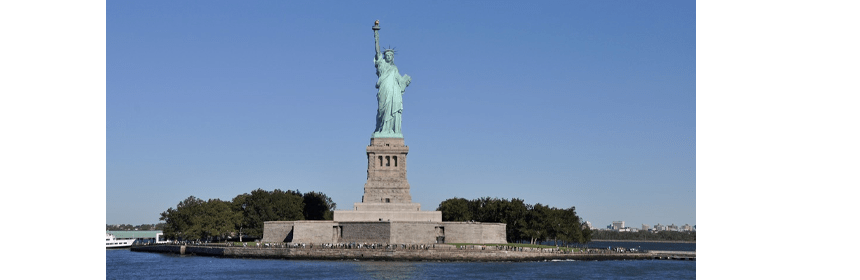
The poem on the pedestal of the Statue of Liberty in New York Harbor is a sonnet titled “The New Colossus,” written by American poet Emma Lazarus in 1883. Its famous lines, “Give me your tired, your poor, / Your huddled masses yearning to breathe free” transformed the statue from a monument of generic liberty into a worldwide symbol of immigration, refuge, and hope.

Lady Liberty was the first thing millions of immigrants saw as they arrived in the New World. “Her name,” the poem declares, is “Mother of Exiles. From her beacon-hand Glows world-wide welcome.”

Not anymore. Unless you can trace your lineage to the indigenous people of North America, and only about 2% of the current population of the United States can do so, your ancestors came from someplace else. As you contemplate the 250th anniversary of the birth of our nation, you might consider that without the welcoming arms of the United States, your personal history would be quite different.

Although the United States is a nation of immigrants, there has always been a faction which opposes it. French and Irish immigrants were targeted in the 1790s. In 1798, President John Adams signed the Alien and Sedition Acts. This extended the naturalization residency requirement from 5 to 14 years and allowed the government to deport “dangerous” open-door arrivals.

Catholics were the targets in the 1840s. Protestant Americans feared that an influx of Catholics would be loyal to the Pope rather than the U.S. government. The late 19th Century brought racial exclusion with the target being Chinese and other Asian laborers. Congress passed the Chinese Exclusion Act of 1882. It was the first major federal law to ban immigration based explicitly on race and nationality. The 20th Century brought a quota system, starting with the Immigration Act of 1924.

Modern opposition to immigration in the United States differs from historical eras by focusing heavily on border security, legal status, and federal enforcement rather than explicit racial exclusion. Under the administration of Donald Trump, the federal government has pushed measures like the “One Big Beautiful Bill” Act and the Laken Riley Act, which expand mandatory detentions, mandate higher federal funding for border walls, and limit federal benefits for even lawfully present immigrants. At this time immigration to the United States has basically stopped. With the exception of a special exception for white South Africans who claim they are being persecuted in their home country.

We as a people are deeply split on this issue. Data from Pew Research Center shows that about 52% of Americans believe current administration tactics go “too far” on deportations, highlighting a steep partisan gap. According to polling compiled by NORC, while a majority of Republicans strongly back federal agencies like Immigration and Customs Enforcement (ICE), most Democrats and independents hold unfavorable views of hardline enforcement. Conversely, a vast cross-partisan majority of voters (around 72%, according to the National Immigration Forum) favor a compromise solution pairing strict border security with a path to earned legal status for those already in the country.

Congress’s ongoing inability to pass a comprehensive, long-term immigration reform bill has left America’s immigration system broken, forcing a reliance on executive orders and courtroom battles instead of permanent laws. For decades, the standard playbook of a “grand compromise” pairing enhanced border enforcement with a pathway to legal status for undocumented immigrants has repeatedly collapsed under intense partisan polarization.

Because Congress cannot pass permanent laws, immigration policy changes drastically with every presidential administration. Borders are managed and humanitarian protections are granted or revoked entirely by executive actions, which are immediately challenged in court.

Last week the Supreme Court issued two monumental 6-3 rulings that significantly expanded the federal government’s power to enforce hardline border restrictions and strip protections from long-term residents. Both decisions split strictly along the Court’s conservative-liberal divide. They represent major legal victories for the Trump administration’s “America First” anti-immigration agenda.

Both majority opinions were written by Justice Samuel Alito. In Mullin v. Doe, dealing with Temporary Protected Status, the majority emphasized that federal courts are legally prohibited from reviewing the Department of Homeland Security’s policy decisions on TPS, rejecting arguments that the terminations were racially motivated.

“There is no judicial review of any determination of the [Secretary of Homeland Security] with respect to the designation, or termination or extension of a designation, of a foreign state under this subsection… This text is clear, and its plain meaning is very broad.”

Mullin v. Doe, Alito, Majority Opinion

The liberal justices argued that the Court bypassed critical constitutional tests regarding equal protection and executive bias. In her dissent, Justice Sonia Sotomayor called out the administration’s past derogatory statements about the affected nations.

“The references—of filth, disease, and primitiveness—are shot through with racial stereotypes and tropes… The statements fairly shout, in their racial undertones and overtones alike, that race entered into the President’s resolve to remove Haitians from this country.”

Mullin v. Doe, Sotomayor, dissenting

In Mullin v. Al Otro Lado, dealing with asylum eligibility, the conservative majority focused strictly on the literal geography of the border line under the Immigration and Nationality Act (INA).

“An alien standing in Mexico does not ‘arriv[e] in the United States’ by attempting, and failing, to set foot in this country. An alien ‘arrives in the United States’ only when he crosses the border.”

Mullin v. Otro Lado, Alito, Majority Opinion

Dissenting again, Justice Sotomayor (joined by Justices Kagan and Jackson), found the liberal minority arguing that the ruling functionally dismantles humanitarian protocols established by Congress.

The majority’s decision “blesses the Executive Branch’s decision to slam the door shut on all who are fleeing persecution, despite the detailed inspection and asylum system that Congress enacted and commands.”

Mullin v. Otro Lado, Sotomayor, dissenting

The initial effect of the first decision will be the immediate loss of TPS legal status for 350,000 people, mostly Haitian. That strips them of deportation protections and valid work permits and puts them at immediate risk of arrest and removal. The effect of a second decision clears the Trump administration to continue its current policy of turning away asylum seekers who come the U.S. borders.

Trump advisor Stephen Miller, who has led the administration’s anti-immigration policy, says the administration will move to remove the roughly 1.3 million TPS migrants, warning that “if you no longer have status in this country, then you’re supposed to be deported.” Miller’s ancestors escaped Russian pogroms and the Holocaust. He also declared, “America’s doors are closed fully to asylum seekers”, dismissing asylum applications as “fake.” Trump’s ancestors came from Germany and Scotland.

The welcome mat has been pulled up at the door of the once-shinning beacon of hope for the world.

Happy 250th.

####

It’s not Easy Being Green

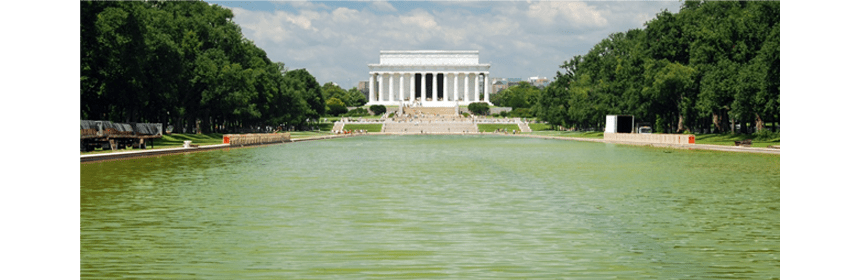
The economy, the war, the arch, the east wing, all of these controversies swirling around Washington these days seem to pale when compared to the saga of the Lincoln Memorial Reflecting Pool. The pool recently underwent a $14 million repainting project ordered by Donald Trump. However, within two weeks of refilling, the pool developed severe algae blooms that turned the water green, and its new blue paint began peeling in large chunks.

Trump insisted that the bottom of the pool be repainted “American flag blue” and that the work be completed well before the nation’s 250 birthday celebration on the Fourth of July. But the repainting did not address the well-known problems with the pool, which is more than one hundred years old.

Trump has claimed, with his usual lack of evidence, that the peeling paint and algae were caused by vandals who slashed a 300-foot gash in the sealant and dumped chemicals into the water. In a court filing, an official with the National Park Service declares, “… the U.S. Park Police responded to an NPS report of damage to the reflecting pool, including a caulk over the foam sealant that was cut with a sharp knife or razor and destruction of delaminating surface material. In addition, approximately 70 fence post tops were thrown into the pool.”

U.S. Park Police say they have arrested and cited multiple individuals in connection with the claims. Funny thing about this. There has been no public arraignment of anyone charged with this vandalism and no notice of arrests. Both would be normal procedure. And the area of the pool is under 24-hour surveillance, and no pictures have surfaced showing any kind of vandalism. In spite of the arrests, the only visual evidence shows someone bending over and putting her hands in the water. Another woman is seen taking pictures of the water with her mobile phone.

Trump has called for harsh penalties for the alleged vandals. That means if you vandalize the reflecting pool you will have the book thrown at you. If you attack the Capitol and beat Capitol Police, you will get a pardon and be entitled to compenensation. Go figure.

Critics and experts suggest that the peeling may be due to a faulty renovation. They say the material installed at the bottom of the pool should resist cutting and tearing. But they also say the material may not have been able to adhere to the concrete surface. Scores of federal government workers have now been deployed to combat the green, a battle Trump compared to the war with Iran. Workers were seen on site in waders, attempting to fish out algae and eliminate patches of deep green across the pool.

As the “green crisis” unfolded, the U.S. Department of the Interior, which oversees the National Park Service, had claimed the water was “crystal clear”, and blamed the “Fake News Media” for reports to the contrary. “The Reflecting Pool water is crystal clear, and our National Park Service team is now vacuuming up the dead algae resting on the bottom of some parts of the Reflecting Pool – just like the destroyed Iranian Navy resting on the bottom of the Persian Gulf,” the department’s press office posted. Why believe what you can see with your own eyes when you can believe what the government is telling you?

The experts say Trump’s rush job was a recipe for failure at each step.

  • Step 1: Remove filters in Reflecting Pool because Obama put them in.
  • Step 2: Give your neighbor who runs “Greenwater Services” a $20 million no-bid contract to paint the pool.
  • Step 3: Personally inspect the work by driving your motorcade of ten heavy armored SUVs on its surface.
  • Step 4: Fill the pool with water from the Potomac River, the phosphates from which cause algae blooms.
  • Step 5: Freshly sealed pool and extreme heat, aggravated by the dark blue color, results in a super scum event. 
  • Step 6: Direct National Park Service to dump hydrogen peroxide into the pool which kills algae but also causes the paint to peel.
  • Step 7: Deploy US National Guard to stop people from taking photos of the swamp as a perfect metaphor for the administration. Put up a fence around the pool to keep people away.

The proper way to repair and update this national treasure is well known and has been known for years. But the plan is expensive and will take time. It includes completely replacing the pool’s concrete foundation with stone. The concrete has cracked as the bottom of the pool, built on swampland as is most of Washington, has settled. The plan would also contend with the pool’s ongoing water-loss issues, caused by the breaking of pipes also caused by the settling ground. Formal estimates on cost and time have not been released although the numbers $100 million and four years have been cited before by the National Park Service.

The landmark pool may now be dry and inaccessible on the Fourth of July.

Wait until Trump builds his arch.

####

This is How It Should Be

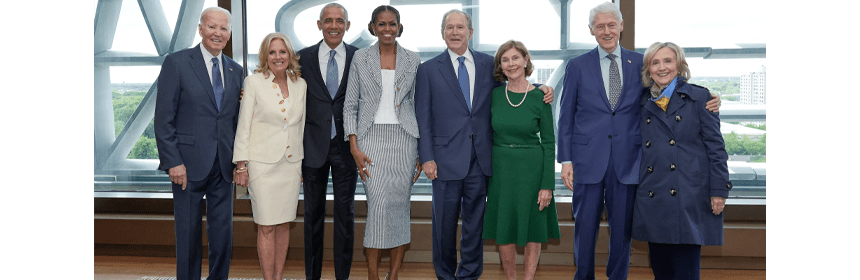
This is a great picture in these troubled times. All four of the living former Presidents of the United States, and First Ladies, gathering in Chicago for the opening of the Barack Obama Presidential Center. It was an uplifting event, full of hope and optimism for the future of a country about to celebrate the 250th anniversary of its birth. The only downside was that we found ourselves noting how remarkable it was. This is how it should be.

It was a fitting memory of those eight years of Obama’s history-making presidency. Something I thought I would never live to see as I grew up in the 1960s, during the turmoil of the civil rights protests. For four years I rode my bike, weather permitting, right past the spot in Jackson Park where the Obama Center now stands. I was going from our apartment just north and east of the location to my high school in the middle of the University of Chicago campus, just to the west.

The ceremony was, like the Obamas themselves, classy and dignified. President Obama spoke not about himself, but about the accomplishments of the team he put together in Washington. He focused on rejecting political cynicism, defending American democracy, and honoring the South Side community that shaped his early career. He said, “I found my purpose here, and I fortified my faith here, and I found my community here.” He noted that the Jackson Park location sits near where he met Michelle, where they married, and where his daughters took their first steps.

President Obama stated he did not want the center to feel like a static “mausoleum” or evoke “nostalgia for some gauzy, bygone era.” Instead, he designed it to address the “unfinished business” of progress. He described democracy as frustrating, slow, and inefficient, but called on visitors to view the center as an affirmation of why democracy is so precious. He explicitly urged us to reject growing cultures of mistrust, declaring that giving in to cynicism would be a “betrayal of our founding ideals.” He closed his speech by channeling 19th-century abolitionist Theodore Parker, describing a “defiant call not to abandon hope or give way to fear,” reminding the crowd that the country must keep fighting even in the face of impossible odds.

What few political zingers were heard came from former First Lady Michelle Obama, who introduced her husband. She praised her husband’s resilience under fire, redefining what a “lasting legacy” means, and positioning the Center as a refuge from modern political chaos. She addressed him directly, saying, “Eight years in the crucible and not once did you melt in the heat. Not once did you let it harden you.”

“You were unflappable at every turn, always focused, always calm, always looking at the long view,” the former First Lady said to her husband. “How absurd it is to even imagine that you might have buckled under the pressure even once, lashed out in frustration, lost your temper. How absurd it is to imagine that you might have done anything but make our family and this entire country proud.”

“No, you were too busy. I’m not done, y’all! Not done,” Mrs. Obama continued as the crowd roared with approval. “So much to say. You were doing the people’s work, rescuing our economy, expanding healthcare, ending a war, ordering the Bin Laden raid, saving an auto industry, winning a peace prize.” Seated in the wing, Hillary Clinton burst out laughing at the obvious jab and President Obama laughed along with her.

We shall leave he-who-was-not-directly-named to sit in the Oval Office fuming. This was a private, not a state event, and he was not invited. The Obamas live in his head to this day.

The entertainers included John Legend, Stevie Wonder, Jennifer Hudson, Bono, the Roots, Christina Aguilera, Common, Marc Anthony.

It is not just a look into the past, but a living testament for the future.

It was as it should be.

#####

Poof! It’s Gone. Maybe.

We think Donald Trump‘s name has been removed from the John F. Kennedy Center for the Performing Arts. At least, that what Trump’s handpicked board of directors told the District Court for the District of Columbia in a filing on Saturday. The removal had been ordered by the court two weeks earlier in a decision enforcing the Center’s original statutory name.

Trump’s name was added in December 2025 after he replaced the Kennedy Center’s leadership and the new board voted to rename the institution. The court found this action illegal, ruling that the board cannot unilaterally change the name of a national memorial.

In his 94-page decision, U.S. District Judge Christopher Cooper wrote, “The Kennedy Center’s organic statute makes crystal clear that the Center is to be named for President Kennedy, and it cannot bear any other formal name or public memorial based on the Board’s unilateral say-so. Congress gave the Kennedy Center its name, and only Congress can change it.”

The renaming triggered a large outcry and a boycott of the Center by patrons, performers, and donors. A crowd of several hundred people gathered on Saturday at the Center to witness the removal of Trump’s name from the exterior. Which brings us to my use of the word “maybe.”

While the Trump lettering was put up by workers on simple lifts, workers Saturday first erected an expansive scaffold in front of the lettering. Then they draped a large curtain or tarp to prevent people from watching their work. Several web cams had been pointed on the sign, transmitting the image around the world. The curtain remains up on Sunday morning. We have only the sworn statement of Trump’s board of directors that the name has been removed.

Why is the curtain still up? Perhaps Trump just couldn’t stand to see the empty space his name once filled. And didn’t want to watch his name coming down.

This is not the end of the lawsuit, which had been brought by Rep. Joyce Beatty (D-Ohio), an ex officio trustee who sued her fellow trustees for adding Trump’s name to the title of the Kennedy Center. Hours before Friday’s deadline, two courts denied the Kennedy Center’s last-ditch attempt to delay the removal, even as crews erected scaffolding next to the building.

Judge Cooper ruled at 1 p.m. that the Kennedy Center’s lawyers failed to demonstrate they were likely to win their appeal or that the center would suffer “irreparable harm” if Trump’s name were removed. At 3:46 p.m., Justice Department lawyers representing the center appealed Cooper’s denial, filing an emergency motion for a stay with the Court of Appeals for the D.C. Circuit. Shortly after 7 p.m., the appeals court denied the second attempt. But the appeal will continue.

The addition of Trump’s name sparked immediate backlash from the arts community and members of the Kennedy family, who argued that the renaming desecrated a living memorial to the assassinated president. Congress established the center in 1964, two months after Kennedy’s death, designating it “the sole national monument to his memory within the city of Washington and its environs.”

Trump’s Department of Justice, paid for by taxpayers, represents him in these cases.

Last week the Center was also sued by the Washington National Opera. The WNO performed in the Center for fifty years but decamped when Trump took over. The opera claims the Center is refusing to return more than $17 million dollars of endowment contributions, gifts and donations which it managed on behalf of the WNO.

June 16 Update

Official word from The Kennedy Center is that the tarps will stay up for the “two-year renovation” and “replacement” of the marble facade slabs. Trumpian subtext, “OK, my name may be removed, but I’m not going to let you see it!!!! Na Na Na Na-Na.” And make no mistake about it, Trump is still the Chairman of The Kennedy Center, and his “Board” are 100% partisan sycophants.  The Kennedy Center is still in mortal danger.

####

Trump Meets the Press

This goes on my list of most memorable television interviews. And I have seen many.

Donald Trump sat for an interview with Kristen Welker, host of NBC’s Meet the Press. I have no idea why. Welker announced that she and her crew had been invited to follow Trump to a rally in Wisconsin, where Trump addressed farmers, one of his most supportive constituent groups. Why they continue to overwhelmingly support him is something else I don’t understand. His policies have crippled their export markets and put them on government subsidies, welfare, and threatened their livelihood. Still, he found himself addressing a friendly crowd. Then he sat down with Welker in a barn in the midst of a pouring rainstorm. As the interviewed progressed, the storm moved inside.

Read more

If It Ain’t Broke…

The maxim reads, “If it ain’t broke, don’t fix it.” Advice which generally means don’t try to fix something that works. The odds are you’ll mess it up. In the context of the CBS blockbuster newsmagazine Sixty Minutes, it seems to apply. Unless of course, fixing something broken is not the goal of the new owners of CBS.

Read more
« Older Entries