Category Archives: Uncategorized

Poof! It’s Gone. Maybe.

We think Donald Trump‘s name has been removed from the John F. Kennedy Center for the Performing Arts. At least, that what Trump’s handpicked board of directors told the District Court for the District of Columbia in a filing on Saturday. The removal had been ordered by the court two weeks earlier in a decision enforcing the Center’s original statutory name.

Trump’s name was added in December 2025 after he replaced the Kennedy Center’s leadership and the new board voted to rename the institution. The court found this action illegal, ruling that the board cannot unilaterally change the name of a national memorial.

In his 94-page decision, U.S. District Judge Christopher Cooper wrote, “The Kennedy Center’s organic statute makes crystal clear that the Center is to be named for President Kennedy, and it cannot bear any other formal name or public memorial based on the Board’s unilateral say-so. Congress gave the Kennedy Center its name, and only Congress can change it.”

The renaming triggered a large outcry and a boycott of the Center by patrons, performers, and donors. A crowd of several hundred people gathered on Saturday at the Center to witness the removal of Trump’s name from the exterior. Which brings us to my use of the word “maybe.”

While the Trump lettering was put up by workers on simple lifts, workers Saturday first erected an expansive scaffold in front of the lettering. Then they draped a large curtain or tarp to prevent people from watching their work. Several web cams had been pointed on the sign, transmitting the image around the world. The curtain remains up on Sunday morning. We have only the sworn statement of Trump’s board of directors that the name has been removed.

Why is the curtain still up? Perhaps Trump just couldn’t stand to see the empty space his name once filled. And didn’t want to watch his name coming down.

This is not the end of the lawsuit, which had been brought by Rep. Joyce Beatty (D-Ohio), an ex officio trustee who sued her fellow trustees for adding Trump’s name to the title of the Kennedy Center. Hours before Friday’s deadline, two courts denied the Kennedy Center’s last-ditch attempt to delay the removal, even as crews erected scaffolding next to the building.

Judge Cooper ruled at 1 p.m. that the Kennedy Center’s lawyers failed to demonstrate they were likely to win their appeal or that the center would suffer “irreparable harm” if Trump’s name were removed. At 3:46 p.m., Justice Department lawyers representing the center appealed Cooper’s denial, filing an emergency motion for a stay with the Court of Appeals for the D.C. Circuit. Shortly after 7 p.m., the appeals court denied the second attempt. But the appeal will continue.

The addition of Trump’s name sparked immediate backlash from the arts community and members of the Kennedy family, who argued that the renaming desecrated a living memorial to the assassinated president. Congress established the center in 1964, two months after Kennedy’s death, designating it “the sole national monument to his memory within the city of Washington and its environs.”

Trump’s Department of Justice, paid for by taxpayers, represents him in these cases.

Last week the Center was also sued by the Washington National Opera. The WNO performed in the Center for fifty years but decamped when Trump took over. The opera claims the Center is refusing to return more than $17 million dollars of endowment contributions, gifts and donations which it managed on behalf of the WNO.

June 16 Update

Official word from The Kennedy Center is that the tarps will stay up for the “two-year renovation” and “replacement” of the marble facade slabs. Trumpian subtext, “OK, my name may be removed, but I’m not going to let you see it!!!! Na Na Na Na-Na.” And make no mistake about it, Trump is still the Chairman of The Kennedy Center, and his “Board” are 100% partisan sycophants.  The Kennedy Center is still in mortal danger.

####

Inflation!

Grocery prices

Go ahead. Tell me the higher prices we see staring back at us every day at the grocery store and the gas pump are just a temporary thing. I dare you.

The latest inflation report shows that price pressures heated up again in May, with the Consumer Price Index rising 0.5% month‑over‑month and 4.2% year‑over‑year, the highest annual rate since April 2023. That 4.2% figure matched economists’ expectations, but it still marks a clear acceleration from April’s 3.8% pace. The monthly increase was driven heavily by energy costs, which jumped 3.9% in May and are up 23.5% over the past year, reflecting the ongoing impact of the Iran conflict on global oil markets. Gasoline alone surged 7% in May and more than 40% compared with a year ago, accounting for the majority of the overall CPI increase.

Core inflation—which excludes food and energy—remained more subdued. Core CPI rose 0.2% for the month and 2.9% year‑over‑year, both in line with forecasts and cooler than April’s monthly reading. That suggests underlying inflation pressures are not spiraling, even as headline inflation is being pushed higher by energy. Some categories even showed mild relief: core commodities slipped 0.1%, and food prices rose only 0.2% on the month, though they remain 3.1% higher than a year ago. Still, essentials like electricity and medical care continue to climb at rates above 3%, contributing to the financial strain many households feel.

The report lands at a delicate moment for the Federal Reserve. Markets widely expect the Fed to hold rates steady at its June 17 meeting, but policymakers will be parsing this data closely for signs of persistent inflation. With headline inflation back above 4% and energy‑driven pressures unlikely to ease immediately, the Fed faces a tricky balance: acknowledge the progress in core inflation without ignoring the renewed squeeze on consumers. For households, the picture is similarly mixed—some categories are stabilizing, but the basics of daily life remain noticeably more expensive than a year ago.

The new Fed Chair, Kevin Warsh, faces a sharp collision between immense political pressure to cut interest rates and May’s hot inflation report that makes a rate reduction nearly impossible. The European Central Bank just raised rates, saying the risk of inflation caused by the shock rising energy prices must be countered.

Add to that the report on Producer Prices for May. The PPI captures inflation at the wholesale level—before costs reach consumers. PPI rose 1.1% month‑over‑month, matching the prior month but exceeding expectations of 0.7%. It rose 6.5% year‑over‑year, slightly above the 6.4% consensus and up from 5.7% previously.

Combined with rising unemployment claims, in spite of the positive employment numbers for May, these reports point to a cooling labor market but persistent inflation. That is the Federal Reserve’s nightmare.

As for Donald Trump, across multiple on‑camera exchanges, Trump responded to questions about inflation by saying:

“You know what I really love? I love the inflation.”

“The numbers were great… I love the inflation.”

Donald Trump, International Business Times UK

He later told the New York Post that he meant he “loved” that inflation wasn’t even higher, arguing his comments were taken out of context. He said the inflation spike is a temporary consequence of the U.S.-Iran war, and insisted inflation will “come down like a rock” once the war in Iran ends.

Two notes. The consensus among economists is that even if the war were to end today, it will take months if not a year for prices to recover. And also, Trump has repeatedly predicted an end to the war he started more than 100-days ago. CNN has put together a devastating video montage.

We shall see.

####

Economic Conundrum

The May Employment Situation Report released by the Bureau of Labor Statistics (BLS) handily beat expectations, with the U.S. economy adding 172,000 nonfarm payroll jobs. Economists had forecasted a much more modest gain of roughly 80,000 to 85,000 jobs, making this a significant upside surprise.

If the professionals were surprised, what are we average citizens supposed to make of it? Donald Trump celebrated the numbers, declaring that “it’s raining jobs” in America, while pushing back against Wall Street and Federal Reserve anxieties regarding inflation. Over the weekend, Trump focused his responses on celebrating the numbers as a massive administrative win while lecturing the financial markets for dropping on good news.

I spent three decades trying to figure out the gyrations of the U.S. economy as a reporter for public television’s Nightly Business Report. It got harder and harder as the years went on. I’ll admit to being as confused as anyone by the strength of the economy today. So, I called some of those professional economists and asked them to explain.

Many view Trump’s claim that this jobs report is a “big win” for his specific policies with a mix of validation and heavy skepticism. While his administration’s legislative actions are directly impacting specific sectors like private manufacturing and corporate investment, broader macroeconomic factors and long-term structural trends are also heavily driving the numbers. They seem to be ignoring tariffs and direct government investment. Too socialistic I presume.

National Economic Council Director ⁠Kevin Hassett and other administration officials point directly to tax provisions within recent legislation—such as the One Big Beautiful Bill Act—and aggressive deregulation. They argue tax incentives have given companies the financial breathing room to hire aggressively without passing high costs to consumers. They also highlight a major comeback in factory construction and data center investments, fueled by corporate tax cuts and protective trade policies.

While the job surge in May, and equally as important the upward adjustments adding 93,000 jobs to the March and April reports, is positive, there are signals which some economists cite to qualify the surge and caution about the road ahead.

  • The “Low-Fire” Environment: After struggling to find staff in recent years, companies are hoarding talent and keeping layoffs at record lows. Because employers are reluctant to shed workers, unemployment numbers remain tight.
  • Sector-Specific Demand: The bulk of net job creation remains heavily concentrated in non-cyclical, hands-on industries. Healthcare continues to expand to meet the needs of an aging population, while construction and public infrastructure remain heavily active.
  • AI and Tech Investment: The massive, ongoing capital buildout in AI—projected to require over $200 billion in new spending—is driving intense demand for specialized tech and cybersecurity talent.
  • Increased Productivity: Corporate profits are soaring because companies are becoming more efficient, often using new technology tools to do more with their existing workforces, which drives up stock valuations.
  • “Optionality” via Job Openings: While hiring data looks robust on paper, economists note that many small and medium-sized firms are posting open roles to keep their options open, rather than bringing workers on board immediately.

This dynamic creates a somewhat paradoxical labor market where overall job security is high, but finding a new job can feel highly competitive due to automated screening and “one-click” application surges.

Analysts as SHRM, the Society for Human Resource Management, see what they brand a “low-hire, low-fire” narrative evolving. They note a surprise jump in job openings to 7.6 million. Paired with May’s payroll surge, they say employers are clearly demonstrating a renewed willingness to expand headcounts despite broader geopolitical headwinds and inflation anxieties.

I would have thought the Trump tariffs would be dragging down the economy by now. My economist friends tell me the fact that the courts have ruled most of them illegal may explain why they have had little effect. Most of the inflation we have seen, they note, can be blamed on the war with Iran and its effect on energy and petroleum derivatives.

What does it all mean? If you have a job, indications are you need not worry, yet. If you’re looking for one, you might take note that the hot job sectors are not those which require an advanced degree. That’s bad news for recent graduates. The surprising gains were driven by specific pockets of high demand:

  • Leisure and Hospitality: Surged by 70,000 jobs, heavily outperforming its 12-month historical average.
  • Local Government: Added 55,000 jobs, heavily fueled by non-education municipal sectors.
  • Healthcare: Kept up its consistent growth pattern by adding 35,000 jobs.

Financial Activities experienced a decline in overall net employment for the month.

The Federal Reserve, even with a new chairman seen as pro-Trump, is going to have a hard time satisfying Trump’s demand for lower interest rates. With high inflation and the job market still doing well, higher rates may be indicated.

And the stock market? Trump complained that the market fell on the strong jobs news. That is further proof he doesn’t understand the financial markets. The markets are now mostly driven by speculative fever and speculators gamble with other people’s money. Interest rates are the cost of that money. What’s good for jobs is, in the markets’ perverse way of looking at things, bad for stocks because higher interest rates cost the speculators money.

To be continued.

####

Funerals at CBS

There are two funerals on tap this week at CBS, Inc., the company where I spent the first decade of my professional career. When I joined it in 1974, it had recently changed its name from the Columbia Broadcasting System to better reflect its position as a major media company, not just a broadcaster. Its four core lines of business were Broadcasting (TV and radio), Records (music), Publishing (books and magazines), and Musical Instruments/Toys.

One thing it did not change was its leadership. William S. Paley was the legendary media tycoon who built CBS from a small, struggling 16-station radio network into a multi-billion-dollar global broadcasting and entertainment empire. He is widely regarded as one of the founding fathers of modern American broadcasting. Paley entered the picture in September 1928, when his wealthy family bought a majority stake a struggling radio company. He was subsequently named president at just 26 years old, going on to transform the then tiny network into a media empire. In 1974, he was firmly in control.

I can’t imagine what he would think of today’s CBS. Faced with a business climate which seems to value size over all else, CBS has gone from owner to owner in the post Paley years. Today it is owned by Paramount Skydance (formally known as Paramount, a Skydance Corporation). The network’s ownership structure underwent a massive shift when Skydance Media, led by tech heir and filmmaker David Ellison, officially completed an $8 billion merger with CBS’s previous parent company, Paramount Global, on August 7, 2025. Ellison’s takeover of the storied broadcasting was aided by a cash guarantee from his father Larry. Larry Ellison, the billionaire co-founder of Oracle, played the critical role of primary financial bankroller and majority equity owner in the Skydance acquisition of Paramount Global (and by extension, CBS).

Which brings us to this week’s funerals. Not unplanned deaths. These are self-inflicted executions.

The Late Show with Stephen Colbert

First to die will be The Late Show with Stephen Colbert. It will air its final episode on May 21. The Late Show franchise originally began on August 30, 1993, when David Letterman launched the inaugural Late Show with David Letterman. It was a bold attempt for CBS to compete in the late-night hours, where NBC’s Tonight Show had reigned supreme seemingly since the beginning of time. I remember gathering with my dormmates around the communal television after a long day of classes and studying to relax with Johnny Carson. When Carson retired, Letterman, who had a program which followed Carson, seemed the heir apparent. NBC instead chose comedian Jay Leno, leaving Letterman free. CBS swooped in.

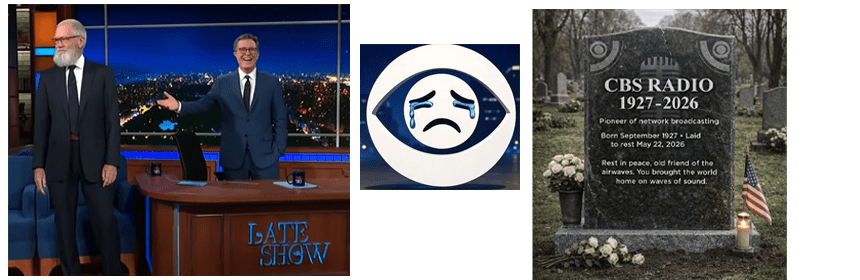
When Letterman retired in 2015, after hosting for 22 years, CBS selected Stephen Colbert, host of his own show on the Comedy Central channel, to succeed him. In the picture above you can see Letterman and Colbert, together last week to throw their own wake. What better way than by gleefully tossing CBS office furniture, including a desk chair and sofas, plus watermelons — a signature Letterman gag — off the side of the building, aimed at the target below: a giant CBS logo.

The official reason provided by CBS for canceling The Late Show is financial, though the decision is heavily shadowed by a massive corporate and political timing controversy. CBS did not reveal detailed financial information. For many the show’s cancellation carries the stench of suspected political interference. Publicly, media critics, industry insiders, and even former host Letterman have vehemently rejected the financial excuse, calling CBS executives “lying weasels” and accusing them of political cowardice.

In July 2025, Paramount paid a $16 million legal settlement to Donald Trump after he sued over how 60 Minutes edited an interview with Kamala Harris. Days later, Colbert ruthlessly mocked his own parent company on air, calling the payout a “big fat bribe”. At the exact moment Colbert made these comments, Paramount was desperately seeking crucial regulatory approval from the Trump administration’s FCC for its $8 billion merger with Skydance Media. Just days after Colbert’s monologue, CBS stunned the industry by canceling the show. Weeks later, the FCC approved the multibillion-dollar Skydance merger. Trump later gloated publicly on social media, bragging that Colbert had been “fired.”

CBS Radio News

The second funeral will be held at the end of the Friday. On that day CBS permanently shuts down CBS News Radio, brining a historic 99-year era of American broadcasting to a sudden end.

Sometime when I was in grade school, I set my clock radio to wake me up at 7AM Chicago time. The radio was tuned to WBBM, the CBS owned station. At that time, I heard The CBS World News Roundup. I have started my day with that broadcast most days since. That is something in the neighborhood of 65 years. But the CBS News Roundup, and the CBS News Hourly reports at the top of every hour of every day, can trace their history back to 1928. This shutdown, ordered by Larry Ellison’s pick as Editor-in-Chief of CBS News, Bari Weiss, completely dismantles the original foundation of William Paley’s media empire and eliminates all remaining jobs within the radio news division.

Finances again are blamed. Legacy media has been heavily battered by years of declining advertising revenue and shifting listener habits as audiences steadily migrated toward podcasts, social media, and digital streaming platforms. But creative leadership could have explored options. The audio medium of radio is perfect for podcasts and streaming. The new bosses at CBS clearly had their eye only on the issue of paying down the Ellison’s debt. The shutdown functions as part of a larger 6% staff reduction across the entire CBS News workforce under the network’s new Paramount Skydance corporate ownership.

There was a time when the government insisted broadcasters devote time to news and public affairs. And they insisted content be fair and balanced and provide opportunities for differing viewpoints to be heard. This was the price one paid for the privilege of controlling one of the limited number of broadcast channels available, as the words of the Communications Act read, “In the public interest, convenience, and necessity.” There were also station owners who took that requirement to heart, desiring to serve their communities and their nation. Those visionaries are long gone.

The CBS Radio Network’s sudden exit leaves roughly 700 local affiliate stations nationwide without their primary hourly national news feeds. Major local all-news stations, like KNX in Los Angeles, WBBM in Chicago, and WWJ in Detroit, had to immediately assure listeners that local reporting would continue while they frantically negotiated new contracts with national syndication competitors like ABC News, Fox News, or NBC News.

Media historians and former network legends have reacted with grief, with former CBS Evening News anchor Dan Rather lamenting, “It’s another piece of America that is gone”. Until this final week, CBS News Radio was the absolute last of the three original national U.S. radio networks (alongside NBC and the Mutual Broadcasting System) still operating under its original parent brand.

The World News Roundup was the longest-running continuous program in broadcast history. And the network famously invented modern wartime reporting with Edward R. Murrow’s London Blitz broadcasts.

I will have to find another way to start my day.

#####

R.I.P. V.R.A.

John Roberts, Chief Justice of the United States, has achieved his life goal. With the Court’s ruling in Louisiana v. Callais, he has killed the Voting Rights Act. Roberts made the destruction of the VRA of 1965 his lifelong crusade. His opposition to the Act dates back to his days as a law clerk for then Associate Justice William Rehnquist. Rehnquist notoriously wrote a memo in 1952 stating, “I think Plessy v. Ferguson was right and should be re-affirmed.” Plessy was the infamous “separate but equal” case institutionalizing racism in public schools. It was overturned by Brown v. Board of Education in 1954.

Read more

Hot Off the Griddle

He’s in the groove. Donald Trump finally has his production line going and he’s serving up indictments like he’s working the griddle at the local fast-food joint.

On October 9, a federal grand jury in the Eastern District of Virginia indicted New York Attorney General Letitia James on charges of bank fraud and making false statements to a financial institution. The charges relate to allegations involving a mortgage loan. James is the second name on Trump’s revenge list. The same judicial district run by the same US Attorney indicted former FBI director James Comey last week. Just like the Comey case, the James indictment came over opposition from career prosecutors.

Read more

24 Years

It is hard to believe it is 24 years since the 9-11 attack. In many ways, it seems to be ancient history. Many of my students were not yet born on that day. But in other ways, it seems like just yesterday.

I have written about my experience on that day before, and I will not repeat that lengthy reflection now.

But I will share, I think for the first time, the video of my interview that day which appeared on public television. I apologize. The video is a little choppy and grainy.

Read more
« Older Entries