Category Archives: Blog

The Pirro Pivot

In one area the Trump administration is remarkably successful. It is hard to imagine another national government where more unqualified, incompetent, and corrupt people have been assembled in one place. Robert F. Kennedy, Jr. and Pete Hegseth take note.

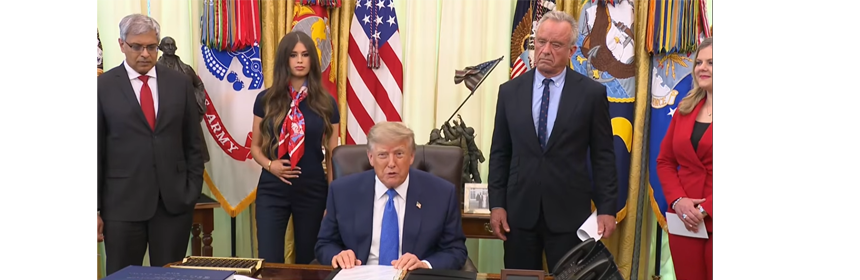
Pictured above is Jeanine Perro, the United States Attorney for the District of Columbia, one of the most important federal prosecutors in the Department of Justice. Perro auditioned for her post in the usual Trump way. It is true that Pirro was Westchester County’s first female judge and district attorney. But that was two decades ago. Her key qualification for a post in the Trump administration was her longtime service as a Fox Channel personality hosting Justice with Judge Jeanine and co-hosting The Five. Pirro is also a best-selling author. One of her titles, “Liars, Leakers, and Liberals: The Case Against the Trump Conspiracy,” surely caught Trump’s eye.

Since her appointment Pirro has consistently aligned her office with Trump’s aggressive law-and-order directives, specifically implementing the federal crime crackdown in D.C. Pirro publicly defended and credited Trump’s federal law enforcement enhancements for lowering crime statistics in the nation’s capital, stating that the administration brought much-needed safety after previous high homicide rates.

In this video from July 2, 2026, Perro is holding a news conference to announce the indictment of David Hearn, a Maryland resident, charging he vandalized the famous Lincoln Memorial Reflecting Pool, the object of a high-priority renovation directed by Trump himself. Pirro told reporters that Hearn was seen by National Park Service employees making a “forcefully and violently” effort to rip up the pool liner with his bare hands. When reporters pressed her for details and asked how she would prove the damage exceeded the $1,000 felony threshold, Pirro snapped at the press and repeatedly clashed with reporters questioning the validity of the case.

Pirro had presented her case to a D.C. grand jury and personally signed the indictment. The charge carries a sentence of up to 10 years in prison upon conviction. Hearn, 67, competed for the United States as a canoeist in 1992, 1996 and 2000 Summer Olympics.

In the month that followed Donald Trump and the Secretary of the Interior, Doug Burgum, who supervises the National Park Service and is responsible for the pool, insisted that the damage involved “multiple gashes” by vandals, first and foremost Hearn. Hearn insisted that all he did was pick up a piece of material floating in the water, which had peeled off from the bottom of the pool. Burgum said the pool suffered “multiple gashes” to the industrial liner that add up to 350 feet of damage. He said Interior Department employees had witnessed Hearn’s actions. In an interview on CNN’s “State of the Union,” Burgum said that the same contractor who installed the lining will repair it and that the peeling liner had nothing to do with faulty workmanship.

Fast forward to Friday, July 31. Jeanine Perro was nowhere to be seen late in the afternoon, when the United States Department of Justice dropped off a 20-page document at the D.C. Superior Court. No news conference, no press release. This is known as “taking out the garbage.” You dump into public view something you hope will draw little or no notice, figuring late on a Friday reporters and the general public will be focused on the upcoming weekend and not paying too much attention. “Government’s Motion to Dismiss the Indictment” is the title. One of Pirro’s assistants prepared the dismissal motion, although the motion was submitted on her behalf.

The motion says that after the indictment came down the Interior Department (DOI) provided additional documents to the U.S. attorney’s office “indicating that damage to the Lincoln Memorial Reflecting Pool in June 2026 was the result of flawed installation by the contractor, Atlantic Industrial Coatings.” The DOJ said it “first became aware of information showing that the damage was the result of a botched installation and not vandalism” after reviewing more documents. “Had DOI been forthcoming with the information clearly in its possession, the government would not have sought a grand jury indictment.

In other words, never mind.

The DOJ said when it presented the case to the grand jury, it was “not in possession of any information from DOI indicating that any damage to the Reflecting Pool was caused by anything other than the actions of the defendant and other vandals who damaged the pool’s lining.” The filing continues, “it is difficult to attribute the widespread damage to the Reflecting Pool to vandalism, let alone to establish that fact beyond a reasonable doubt.”

So why did Pirro pivot? Why not just continue the case and hope it will fade away in the year or two it would take to get before a jury? After all, that is what the boss in the Oval Office clearly wanted. I can only speculate that Pirro is thinking about her future.

Presenting a case to a grand jury built on incomplete or misleading information, without a proper investigation, could invite sanctions for filing a frivolous proceeding. Pirro may be planning on returning to her Fox platform at the end of the Trump administration. But even Fox might look askance at hiring a commentator who had been disciplined or even disbarred for unethical behavior.

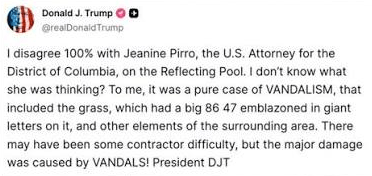
Pirro might be looking for a new job sooner than she planned. The boss is not happy. In a social media post, Trump writes, “I disagree 100% with Jeanine Pirro… it was a pure case of VANDALISM.”

One would think Hearn would have some recourse here for what was done to his reputation and for what his defense may have cost. Think again. Statute and case law make it virtually impossible to recover against government officials no matter how outrageous their actions. He might be able to make a claim to recover his legal fees. But that is still an uphill battle.

Maybe he should sell the film rights. Or write a book. Maybe Pirro can give him some advice along those lines.

####

The Supremes 2026

The Supreme Court wrapped up its 2025-2026 term with a flood of high-profile decisions announced on June 26, 29, and 30th. The usual end of the session reviews quickly flooded the media. Most watchers of the Supremes tried to frame the session as a win or loss for Donald Trump. Or at least a win or loss for the conservation majority which has dominated the Court in recent years.

I see the term as a continuation of the conservative drive to remake, or at least change the direction, of constitutional interpretation in the United States. It featured major rulings on birthright citizenship, tariffs, transgender school sports, independent agencies, and election rules, while also producing some surprising coalitions in the final week of the term. The great online court watching service, scotusblog, has the numbers.

The term was more polarized than the one before it. The share of decisions that were 6-3 rose from 15.2% last term to 28.8% this term and ideologically split 6-3 decisions rose from 9% to 22.7%. Liberal justices also dissented together more often than before. The Court still had a conservative center, with Chief Justice John Roberts, Justice Brett Kavanaugh, and Justice Amy Coney Barrett frequently in the majority. Yet some headline cases ended with the liberal justices in the majority. Although I would not make as much of that as some other commentators have done. I think their wishful thinking is not justified.

Major rulings

One of the term’s defining cases was the birthright-citizenship dispute, Trump v. Barbara. The outcome was expected, but the voting alignment was not. Roberts wrote the opinion, joined by Justices Sonia Sotomayor, Elena Kagan, Barrett, and Ketanji Brown Jackson, while Justices Clarence Thomas, Samuel Alito, and Neil Gorsuch dissented. That made it a major case in which the liberal justices were part of the prevailing coalition rather than the dissent.

The New York Times wrote the decision “capped a more than decade-long effort by Mr. Trump to use the issue as a political tool.” A relief, to be sure, but no cause for celebration. A plain reading of the 14th Amendment would bring anyone to the same decision. The court was split, however, with some justices unable to resist the temptation to dehumanize immigrants by calling them “foreign birth tourists.”

The outlier was conservative Justice Brett Kavanaugh, who concurred in the outcome but dissented as to the reason. The five justices in the majority cited the amendment. Justice Kavanaugh said current immigration law grants citizenship to anyone born on U.S. soil, implying that Trump can have his way if he can get Congress to change the law. As for Alito and Thomas, they dissented with their usual outrage at any decision which upholds the rights and dignity of groups that they see as fundamentally less deserving of rights and dignity than themselves.

Another major case was Learning Resources v. Trump, the tariffs case. The Court rejected the administration’s tariff position, and the decision reflected the Court’s willingness to police the limits of presidential power where statutory authority is unclear.

Executive Power

The term also produced an important executive power ruling in Trump v. Slaughter, involving the president’s power to remove the head of the Federal Trade Commission. The Court overturned, in the majority’s words, whatever is left of Humphrey’s Executor, the 1935 precedent protecting some independent agencies from at-will presidential removal. SCOTUSblog described it as the term’s major overruling, because the Court made explicit a direction it had been moving toward in earlier removal-power cases.

While Slaughter seems to imply Congress cannot put any restraints on the president when it comes to firing officers of the executive branch, a majority did make an exception, for now, in the case of Federal Reserve Governor Lisa Cook. In Trump v. Cook, Trump had fired Cook, citing accusations regarding a home mortgage. The Court rejected that effort by a 5-4 vote, with Roberts joined by Sotomayor, Kagan, Kavanaugh, and Jackson.

The case was sent back to the district court, where Cook will be given an opportunity to contest the allegations. I see this as only a temporary victory, because the president can fire Cook again without cause, as he did in the case of Slaughter.

In Slaughter, Chief Justice Roberts ruled that because the FTC exercises executive power, its commissioners must be removable at will. The statute governing the FTC allowed removal only for “inefficiency, neglect of duty, or malfeasance”. The Federal Reserve Act (12 U.S.C. § 242) uses the exact same core standard, stating that governors may be removed “for cause by the President”. I don’t see how the Court can differentiate the two cases, should Cook come back before it.

Voting and social issues

In Louisiana v. Callais, Louisiana urged the Court to rethink Section 2 of the Voting Rights Act, and the case raised the possibility of further narrowing race-conscious redistricting rules. The Court continued its campaign to neuter the VRA, a lifelong goal of Chief Roberts, allowing Louisiana to redraw its Congressional districts to eliminate a Democratic seat, not caring that it also cut down minority representation from the state.

In Watson v. Republican National Committee, a 5-4 decision in which Barrett and Roberts joined the liberal wing, the Court rejected a position on late-arriving ballots that had been strongly supported by the Trump administration. The ruling allows Mississippi to continuing counting ballots which arrive by mail for five days after the date of an election, as long as the ballots are postmarked on or before election day.

The Court also dealt with transgender school sports litigation, including West Virginia v. B.P.J. and Little v. Hecox, decided together, the Court held that schools can separate women’s and men’s sports teams defined by biological sex. Those cases fit the Court’s broader recent pattern of closely watched disputes over gender identity, education, and equal-protection claims. Taken together with prior terms, they showed that the Court continues to use these cases to define the legal boundaries of state regulation in culture-war conflicts.

While progressives are beginning to believe there is a future down the road with a Democratic president arriving in two years, it will not be sufficient to change the direction of law in the nation. He, or she, will be up against a Supreme Court which continues to reenforce a conservative rule of law, empowering a president now with no promise it will continue to do so if a progressive occupies the Oval.

####

Trump is Fired-Up

Fresh from his attempt to convince the American people that the election of 2020, yes, that one, was rigged, fearless leader was up early to attack another whipping boy, our neighbor to the north.

Donald Trump threatened to impose additional tariffs on Canada, accusing the country’s government of “willful negligence” in its handling of massive wildfires that have wafted heavy smoke and worsened air quality in parts of the Midwest and East Coast.

“We are holding Canada responsible for the fact that they are not properly maintaining their Forests, and Brush therein, and the United States is being unnecessarily invaded by filthy, polluted, and unhealthy air, the quality of which is dangerous, and totally unacceptable!” Trump wrote in a Truth Social post.

Republican members of Congress have jumped on Trump’s coattails, as usual, publicly criticizing Canada for not doing enough to prevent wildfires in Ontario and Manitoba, which have sent smoke into the U.S. Four Republican members of Congress from Michigan wrote a sharply worded letter to Prime Minister Mark Carney, the lawmakers warning that if Canada does not take further action, “the United States will look elsewhere, and act on our own, to protect our people.”

More than a dozen U.S. states are under air quality alerts as wildfires continue to burn across Canada and in northern Minnesota. A thick haze has officials urging residents in some major U.S. cities, such as Chicago and Washington, D.C., to stay indoors or wear masks due to potentially hazardous air pollution.

(Photo by ANGELA WEISS / AFP via Getty Images)

Canadian officials and experts have pushed back against these accusations. Environment and Climate Change Canada climatologist David Phillips highlighted that wildfire smoke does not respect political boundaries and is carried by weather systems, meaning the problem is not solely Canada’s responsibility.

The Canadian Interagency Forest Fire Centre, a fire protection service based in Winnipeg, Manitoba, reported 897 active fires as of Friday, with Ontario, Quebec and the Northwest Territories seeing the most activity. Fewer than 100 of those fires are considered “under control.”

Canadians have also noted that U.S. emissions contribute to wildfire conditions in Canada, emphasizing the global nature of climate-driven fire risks. The scientific consensus indicates that smoke drift is a natural consequence of weather and climate conditions, not a failure of Canadian policy alone. Both countries face increasing wildfire risks due to climate change, and cross-border cooperation is essential to manage air quality and fire mitigation effectively.

Canadians have been affected by Alaska fires, and by fires from California, Washington State, and Oregon. They all bring smoke into Canada. Canada also sends firefighting resources, including waterbombers, to help the U.S. A prime example of international cooperation which helps both countries deal with challenging weather conditions brought about by changes in the climate.

Science, cooperation, and climate change are all terms that Trump finds offensive. His response to these challanges, as to most other things, is to point fingers and theaten retribution.

“Canada has refused to engage in basic Forest Management and Debris Removal, knowing that such refusal will lead to exactly this result,” Trump posted. “This is Willful Negligence, and becoming a yearly occurrence, costing the United States Billions of Dollars, which cost of this pollution must of necessity be added to the TARIFFS Canada is currently paying.”

And so it goes.

####

US at 250

“The Second Day of July 1776, will be the most memorable Epocha, in the History of America. I am apt to believe that it will be celebrated, by succeeding Generations, as the great anniversary Festival. It ought to be commemorated, as the Day of Deliverance by solemn Acts of Devotion to God Almighty. It ought to be solemnized with Pomp and Parade, with Shews, Games, Sports, Guns, Bells, Bonfires and Illuminations from one End of this Continent to the other from this Time forward forever more.”

John Adams, Letter to Abigail Adams, July 3, 1776

John Adams, by far the most prescient of the founders, described Independence Day in this letter sent to his wife Abigail on July 3rd, 1776. He got most of it right.

Adams predicted that the anniversary of American independence would be celebrated forever. He expected July 2 to become Independence Day because that was the day Congress approved Virginia’s resolution that the thirteen colonies declare their independence from England. Instead, we celebrate July 4, the date on which the text of the Declaration of Independence was approved and eventually printed with that date. But his description, parades, bells, fireworks (“illuminations”), bonfires, sports, and public celebrations, closely resembles how we celebrate the Fourth of July today.

Adams foresaw the growth of the United States of America to span the continent from west coast to east. And his letter to Abigail captures his confidence that the new nation would endure as a great nation among those of the world.

I often wonder, in this age of divisiveness, if we have fulfilled Adams’s dreams. The United States is unquestionably the world leader in many respects. It has the world’s biggest economy. It has grown dramatically in population. It has expanded to stretch from one ocean to the next. It claims to have the most powerful military, although it doesn’t seem to be able to keep a strait essential to the world’s energy supply open. It certainly outspends the next dozen or so countries on that military. Adams foresaw those things and I think on those points the United States today would please him.

But he would be less pleased to discover that his biggest fears have also come to pass. He wrote of the dangers facing the new republic. His biggest fear came not from without, but from within. He warned that avarice could produce leaders who put personal gain over the needs of the people. He predicted that under certain circumstances, factions succumbing to greed for power and money could infect multiple branches of government and defeat the system of checks and balances the framers wrote into the Constitution in 1787. I do not believe he would be pleased with the current state of affairs in Washington.

The Declaration was always a contradiction. It famously contains what the great biographer Walter Isaacson calls, “The Greatest Sentence Ever Written.” Yet the author of, ““We hold these truths to be self-evident, that all men are created equal, that they are endowed by their Creator with certain unalienable Rights, that among these are Life, Liberty, and the pursuit of Happiness,” Thomas Jefferson, was a slaveholder throughout his entire life, as were many of the Revolutionary era leaders.

Jefferson listed slavery as one of the evils brought to the new world by the King of England. But that sentence was removed from the Declaration during the final debate. Jefferson later wrote it was the price for gaining the acquiesce of South Carolina and Georgia to the independence resolution.

Slavery wasn’t abolished until the 13th Amendment was ratified in 1865, after the Civil War. Voting rights for women didn’t arrive until the 20th century, with ratification of the 19th Amendment in 1920.

Many people believe the nation should work toward unity, the assimilation of the various immigrant groups which have arrived on our shores in waves over the years. This is what I call the “great melting pot” strategy. This may be the answer in other countries, where the population is homogeneous and it is easy to be loyal to a race or a land. The United States has never been that. Unless you can trace your lineage to the indigenous people, and only about two per cent of the population can, then you trace your roots to someplace else. We expect immigrants to be loyal to the country, and history proves they are. Yet we retain as important parts of our identity those aspects of heritage which our ancestors brought to these shores.

There is no question that this diversity, a word the present administration sees as obscene, adds to our divisions. But history proves it is also a source of great strength. We should embrace the diversity of our people. We should strive toward tolerance and understanding of fellow Americans who have stories which are different than our own. Our diversity makes it clear that the people who are Americans choose to be Americans. I see in the continuing clamor of people from all over the world to immigrant to the United States evidence that we are doing something right.

For me the obvious contradiction between the words of the Declaration and reality is resolved by viewing the Declaration we celebrate today as aspirational, rather than literal. The document was a statement of profound principles and ideals, rather than a word-for-word reflection of 1776 reality. It remains so to this day as we strive to, in the words of the great preamble to the Constitution, “form a more perfect union.” For me, that gives hope that we can come closer to our goals. Someday.

“You will think me transported with Enthusiasm but I am not.—I am well aware of the Toil and Blood and Treasure, that it will cost Us to maintain this Declaration, and support and defend these States.—Yet through all the Gloom I can see the Rays of ravishing Light and Glory. I can see that the End is more than worth all the Means. And that Posterity will tryumph in that Days Transaction, even altho We should rue it, which I trust in God We shall not.”

John Adams. 1776

Do we see on the occasion of our 250th birthday John’s rays of ravishing light and glory?

Do we agree with Adams, that the end is more than worth all the trials and tribulations, the blood and the treasure? That the end is more than worth all the means?

It’s up to us now. And to the generations to come.

Happy Birthday America.

####

Yearning to Breathe Free

The poem on the pedestal of the Statue of Liberty in New York Harbor is a sonnet titled “The New Colossus,” written by American poet Emma Lazarus in 1883. Its famous lines, “Give me your tired, your poor, / Your huddled masses yearning to breathe free” transformed the statue from a monument of generic liberty into a worldwide symbol of immigration, refuge, and hope.

Lady Liberty was the first thing millions of immigrants saw as they arrived in the New World. “Her name,” the poem declares, is “Mother of Exiles. From her beacon-hand Glows world-wide welcome.”

Not anymore. Unless you can trace your lineage to the indigenous people of North America, and only about 2% of the current population of the United States can do so, your ancestors came from someplace else. As you contemplate the 250th anniversary of the birth of our nation, you might consider that without the welcoming arms of the United States, your personal history would be quite different.

Although the United States is a nation of immigrants, there has always been a faction which opposes it. French and Irish immigrants were targeted in the 1790s. In 1798, President John Adams signed the Alien and Sedition Acts. This extended the naturalization residency requirement from 5 to 14 years and allowed the government to deport “dangerous” open-door arrivals.

Catholics were the targets in the 1840s. Protestant Americans feared that an influx of Catholics would be loyal to the Pope rather than the U.S. government. The late 19th Century brought racial exclusion with the target being Chinese and other Asian laborers. Congress passed the Chinese Exclusion Act of 1882. It was the first major federal law to ban immigration based explicitly on race and nationality. The 20th Century brought a quota system, starting with the Immigration Act of 1924.

Modern opposition to immigration in the United States differs from historical eras by focusing heavily on border security, legal status, and federal enforcement rather than explicit racial exclusion. Under the administration of Donald Trump, the federal government has pushed measures like the “One Big Beautiful Bill” Act and the Laken Riley Act, which expand mandatory detentions, mandate higher federal funding for border walls, and limit federal benefits for even lawfully present immigrants. At this time immigration to the United States has basically stopped. With the exception of a special exception for white South Africans who claim they are being persecuted in their home country.

We as a people are deeply split on this issue. Data from Pew Research Center shows that about 52% of Americans believe current administration tactics go “too far” on deportations, highlighting a steep partisan gap. According to polling compiled by NORC, while a majority of Republicans strongly back federal agencies like Immigration and Customs Enforcement (ICE), most Democrats and independents hold unfavorable views of hardline enforcement. Conversely, a vast cross-partisan majority of voters (around 72%, according to the National Immigration Forum) favor a compromise solution pairing strict border security with a path to earned legal status for those already in the country.

Congress’s ongoing inability to pass a comprehensive, long-term immigration reform bill has left America’s immigration system broken, forcing a reliance on executive orders and courtroom battles instead of permanent laws. For decades, the standard playbook of a “grand compromise” pairing enhanced border enforcement with a pathway to legal status for undocumented immigrants has repeatedly collapsed under intense partisan polarization.

Because Congress cannot pass permanent laws, immigration policy changes drastically with every presidential administration. Borders are managed and humanitarian protections are granted or revoked entirely by executive actions, which are immediately challenged in court.

Last week the Supreme Court issued two monumental 6-3 rulings that significantly expanded the federal government’s power to enforce hardline border restrictions and strip protections from long-term residents. Both decisions split strictly along the Court’s conservative-liberal divide. They represent major legal victories for the Trump administration’s “America First” anti-immigration agenda.

Both majority opinions were written by Justice Samuel Alito. In Mullin v. Doe, dealing with Temporary Protected Status, the majority emphasized that federal courts are legally prohibited from reviewing the Department of Homeland Security’s policy decisions on TPS, rejecting arguments that the terminations were racially motivated.

“There is no judicial review of any determination of the [Secretary of Homeland Security] with respect to the designation, or termination or extension of a designation, of a foreign state under this subsection… This text is clear, and its plain meaning is very broad.”

Mullin v. Doe, Alito, Majority Opinion

The liberal justices argued that the Court bypassed critical constitutional tests regarding equal protection and executive bias. In her dissent, Justice Sonia Sotomayor called out the administration’s past derogatory statements about the affected nations.

“The references—of filth, disease, and primitiveness—are shot through with racial stereotypes and tropes… The statements fairly shout, in their racial undertones and overtones alike, that race entered into the President’s resolve to remove Haitians from this country.”

Mullin v. Doe, Sotomayor, dissenting

In Mullin v. Al Otro Lado, dealing with asylum eligibility, the conservative majority focused strictly on the literal geography of the border line under the Immigration and Nationality Act (INA).

“An alien standing in Mexico does not ‘arriv[e] in the United States’ by attempting, and failing, to set foot in this country. An alien ‘arrives in the United States’ only when he crosses the border.”

Mullin v. Otro Lado, Alito, Majority Opinion

Dissenting again, Justice Sotomayor (joined by Justices Kagan and Jackson), found the liberal minority arguing that the ruling functionally dismantles humanitarian protocols established by Congress.

The majority’s decision “blesses the Executive Branch’s decision to slam the door shut on all who are fleeing persecution, despite the detailed inspection and asylum system that Congress enacted and commands.”

Mullin v. Otro Lado, Sotomayor, dissenting

The initial effect of the first decision will be the immediate loss of TPS legal status for 350,000 people, mostly Haitian. That strips them of deportation protections and valid work permits and puts them at immediate risk of arrest and removal. The effect of a second decision clears the Trump administration to continue its current policy of turning away asylum seekers who come the U.S. borders.

Trump advisor Stephen Miller, who has led the administration’s anti-immigration policy, says the administration will move to remove the roughly 1.3 million TPS migrants, warning that “if you no longer have status in this country, then you’re supposed to be deported.” Miller’s ancestors escaped Russian pogroms and the Holocaust. He also declared, “America’s doors are closed fully to asylum seekers”, dismissing asylum applications as “fake.” Trump’s ancestors came from Germany and Scotland.

The welcome mat has been pulled up at the door of the once-shinning beacon of hope for the world.

Happy 250th.

####

It’s not Easy Being Green

The economy, the war, the arch, the east wing, all of these controversies swirling around Washington these days seem to pale when compared to the saga of the Lincoln Memorial Reflecting Pool. The pool recently underwent a $14 million repainting project ordered by Donald Trump. However, within two weeks of refilling, the pool developed severe algae blooms that turned the water green, and its new blue paint began peeling in large chunks.

Trump insisted that the bottom of the pool be repainted “American flag blue” and that the work be completed well before the nation’s 250 birthday celebration on the Fourth of July. But the repainting did not address the well-known problems with the pool, which is more than one hundred years old.

Trump has claimed, with his usual lack of evidence, that the peeling paint and algae were caused by vandals who slashed a 300-foot gash in the sealant and dumped chemicals into the water. In a court filing, an official with the National Park Service declares, “… the U.S. Park Police responded to an NPS report of damage to the reflecting pool, including a caulk over the foam sealant that was cut with a sharp knife or razor and destruction of delaminating surface material. In addition, approximately 70 fence post tops were thrown into the pool.”

U.S. Park Police say they have arrested and cited multiple individuals in connection with the claims. Funny thing about this. There has been no public arraignment of anyone charged with this vandalism and no notice of arrests. Both would be normal procedure. And the area of the pool is under 24-hour surveillance, and no pictures have surfaced showing any kind of vandalism. In spite of the arrests, the only visual evidence shows someone bending over and putting her hands in the water. Another woman is seen taking pictures of the water with her mobile phone.

Trump has called for harsh penalties for the alleged vandals. That means if you vandalize the reflecting pool you will have the book thrown at you. If you attack the Capitol and beat Capitol Police, you will get a pardon and be entitled to compenensation. Go figure.

Critics and experts suggest that the peeling may be due to a faulty renovation. They say the material installed at the bottom of the pool should resist cutting and tearing. But they also say the material may not have been able to adhere to the concrete surface. Scores of federal government workers have now been deployed to combat the green, a battle Trump compared to the war with Iran. Workers were seen on site in waders, attempting to fish out algae and eliminate patches of deep green across the pool.

As the “green crisis” unfolded, the U.S. Department of the Interior, which oversees the National Park Service, had claimed the water was “crystal clear”, and blamed the “Fake News Media” for reports to the contrary. “The Reflecting Pool water is crystal clear, and our National Park Service team is now vacuuming up the dead algae resting on the bottom of some parts of the Reflecting Pool – just like the destroyed Iranian Navy resting on the bottom of the Persian Gulf,” the department’s press office posted. Why believe what you can see with your own eyes when you can believe what the government is telling you?

The experts say Trump’s rush job was a recipe for failure at each step.

  • Step 1: Remove filters in Reflecting Pool because Obama put them in.
  • Step 2: Give your neighbor who runs “Greenwater Services” a $20 million no-bid contract to paint the pool.
  • Step 3: Personally inspect the work by driving your motorcade of ten heavy armored SUVs on its surface.
  • Step 4: Fill the pool with water from the Potomac River, the phosphates from which cause algae blooms.
  • Step 5: Freshly sealed pool and extreme heat, aggravated by the dark blue color, results in a super scum event. 
  • Step 6: Direct National Park Service to dump hydrogen peroxide into the pool which kills algae but also causes the paint to peel.
  • Step 7: Deploy US National Guard to stop people from taking photos of the swamp as a perfect metaphor for the administration. Put up a fence around the pool to keep people away.

The proper way to repair and update this national treasure is well known and has been known for years. But the plan is expensive and will take time. It includes completely replacing the pool’s concrete foundation with stone. The concrete has cracked as the bottom of the pool, built on swampland as is most of Washington, has settled. The plan would also contend with the pool’s ongoing water-loss issues, caused by the breaking of pipes also caused by the settling ground. Formal estimates on cost and time have not been released although the numbers $100 million and four years have been cited before by the National Park Service.

The landmark pool may now be dry and inaccessible on the Fourth of July.

Wait until Trump builds his arch.

####

Up, Up, and Away

Space X Launch

I have not held back on my feelings for Elon Musk. But his persona and his work for the Trump administration notwithstanding, I will concede that he is the greatest marketer since P. T. Barnum. Barnum was a 19th century showman, self-made entrepreneur, and co-founder of the Barnum & Bailey Circus. He is often credited for coining the phrase, “There’s a sucker born every minute” although there is no evidence that he actually said it. Elon Mush might have been able to sell shares in his company, SpaceX (Ticker: SPCX), to Barnum. He did manage to sell shares to millions of retail investors.

As of this writing, SPCX had overtaken Amazon to become the world’s fifth-most valuable public company. It trails just behind Microsoft. Its market capitalization sits at approximately $2.66 trillion. This is all within days of setting records as the largest initial public offering (IPO) in history. SpaceX priced its shares at $135 each, offering 555.6 million shares and raising about $75 billion.

It is an amazing achievement when one considers the fact that, on paper, this valuation is unsupported by any reasonable standard. Mainstream financial analysts note that the company’s $2.66 trillion market cap trades at a staggering, speculative 142x price-to-sales ratio, especially considering the company logged a $4.9 billion net loss last year.

Bulls are pricing in Elon Musk’s projection that SpaceX could achieve $1 trillion in annual revenue by 2030 following its merger with xAI. xAI is another one of Musk’s companies. It develops artificial intelligence tools and is the creator of the AI chatbot Grok. According to its prospectus, SpaceX has accumulated a total loss of $41.3 billion since it was founded in 2002.

There is a third leg to the SpaceX story. Musk, who became the world’s first trillionaire based on his combined stakes in SpaceX and Tesla, may have started the company as a reusable rocket maker, but the only profitable part of the business today is the Starlink satellite internet division. It has brought the Internet to the world.

The sight of rocket ships (SpaceX Falcon) landing upright on their tails, ready for reuse, excites anyone who, like me, watched Flash Gordon’s spaceship do the same thing on Saturday morning television as a child. But SpaceX is already on to the next thing. It has a new rocket, Starship, which is still in its test phase, and failing spectacularly. SpaceX has also stimulated competition, and one has to consider the future market for launch services to value its profit potential in the years ahead.

Musk wasted no time in putting his company’s new cash infusion to work. Less than a week after the IPO SpaceX announced a $60 billion purchase of Cursor, a privately company currently owned by Anysphere. Cursor is the hottest AI coding tool in the world. It helps developers write, edit and review computer code. This will be one of the biggest AI acquisitions ever. Anthropic, which has filed for its own IPO, currently dominates the AI coding market with its Claude-based tools.

SpaceX share prices rose following the IPO and jumped when the Cursor acquisition was announced. But rational investors still scoff at the idea of paying 140 times revenue for a company. A rational investor will also note that only about five percent of SPCX is in play right now. That makes supply short and raises prices. Beginning sixty days after the IPO (mid-August), the various lockout periods begin to expire. At that point, insiders who had shares before the offering either as employee benefits or private investment, can begin selling their shares. There are hundreds of newly minted millionaires who will want to do that. This will increase supply and would be expected to push the stock price down.

So, the rational investor will stay away and compare buying of SPCX shares to rolling the dice in Las Vegas. Personally, I’ve always enjoyed the shows and the restaurants in Vegas but am not inclined to gamble there. I take a few wild shots on Wall Street instead. This may be one of them.

####


« Older Entries