Category Archives: Law

The Pirro Pivot

In one area the Trump administration is remarkably successful. It is hard to imagine another national government where more unqualified, incompetent, and corrupt people have been assembled in one place. Robert F. Kennedy, Jr. and Pete Hegseth take note.

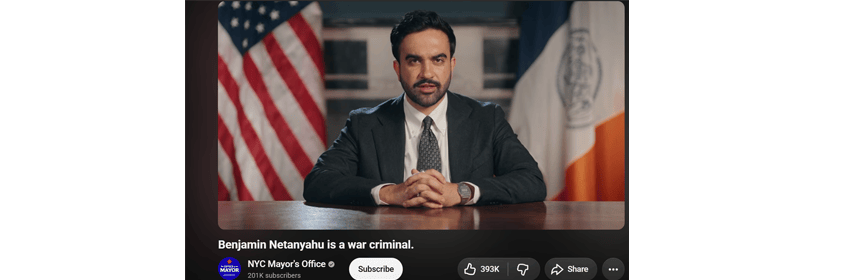
Pictured above is Jeanine Perro, the United States Attorney for the District of Columbia, one of the most important federal prosecutors in the Department of Justice. Perro auditioned for her post in the usual Trump way. It is true that Pirro was Westchester County’s first female judge and district attorney. But that was two decades ago. Her key qualification for a post in the Trump administration was her longtime service as a Fox Channel personality hosting Justice with Judge Jeanine and co-hosting The Five. Pirro is also a best-selling author. One of her titles, “Liars, Leakers, and Liberals: The Case Against the Trump Conspiracy,” surely caught Trump’s eye.

Since her appointment Pirro has consistently aligned her office with Trump’s aggressive law-and-order directives, specifically implementing the federal crime crackdown in D.C. Pirro publicly defended and credited Trump’s federal law enforcement enhancements for lowering crime statistics in the nation’s capital, stating that the administration brought much-needed safety after previous high homicide rates.

In this video from July 2, 2026, Perro is holding a news conference to announce the indictment of David Hearn, a Maryland resident, charging he vandalized the famous Lincoln Memorial Reflecting Pool, the object of a high-priority renovation directed by Trump himself. Pirro told reporters that Hearn was seen by National Park Service employees making a “forcefully and violently” effort to rip up the pool liner with his bare hands. When reporters pressed her for details and asked how she would prove the damage exceeded the $1,000 felony threshold, Pirro snapped at the press and repeatedly clashed with reporters questioning the validity of the case.

Pirro had presented her case to a D.C. grand jury and personally signed the indictment. The charge carries a sentence of up to 10 years in prison upon conviction. Hearn, 67, competed for the United States as a canoeist in 1992, 1996 and 2000 Summer Olympics.

In the month that followed Donald Trump and the Secretary of the Interior, Doug Burgum, who supervises the National Park Service and is responsible for the pool, insisted that the damage involved “multiple gashes” by vandals, first and foremost Hearn. Hearn insisted that all he did was pick up a piece of material floating in the water, which had peeled off from the bottom of the pool. Burgum said the pool suffered “multiple gashes” to the industrial liner that add up to 350 feet of damage. He said Interior Department employees had witnessed Hearn’s actions. In an interview on CNN’s “State of the Union,” Burgum said that the same contractor who installed the lining will repair it and that the peeling liner had nothing to do with faulty workmanship.

Fast forward to Friday, July 31. Jeanine Perro was nowhere to be seen late in the afternoon, when the United States Department of Justice dropped off a 20-page document at the D.C. Superior Court. No news conference, no press release. This is known as “taking out the garbage.” You dump into public view something you hope will draw little or no notice, figuring late on a Friday reporters and the general public will be focused on the upcoming weekend and not paying too much attention. “Government’s Motion to Dismiss the Indictment” is the title. One of Pirro’s assistants prepared the dismissal motion, although the motion was submitted on her behalf.

The motion says that after the indictment came down the Interior Department (DOI) provided additional documents to the U.S. attorney’s office “indicating that damage to the Lincoln Memorial Reflecting Pool in June 2026 was the result of flawed installation by the contractor, Atlantic Industrial Coatings.” The DOJ said it “first became aware of information showing that the damage was the result of a botched installation and not vandalism” after reviewing more documents. “Had DOI been forthcoming with the information clearly in its possession, the government would not have sought a grand jury indictment.

In other words, never mind.

The DOJ said when it presented the case to the grand jury, it was “not in possession of any information from DOI indicating that any damage to the Reflecting Pool was caused by anything other than the actions of the defendant and other vandals who damaged the pool’s lining.” The filing continues, “it is difficult to attribute the widespread damage to the Reflecting Pool to vandalism, let alone to establish that fact beyond a reasonable doubt.”

So why did Pirro pivot? Why not just continue the case and hope it will fade away in the year or two it would take to get before a jury? After all, that is what the boss in the Oval Office clearly wanted. I can only speculate that Pirro is thinking about her future.

Presenting a case to a grand jury built on incomplete or misleading information, without a proper investigation, could invite sanctions for filing a frivolous proceeding. Pirro may be planning on returning to her Fox platform at the end of the Trump administration. But even Fox might look askance at hiring a commentator who had been disciplined or even disbarred for unethical behavior.

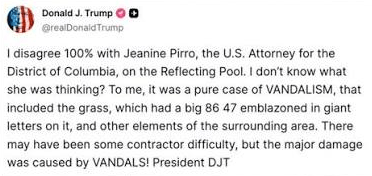
Pirro might be looking for a new job sooner than she planned. The boss is not happy. In a social media post, Trump writes, “I disagree 100% with Jeanine Pirro… it was a pure case of VANDALISM.”

One would think Hearn would have some recourse here for what was done to his reputation and for what his defense may have cost. Think again. Statute and case law make it virtually impossible to recover against government officials no matter how outrageous their actions. He might be able to make a claim to recover his legal fees. But that is still an uphill battle.

Maybe he should sell the film rights. Or write a book. Maybe Pirro can give him some advice along those lines.

####

The Supremes 2026

The Supreme Court wrapped up its 2025-2026 term with a flood of high-profile decisions announced on June 26, 29, and 30th. The usual end of the session reviews quickly flooded the media. Most watchers of the Supremes tried to frame the session as a win or loss for Donald Trump. Or at least a win or loss for the conservation majority which has dominated the Court in recent years.

I see the term as a continuation of the conservative drive to remake, or at least change the direction, of constitutional interpretation in the United States. It featured major rulings on birthright citizenship, tariffs, transgender school sports, independent agencies, and election rules, while also producing some surprising coalitions in the final week of the term. The great online court watching service, scotusblog, has the numbers.

The term was more polarized than the one before it. The share of decisions that were 6-3 rose from 15.2% last term to 28.8% this term and ideologically split 6-3 decisions rose from 9% to 22.7%. Liberal justices also dissented together more often than before. The Court still had a conservative center, with Chief Justice John Roberts, Justice Brett Kavanaugh, and Justice Amy Coney Barrett frequently in the majority. Yet some headline cases ended with the liberal justices in the majority. Although I would not make as much of that as some other commentators have done. I think their wishful thinking is not justified.

Major rulings

One of the term’s defining cases was the birthright-citizenship dispute, Trump v. Barbara. The outcome was expected, but the voting alignment was not. Roberts wrote the opinion, joined by Justices Sonia Sotomayor, Elena Kagan, Barrett, and Ketanji Brown Jackson, while Justices Clarence Thomas, Samuel Alito, and Neil Gorsuch dissented. That made it a major case in which the liberal justices were part of the prevailing coalition rather than the dissent.

The New York Times wrote the decision “capped a more than decade-long effort by Mr. Trump to use the issue as a political tool.” A relief, to be sure, but no cause for celebration. A plain reading of the 14th Amendment would bring anyone to the same decision. The court was split, however, with some justices unable to resist the temptation to dehumanize immigrants by calling them “foreign birth tourists.”

The outlier was conservative Justice Brett Kavanaugh, who concurred in the outcome but dissented as to the reason. The five justices in the majority cited the amendment. Justice Kavanaugh said current immigration law grants citizenship to anyone born on U.S. soil, implying that Trump can have his way if he can get Congress to change the law. As for Alito and Thomas, they dissented with their usual outrage at any decision which upholds the rights and dignity of groups that they see as fundamentally less deserving of rights and dignity than themselves.

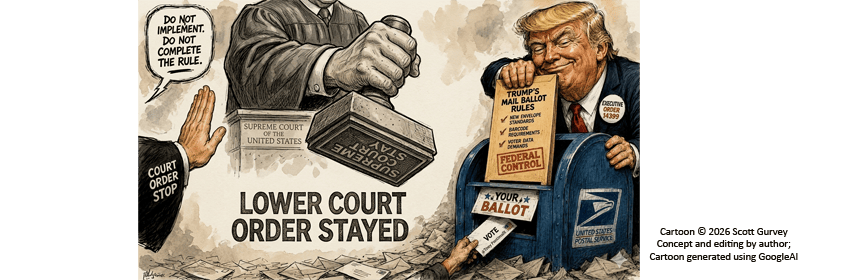
Another major case was Learning Resources v. Trump, the tariffs case. The Court rejected the administration’s tariff position, and the decision reflected the Court’s willingness to police the limits of presidential power where statutory authority is unclear.

Executive Power

The term also produced an important executive power ruling in Trump v. Slaughter, involving the president’s power to remove the head of the Federal Trade Commission. The Court overturned, in the majority’s words, whatever is left of Humphrey’s Executor, the 1935 precedent protecting some independent agencies from at-will presidential removal. SCOTUSblog described it as the term’s major overruling, because the Court made explicit a direction it had been moving toward in earlier removal-power cases.

While Slaughter seems to imply Congress cannot put any restraints on the president when it comes to firing officers of the executive branch, a majority did make an exception, for now, in the case of Federal Reserve Governor Lisa Cook. In Trump v. Cook, Trump had fired Cook, citing accusations regarding a home mortgage. The Court rejected that effort by a 5-4 vote, with Roberts joined by Sotomayor, Kagan, Kavanaugh, and Jackson.

The case was sent back to the district court, where Cook will be given an opportunity to contest the allegations. I see this as only a temporary victory, because the president can fire Cook again without cause, as he did in the case of Slaughter.

In Slaughter, Chief Justice Roberts ruled that because the FTC exercises executive power, its commissioners must be removable at will. The statute governing the FTC allowed removal only for “inefficiency, neglect of duty, or malfeasance”. The Federal Reserve Act (12 U.S.C. § 242) uses the exact same core standard, stating that governors may be removed “for cause by the President”. I don’t see how the Court can differentiate the two cases, should Cook come back before it.

Voting and social issues

In Louisiana v. Callais, Louisiana urged the Court to rethink Section 2 of the Voting Rights Act, and the case raised the possibility of further narrowing race-conscious redistricting rules. The Court continued its campaign to neuter the VRA, a lifelong goal of Chief Roberts, allowing Louisiana to redraw its Congressional districts to eliminate a Democratic seat, not caring that it also cut down minority representation from the state.

In Watson v. Republican National Committee, a 5-4 decision in which Barrett and Roberts joined the liberal wing, the Court rejected a position on late-arriving ballots that had been strongly supported by the Trump administration. The ruling allows Mississippi to continuing counting ballots which arrive by mail for five days after the date of an election, as long as the ballots are postmarked on or before election day.

The Court also dealt with transgender school sports litigation, including West Virginia v. B.P.J. and Little v. Hecox, decided together, the Court held that schools can separate women’s and men’s sports teams defined by biological sex. Those cases fit the Court’s broader recent pattern of closely watched disputes over gender identity, education, and equal-protection claims. Taken together with prior terms, they showed that the Court continues to use these cases to define the legal boundaries of state regulation in culture-war conflicts.

While progressives are beginning to believe there is a future down the road with a Democratic president arriving in two years, it will not be sufficient to change the direction of law in the nation. He, or she, will be up against a Supreme Court which continues to reenforce a conservative rule of law, empowering a president now with no promise it will continue to do so if a progressive occupies the Oval.

####

Poof! It’s Gone. Maybe.

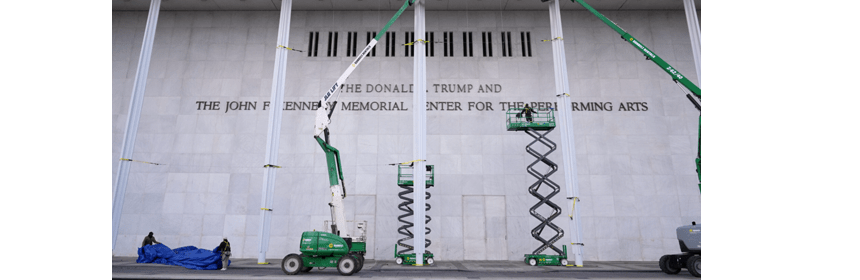
We think Donald Trump‘s name has been removed from the John F. Kennedy Center for the Performing Arts. At least, that what Trump’s handpicked board of directors told the District Court for the District of Columbia in a filing on Saturday. The removal had been ordered by the court two weeks earlier in a decision enforcing the Center’s original statutory name.

Trump’s name was added in December 2025 after he replaced the Kennedy Center’s leadership and the new board voted to rename the institution. The court found this action illegal, ruling that the board cannot unilaterally change the name of a national memorial.

In his 94-page decision, U.S. District Judge Christopher Cooper wrote, “The Kennedy Center’s organic statute makes crystal clear that the Center is to be named for President Kennedy, and it cannot bear any other formal name or public memorial based on the Board’s unilateral say-so. Congress gave the Kennedy Center its name, and only Congress can change it.”

The renaming triggered a large outcry and a boycott of the Center by patrons, performers, and donors. A crowd of several hundred people gathered on Saturday at the Center to witness the removal of Trump’s name from the exterior. Which brings us to my use of the word “maybe.”

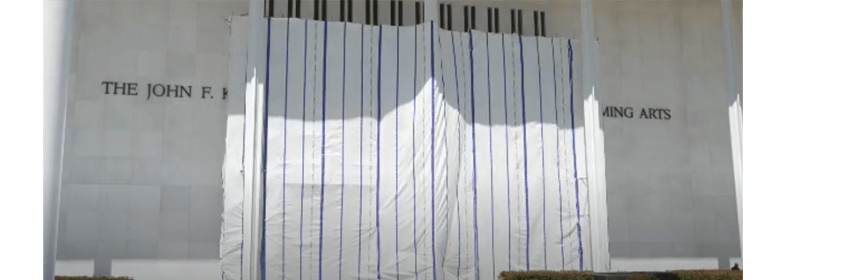
While the Trump lettering was put up by workers on simple lifts, workers Saturday first erected an expansive scaffold in front of the lettering. Then they draped a large curtain or tarp to prevent people from watching their work. Several web cams had been pointed on the sign, transmitting the image around the world. The curtain remains up on Sunday morning. We have only the sworn statement of Trump’s board of directors that the name has been removed.

Why is the curtain still up? Perhaps Trump just couldn’t stand to see the empty space his name once filled. And didn’t want to watch his name coming down.

This is not the end of the lawsuit, which had been brought by Rep. Joyce Beatty (D-Ohio), an ex officio trustee who sued her fellow trustees for adding Trump’s name to the title of the Kennedy Center. Hours before Friday’s deadline, two courts denied the Kennedy Center’s last-ditch attempt to delay the removal, even as crews erected scaffolding next to the building.

Judge Cooper ruled at 1 p.m. that the Kennedy Center’s lawyers failed to demonstrate they were likely to win their appeal or that the center would suffer “irreparable harm” if Trump’s name were removed. At 3:46 p.m., Justice Department lawyers representing the center appealed Cooper’s denial, filing an emergency motion for a stay with the Court of Appeals for the D.C. Circuit. Shortly after 7 p.m., the appeals court denied the second attempt. But the appeal will continue.

The addition of Trump’s name sparked immediate backlash from the arts community and members of the Kennedy family, who argued that the renaming desecrated a living memorial to the assassinated president. Congress established the center in 1964, two months after Kennedy’s death, designating it “the sole national monument to his memory within the city of Washington and its environs.”

Trump’s Department of Justice, paid for by taxpayers, represents him in these cases.

Last week the Center was also sued by the Washington National Opera. The WNO performed in the Center for fifty years but decamped when Trump took over. The opera claims the Center is refusing to return more than $17 million dollars of endowment contributions, gifts and donations which it managed on behalf of the WNO.

June 16 Update

Official word from The Kennedy Center is that the tarps will stay up for the “two-year renovation” and “replacement” of the marble facade slabs. Trumpian subtext, “OK, my name may be removed, but I’m not going to let you see it!!!! Na Na Na Na-Na.” And make no mistake about it, Trump is still the Chairman of The Kennedy Center, and his “Board” are 100% partisan sycophants.  The Kennedy Center is still in mortal danger.

####

It’s Still the Kennedy Center

A federal judge ruled today that Donald Trump’s name must be removed from the Kennedy Center. The decision says the Trump appointed Kennedy Center Board acted illegally when it voted to add Trump’s name to the Center. The court also ordered a halt to a plan to temporarily close the center for renovations.

U.S. District Judge Christopher Cooper sided with Rep. Joyce Beatty (D-OH), a member of the Kennedy Center’s Board of Trustees, who challenged both the name change and the proposed two-year closure. Her lawsuit, filed last December, argued that “[b]ecause Congress named the center by statute, changing the Kennedy Center’s name requires an act of Congress.”

Read more

John Roberts is …

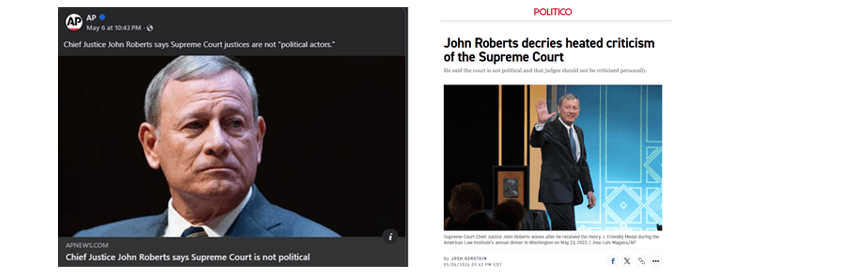
John Roberts is displeased. John Roberts is exasperated. John Roberts is frustrated. John Roberts is annoyed. John Roberts is irked. John Roberts is any other of the many synonyms my thesaurus suggested instead of the word I originally used, which it found to be “vulgar.”

What has the Chief Justice of the United States in high dudgeon (I thought of that one myself) is the reaction to the Court’s recent decision in Louisiana v. Callais, which drove a stake through the heart of the only section of the Voting Rights Act of 1965 the Court had not previously decimated. With the vote falling along party lines, many critics condemned the decision as racist and political.

Read more

Minneapolis, Minnesota

The reason investigations are conducted before making a judgment is because no one knows all the facts in the immediate aftermath of a tragedy.

That didn’t stop Department of Homeland Security Director Kirsti Noem from announcing within hours of the killing of a then unknown woman in Minneapolis that the woman was a domestic terrorist and that the agent of Immigration and Customs Enforcement had acted in self-defense after she ran him over with her car. The next day Vice President J.D. Vance displayed the fruits of his Yale law degree by proclaiming that the agent involved has “absolute immunity.” Vance also claimed, “She tried to stop him from doing his job. When he approached her car, she tried to hit him.”

Read more

Jack Smith Deposition

What were you doing in the evening of December 31, 2025? Were you sitting around waiting for major news to drop in Washington? I didn’t think so. I was noting the passing of 2025 and the arrival of 2026, as I suspect most of the people in the country were doing that New Year’s Eve. As least, that’s what Donald Trump and the Republicans were hoping.

That’s when the Republican-led House Judiciary Committee released former Special Counsel Jack Smith‘s deposition as part of their oversight investigation into the alleged “weaponization” of the Department of Justice. The committee, chaired by Rep. Jim Jordan (R-Ohio), was looking into the January 6 denier‘s belief federal law enforcement resources were misused for partisan purposes. Republicans claimed the investigations were politically motivated and intended to interfere with the 2024 election. 

Read more
« Older Entries