Evicting the Press
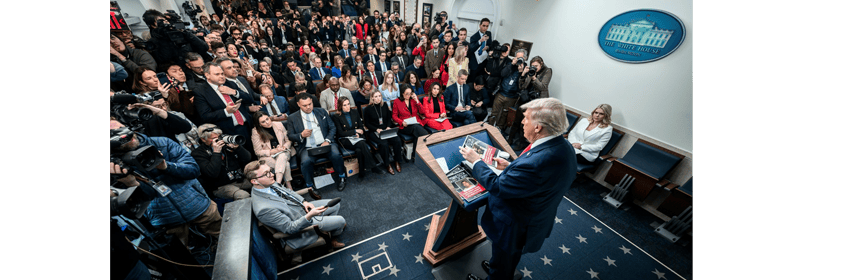
Donald Trump has talked about replacing the press briefing room with an indoor swimming pool. That scoop comes from Maggie Haberman and Jonathan Swan, White House reporters for The New York Times. These two have written a terrific and at the same time depressing book about the first year and a half of the second Trump administration, Regime Change, and they appear to have pretty good sources. At least, while Trump complains about their writing, he rarely says their information is wrong.
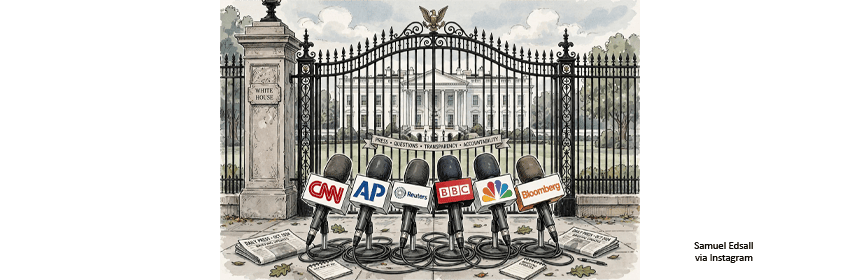
None of this is surprising. Trump’s hatred for members of the press who fail to toe the party line is well known. What you might find surprising is that I think this would be a great idea.
I have not been in that press room for many years. I visited several times when the relationship between press and president was one of respectful tolerance. Each party knew the other had a job to do, even if they didn’t like how it was being done.
While working for Chicago’s WBBM-TV I produced a profile of Illinois native James Brady. Brady was President Ronald Reagan’s Press Secretary. I got to follow him around the West Wing, record a photo event as Reagan opened his first cabinet meeting, and even got to meet and talk briefly with the president. I saw the cabinet room and the Oval Office.
A few weeks later I rushed from Chicago back to Washington. As I got on the airplane, I was pretty sure the President had been shot but was still alive but that Brady was dead, having been fatally hit in the attempt to assassinate Reagan. Brady did survive, although crippled by a shot to the head.
I mention all that to let you know what while I haven’t been there for many years, I know the space fairly well. The entire West Wing is small, the offices are small, and while some members of the press might gloat that working out of the White House press room has a particular cachet, the proximity to the Oval Office is really meaningless. The president’s press staff is on the other side of the door off the stage of the briefing room, now named for Brady. And yes, the Oval Office is only about 30 feet away. But there are plenty of guards between the press and that office. You don’t go through that door without an appointment and an escort.
The first reporters assigned to cover the president did so from outside the gates. President William McKinley allowed some work indoors at a designated table in a second-floor corridor, and presidential secretaries began regular routines of communicating with journalists. President Theodore Roosevelt moved executive offices out of the main residence into the newly erected Temporary Executive Offices. Those temporary spaces are now known as the West Wing. Removing the press would allow for expansion and modernization of the president’s offices.
The truth is you don’t get important information by sitting in the briefing room and being spoon fed by press secretaries. Many press groups have their own offices elsewhere in Washington. The National Press Club Building, just a short walk from the White House, houses several. The best journalists cover the president without hanging around the White House.
In 2006 the briefing room was shut down for a year for remodeling. The press worked out of the White House Conference Center. This is a secure government facility within the White House security parameter. There was some grumbling, but the press survived. A little remodeling, and the press and the communication’s staff will have a modern facility with more space.
There is also the possibility of moving the press into what is now called the Eisenhower Executive Office Building. That is where most of the president’s staff actually works. That building is just across a small, private street separating it from the West Wing entrance. It is also within the security zone.
I did a quick survey. Truthfully, I asked my AI to do it.
In the United Kingdom, the prime minister’s residence, 10 Downing Street, has no media office. Press briefings are held next door at the 9 Downing Street’s Press Briefing Room. In France, the president is in the Élysée Palace; No media office; press service manages access and briefings. In Russia, the Presidential Administration has no media office; press service manages access and briefings. Of course, in Russia the press prints what Putin wants it to print. Trump wishes he could do that too.
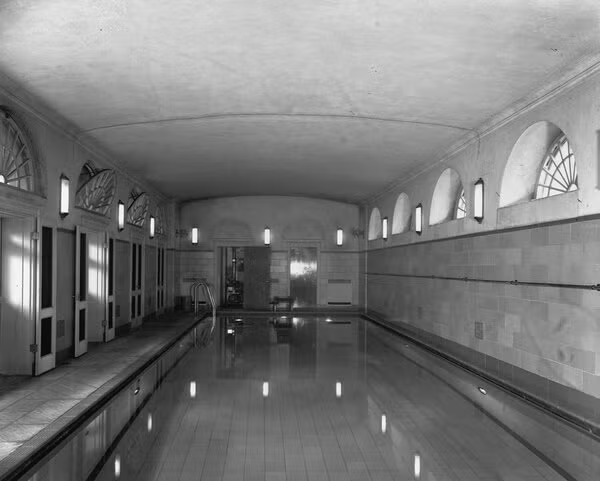
I actually think it is kind of cute that Trump wants to replace the press area with a swimming pool, because that’s exactly what it was. President Franklin Roosevelt added it in 1933 as therapy for his polio-afflicted legs. President Richard Nixon later covered it over to make room for the news media. The briefing room is next door to the small workspace.
As recently as last month, Trump shared a pair of images on Truth Social showing the briefing room as it is now, captioned “Fake News,” alongside another that shows the space reimagined as a gilded swimming pool, captioned “FDR Pool.” The Wall Street Journal reported last month that Trump had repeatedly discussed getting the press out of the White House.
Although I think it is a good idea for the press to move, I doubt Trump will go through with it. He relishes his little public battles with the press too much. He wants the press near for a quick gaggle when he is headed to his car or helicopter. Move them out, and he’ll lose his captive audience. I don’t think so.
#####
####