Category Archives: Supreme Court

The Trump Court’s Summer
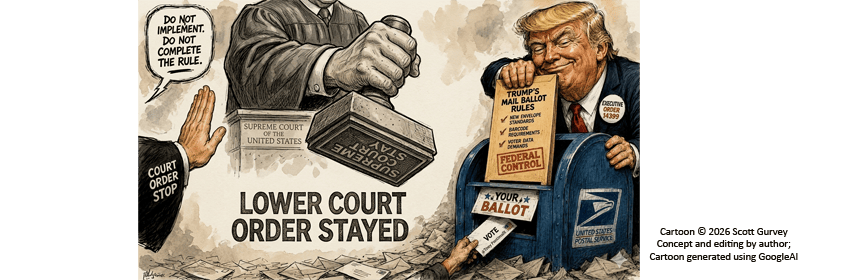
The Supreme Court is only two thirds of the way through its three-month summer vacation. But the conservative majority has kept busy facilitating Donald Trump‘s marauding destruction of the institutions of the government, both physical and abstract. In so doing they have supported his strategy to wreak havoc on the nation, sowing a path of destruction so quickly his opponents can’t mount a defense quickly enough to stop him from achieving his goals. Their embarrassingly rash decisions make a mockery of the judicial process and the rule of law.

Mail-In Ballots

Using the tool of the Executive Order Trump has directed the United States Postal Service to deliver mail-in ballots only to people on a federal list of voters. Never mind the fact that the Constitution assigns to the states control over the election process absent specific legislation passed by Congress. Never mind the fact that the law establishing the USPS charges it with delivering the mail and little more, making any attempt by that organization to restrict the mailing of ballots by the states and their return by the voters illegal. Never mind the fact that in spite of  Trump’s whining that mail-in ballots lead to election fraud not a single court has ever found such fraud affecting the outcome of an election. The Supreme Court members who Trump refers to as “my judges” interrupted their summer vacation to do his bidding.

The Executive Order has been challenged in multiple courts. Several issued injunctions, stopping the order from being implemented pending a full court review. This is known as preserving the status quo and with less than 60 days until the election, agrees with past challenges to election law and procedure.

Which sent Trump running, as he has done so many times before, to “his” judges. They found, on their emergency docket and without any formal brief or public arguments, that the status quo meant don’t interfere with Trump while the case is pending. This stands the entire concept on temporary injunctions on its ear. Trump v. California was decided on a strictly partisan vote, 6-3.

A whistleblower report to Congress from inside the USPS says the service is rushing out “untested” technology that could “derail” the upcoming election. State officials, in many cases about to send out their mail ballots, have no idea how they should respond to the order’s requirements. They only know they face criminal charges for failure to comply.

That is clearly what the conservative majority wants. They did caution that their order was preliminary and not a final decision on whether the administration’s order “will necessarily be lawful” once the plans are complete. “On that score, time will tell,” the majority said in the 10-page, unsigned order. But of course, the election will have come and gone and who knows how many voters will have been kept from casting their ballots by Trump’s action. Which is what he wants. The Court could have dealt with the substantive issues right then and there and eliminated the uncertainly. But that is not their plan.

Justice Ketanji Brown Jackson, with a separate 23-page dissent, considered the merits. “The President does not have any legal authority to require that elections be conducted in accordance with his preferences,” she says, “or to withhold delivery of mail-in ballots that are not formatted consistent with the President’s wishes.”

The Ballroom

And then comes the matter of the ballroom. Everyone who has ever rented a place to live knows full well the lease does not give you the right to damage the place, least you sacrifice your security deposit and be subject to a lawsuit for additional damages. So, what do you think “We the People,” landlords of The White House, should charge Donald Trump? He has trashed the joint from end to end.

The West Wing offices have been gilded to look like the French Palace of Versailles. The lawns and gardens have been paved over like a roadside motel. And the East Wing has been totally destroyed and rising in its place is some sort of monstrosity which will dwarf the historic residence the people loan every four years to their president.

The conservative majority which dominates the Court won’t stop it.

Again, a district court granted an injunction to stop the building pending a full hearing on the key question, “Can a president do what he wants with the White House?” Again, the conservatives on the Supreme Court stayed the injunction, finding that preserving the status quo meant letting Trump continue pending the court hearings. Trump has the workers on the job 20 hours day with the clear expectation that he will have his giant ballroom finished before the court issues a final ruling. That is characterized by another French term, a fait accompli.

In July 2025, the White House said the ballroom would be funded by private donations and cost about $200 million. Later, the cost was adjusted to $400 million. Now, the price tag is closer to $600 million, according to contractor invoices, and about half will be paid by taxpayers. No surprise. The ballroom will be built with missile-resistant columns and a drone-proof roof. What will it cost if the next president decides to pull it down?

The Supreme Court’s shadow docket ruling, National Park Service v National Trust for Historic Preservation, didn’t address the legality of the project. Lower courts said the construction required congressional approval. The decision focused on whether the plaintiff, the National Trust for Historic Preservation, had the standing to bring a lawsuit. The trust had to show that the ballroom’s planned construction would, among other things, cause board member Alison Hoagland “harm.” How can a building inflict pain, and how could such suffering be quantified?

In a declaration, Hoagland wrote: “I would suffer both professional and personal injuries, including to my aesthetic, cultural, and historical interests.” Hoagland, a historian, said she enjoyed walking past the White House and feared that Trump’s addition would distort the building’s character.

This shadow docket ruling was so disgusting even Chief Justice John Roberts couldn’t stomach it, breaking with his five conservative collogues to join the liberals 5-4 and writing the dissent.

Wrote Roberts, “The White House is not just any building, and — when it comes to historic preservation — Hoagland is not just any person. In failing to appreciate as much, the Court misconceives the plaintiff’s injury, allowing the Executive’s likely infringement of the Legislature’s power of the purse and authority to regulate federal property in the District of Columbia to continue.”

The Trump administration didn’t go through the usual review process. But the Republican-controlled Congress, as usual, is not willing to do anything about it. Trump’s desire seems to be to remake Washington in his image. And to leave his name and likeness on as many parts of the government as possible.

An overhaul of the East Potomac Golf Links is about to begin. Trees are already facing the axe. A 250-foot triumphal arch will, according to the White House, start construction within weeks. Trump threatens to tear down the Kennedy Center unless he can put his name back up under the name of the fallen president.

Designed by Trump. Approved by nobody.

#####

The Supremes 2026

The Supreme Court wrapped up its 2025-2026 term with a flood of high-profile decisions announced on June 26, 29, and 30th. The usual end of the session reviews quickly flooded the media. Most watchers of the Supremes tried to frame the session as a win or loss for Donald Trump. Or at least a win or loss for the conservation majority which has dominated the Court in recent years.

I see the term as a continuation of the conservative drive to remake, or at least change the direction, of constitutional interpretation in the United States. It featured major rulings on birthright citizenship, tariffs, transgender school sports, independent agencies, and election rules, while also producing some surprising coalitions in the final week of the term. The great online court watching service, scotusblog, has the numbers.

The term was more polarized than the one before it. The share of decisions that were 6-3 rose from 15.2% last term to 28.8% this term and ideologically split 6-3 decisions rose from 9% to 22.7%. Liberal justices also dissented together more often than before. The Court still had a conservative center, with Chief Justice John Roberts, Justice Brett Kavanaugh, and Justice Amy Coney Barrett frequently in the majority. Yet some headline cases ended with the liberal justices in the majority. Although I would not make as much of that as some other commentators have done. I think their wishful thinking is not justified.

Major rulings

One of the term’s defining cases was the birthright-citizenship dispute, Trump v. Barbara. The outcome was expected, but the voting alignment was not. Roberts wrote the opinion, joined by Justices Sonia Sotomayor, Elena Kagan, Barrett, and Ketanji Brown Jackson, while Justices Clarence Thomas, Samuel Alito, and Neil Gorsuch dissented. That made it a major case in which the liberal justices were part of the prevailing coalition rather than the dissent.

The New York Times wrote the decision “capped a more than decade-long effort by Mr. Trump to use the issue as a political tool.” A relief, to be sure, but no cause for celebration. A plain reading of the 14th Amendment would bring anyone to the same decision. The court was split, however, with some justices unable to resist the temptation to dehumanize immigrants by calling them “foreign birth tourists.”

The outlier was conservative Justice Brett Kavanaugh, who concurred in the outcome but dissented as to the reason. The five justices in the majority cited the amendment. Justice Kavanaugh said current immigration law grants citizenship to anyone born on U.S. soil, implying that Trump can have his way if he can get Congress to change the law. As for Alito and Thomas, they dissented with their usual outrage at any decision which upholds the rights and dignity of groups that they see as fundamentally less deserving of rights and dignity than themselves.

Another major case was Learning Resources v. Trump, the tariffs case. The Court rejected the administration’s tariff position, and the decision reflected the Court’s willingness to police the limits of presidential power where statutory authority is unclear.

Executive Power

The term also produced an important executive power ruling in Trump v. Slaughter, involving the president’s power to remove the head of the Federal Trade Commission. The Court overturned, in the majority’s words, whatever is left of Humphrey’s Executor, the 1935 precedent protecting some independent agencies from at-will presidential removal. SCOTUSblog described it as the term’s major overruling, because the Court made explicit a direction it had been moving toward in earlier removal-power cases.

While Slaughter seems to imply Congress cannot put any restraints on the president when it comes to firing officers of the executive branch, a majority did make an exception, for now, in the case of Federal Reserve Governor Lisa Cook. In Trump v. Cook, Trump had fired Cook, citing accusations regarding a home mortgage. The Court rejected that effort by a 5-4 vote, with Roberts joined by Sotomayor, Kagan, Kavanaugh, and Jackson.

The case was sent back to the district court, where Cook will be given an opportunity to contest the allegations. I see this as only a temporary victory, because the president can fire Cook again without cause, as he did in the case of Slaughter.

In Slaughter, Chief Justice Roberts ruled that because the FTC exercises executive power, its commissioners must be removable at will. The statute governing the FTC allowed removal only for “inefficiency, neglect of duty, or malfeasance”. The Federal Reserve Act (12 U.S.C. § 242) uses the exact same core standard, stating that governors may be removed “for cause by the President”. I don’t see how the Court can differentiate the two cases, should Cook come back before it.

Voting and social issues

In Louisiana v. Callais, Louisiana urged the Court to rethink Section 2 of the Voting Rights Act, and the case raised the possibility of further narrowing race-conscious redistricting rules. The Court continued its campaign to neuter the VRA, a lifelong goal of Chief Roberts, allowing Louisiana to redraw its Congressional districts to eliminate a Democratic seat, not caring that it also cut down minority representation from the state.

In Watson v. Republican National Committee, a 5-4 decision in which Barrett and Roberts joined the liberal wing, the Court rejected a position on late-arriving ballots that had been strongly supported by the Trump administration. The ruling allows Mississippi to continuing counting ballots which arrive by mail for five days after the date of an election, as long as the ballots are postmarked on or before election day.

The Court also dealt with transgender school sports litigation, including West Virginia v. B.P.J. and Little v. Hecox, decided together, the Court held that schools can separate women’s and men’s sports teams defined by biological sex. Those cases fit the Court’s broader recent pattern of closely watched disputes over gender identity, education, and equal-protection claims. Taken together with prior terms, they showed that the Court continues to use these cases to define the legal boundaries of state regulation in culture-war conflicts.

While progressives are beginning to believe there is a future down the road with a Democratic president arriving in two years, it will not be sufficient to change the direction of law in the nation. He, or she, will be up against a Supreme Court which continues to reenforce a conservative rule of law, empowering a president now with no promise it will continue to do so if a progressive occupies the Oval.

####

Yearning to Breathe Free

The poem on the pedestal of the Statue of Liberty in New York Harbor is a sonnet titled “The New Colossus,” written by American poet Emma Lazarus in 1883. Its famous lines, “Give me your tired, your poor, / Your huddled masses yearning to breathe free” transformed the statue from a monument of generic liberty into a worldwide symbol of immigration, refuge, and hope.

Lady Liberty was the first thing millions of immigrants saw as they arrived in the New World. “Her name,” the poem declares, is “Mother of Exiles. From her beacon-hand Glows world-wide welcome.”

Read more

John Roberts is …

John Roberts is displeased. John Roberts is exasperated. John Roberts is frustrated. John Roberts is annoyed. John Roberts is irked. John Roberts is any other of the many synonyms my thesaurus suggested instead of the word I originally used, which it found to be “vulgar.”

What has the Chief Justice of the United States in high dudgeon (I thought of that one myself) is the reaction to the Court’s recent decision in Louisiana v. Callais, which drove a stake through the heart of the only section of the Voting Rights Act of 1965 the Court had not previously decimated. With the vote falling along party lines, many critics condemned the decision as racist and political.

Read more

The Donnie-Mander

The Supreme Court, or rather the six Republican justices on the Supreme Court, have handed Donald Trump another victory. They issued a stay, blocking the order of a three-judge panel in Texas, which found the recent reapportionment of the state’s Congressional districts to be racially motivated and therefor illegal. The six, has been their pattern all year, issued their order in the dark of night on the “shadow” docket without an explanation or opinion. Greg Abbott, et al. v. League of United Latin American Citizens, et al.

The map the lower court panel blocked was seen as one of the most aggressive mid‑decade gerrymanders in recent history. The Supreme Court stay allows Texas to proceed with the new map, which analysts say could give Republicans five additional U.S. House seats in the 2026 midterms.

Gerrymandering 101

What, in a nutshell, is gerrymandering? The Encyclopedia Britannica has a wonderful explanation from which I have borrowed the graphic above. The American Constitution requires that every ten years we conduct a “census” to apportion representation in the House of Representatives. The Fourteenth Amendment, Section 2 begins, “Representatives shall be apportioned among the several States according to their respective numbers, counting the whole number of persons in each State, excluding Indians not taxed.”

Once the number of representatives is determined by the census, it is up to each state to draw the maps of legislative districts. Because the states have statewide elections for senators, governors, and to decide members of the Electoral College, there is data on how the state as a whole divides between the parties. Using the graphic above we find of a total population of fifty, thirty (60%) are orange voters while twenty (40%) are purple voters.

From that starting point, the state could draw “fair” maps which distributed the people in such a manner to generate three orange and two purple representatives, proportionate to the statewide electorate. But the state could also gerrymander, producing an outcome, using the example on the right above, of five orange and no purple representatives, or two orange and three purple representatives.

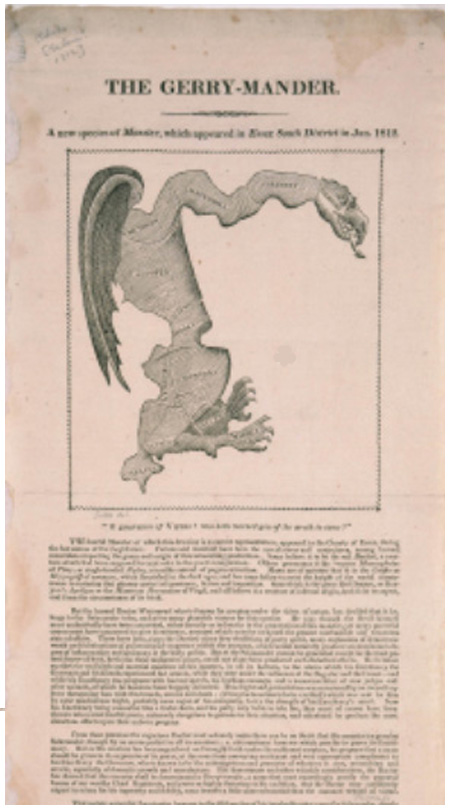
The term “gerrymander” was coined as a portmanteau of the name Elbridge Gerry and the word “salamander.” Gerry, who was the governor of Massachusetts, signed a redistricting law that redrew district lines in a way that favored his party. Critics said the new map created a weirdly shaped district which resembled a salamander. A satirical cartoon published in the Boston Gazette on March 26, 1812, popularized the word. The cartoon depicting the irregular shape helped turn a local political attack into a lasting political term.

The Donnie-Mander

The political parties have a long history of manipulating their maps to various degrees every ten years when the new census requires a reallocation of seats. But two things make this year’s manipulations unusual. First, this is a mid-census reapportionment. The last census was in 2020 with new maps taking effect in 2022 in most states. Second, this mid-census revision to the 2022 map came at the direct demand of Donald Trump. Texas’s Republican Governor Greg Abbott heeded Trump’s call and generated a new map that may add as many as five Republicans to the House in 2026. That is the map the Supreme Court now says can be put into place. With the Republican control in the House hanging on a tiny seven vote majority, Trump is clearly afraid the Democrats could gain control in the next election.

This Trump inspired Donnie-Mander, now sanctified by the Supreme Court, has set off an unprecedented arms race of mid-decade redistricting across the country. Missouri and North Carolina have passed their own Republican leaning maps. California voters approved a map designed to cancel out the Texas gains. Virginia and Maryland are working on new maps favoring Democrats. Illinois is considering one. Florida and Indiana are working on revisions on the Republican side.

National Public Radio has been keeping score on its web site. As of this writing they show a slight gain for Republicans on the basis of district voting patterns in next year’s election. Considering his atrocious polling numbers, Trump is going to need all the help he can get. The Center for Politics at the University of Virginia, one of my favorite pollsters, sees 2026 shaping up to be much too close to call.

Congress has over the years tried to set standards and take control of the redistricting process. It has never been able to pass a law to bring order out of the chaos.

The majority on the Supreme Court, by allowing these partisan mid-decade redistrictings, has created a free-for-all which is a lose-lose for the American people. But 2026 does promise to be a good show.

######

The Supremes 2025

The first Monday of October is upon us. This is the day the Supreme Court begins its new term. The justices have been on recess and away from the Capital since the end of June. But they have had a busy summer. We just don’t know much about what they were doing.

The Supreme Court is shrouded these days. Literally and figuratively.

Read more

R.I.P. – D.O.J.

A former Director of the Federal Bureau of Investigation has been indicted on the direct order of the President of the United States.

Let that sink in. I’m sure that this thing happens all the time in Russia. Or China. Or North Korea. Or Iran. But I can’t think of anything comparable ever happening in the United States of America.

Read more
« Older Entries