Tag Archives: economy

That Damn Debt

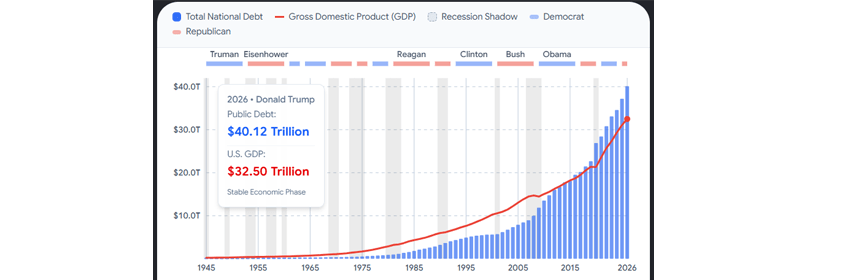
The official U.S. total public debt outstanding breached $40 trillion for the first time in history. It stands at $40,047,426,000,000 according to data released by the U.S. Department of the Treasury. It has increased by about three trillion dollars since January 20, 2025, when the current administration took office.

Considering how much he likes to brag about setting records you’d think Donnie Trump would be in front of the cameras proclaiming, “Biggest debt in history! No one has ever seen a debt as big as this. America is first! We’re winning.”

Instead, fearless leader is attending auto races and showing off his new helipad, $5 million dollars’ worth of big, ugly, granite adorned with his name and sitting on the White House lawn. Something else a future president will have to remove.

Trump left it to Treasury Secretary Scott Bessent to downplay the event, blame the record debt on Joe Biden, and insist the economy will “grow” out of it. The problem with that is obvious. The economy is growing at a rate of about 2%. The debt is growing at the rate of about 6%. As they say, the math ain’t mathin’.

To be fair, as the graph above makes clear, the debt has been growing steadily for decades under both Republican and Democratic administrations. Some of that is growth. Some of that is inflation. The key to watch is not the total debt amount but the ratio of debt to the nation’s total economic output, the GDP. The debt-to-GDP ratio compares a country’s total government debt to its gross domestic product (GDP). It shows a country’s ability to pay back its debts. The U.S. debt-to-GDP ratio is now roughly 124% to 125%.

Trump has stated dozens of times across his campaigns and presidencies that he would control, reduce, or completely eliminate the national debt and federal deficit, famously vowing during his 2016 campaign to wipe out the entire national debt within eight years. Despite these promises, Trump legislative actions, such as the 2017 and 2025 tax cuts, caused substantial increases in annual budget deficits and the overall national debt.

As this graph shows, there is a pattern which began in the Reagan years. The Republicans cut taxes without cutting spending. That increases the annual budget deficit and accelerates increases in the debt. Democrats take control and reduce the deficit, only to have the Republicans repeat the trend the next time they get in control. While Republicans like to blame Democrats for the debt, the facts don’t bear that out. (By the way, I had AI assistance in doing the actual drawing, but I am responsible for finding the numbers and designing both graphs. The numbers come from the Federal Reserve and the Department of Commerce.).

To finance the debt the government borrows money., It does that by issuing securities, Treasury Notes and Bonds. The interest rate it pays is the “cost” of borrowing. More borrowing, more securities. To convince investors to keep buying trillions of dollars in new debt, the U.S. government must offer competitive interest rates. The 10-year treasury yield is currently about 4.7%. The bond market is struggling to meet the demand.

Bessent is doubling long-term government bond buybacks to curb rising rates and inject liquidity into the debt market. On August 19, 2026, the Treasury Department shocked Wall Street by announcing it will increase its buyback operations for 10-year to 30-year bonds to at least $4 billion per operation, up from the previous $2 billion cap. Bessent is executing a strategy he calls a “Treasury Twist“. By purchasing less-liquid, older (“off-the-run”) long-term bonds, the Treasury removes overall duration from the market. To fund these purchases, the Treasury issues short-term bills. This shifts supply to parts of the yield curve better equipped to absorb it. Critics argue that the sudden, unscheduled policy shift disrupts the Treasury’s traditional framework of being regular and predictable, causing further investor anxiety.

Bessent’s action is like putting a Band-Aid on a wound that needs a torniquet. He has joined Trump in an alternate reality. The market isn’t buying it.

When the government borrows hundreds of billions each month, it competes directly with private borrowers for capital. The massive government demand can push up overall interest rates across the entire economy. This means Americans end up paying significantly more for mortgages, auto loans, credit cards, and business loans.

And just like a household credit card, a larger balance means a larger monthly minimum payment. Net interest payments are quickly becoming one of the largest single components of the federal budget. Every dollar spent on interest is a dollar that cannot be spent on infrastructure, national defense, scientific research, tax cuts, or programs like Social Security and Medicare.

If investors eventually begin to worry that the U.S. will never be able to pay back its debt through normal revenues (taxes), they may fear that the government will simply print more money to cover the gap. Flooding the global economy with dollars to inflate away the debt devalues the currency. For us everyday Americans, this manifests as persistent, long-term inflation, reducing the purchasing power of our hard-earned savings and wages.

Time for Donnie and Bessent to play another round of golf.

#####

Economic Conundrum

The May Employment Situation Report released by the Bureau of Labor Statistics (BLS) handily beat expectations, with the U.S. economy adding 172,000 nonfarm payroll jobs. Economists had forecasted a much more modest gain of roughly 80,000 to 85,000 jobs, making this a significant upside surprise.

Read more

Trump’s Economy

The charts above are certainly things Donald Trump did not want to see. Unemployment rate up. Total employment down. They come from the Bureau of Labor Statisticsreport on employment in the United States for August. Just last month the July report, showing a slowing economy, led Trump to fire BLS Commissioner Erika McEntarfer. I wrote a few weeks ago that it was a case of shooting the messenger. Trump falsely claimed downward revisions in the August report were “rigged” to make Republicans look bad. BLS revisions are routine and based on updated employer data. It would be nearly impossible to “rig.”

Just 22,000 nonfarm payroll jobs were added in August. That was below expectations and continued the summer slowdown. The Unemployment Rate rose slightly to 4.3%, up from 4.2% in July. Long-Term Unemployment held steady at 1.93 million, now representing over 25% of all unemployed individuals.

Read more

Kill the Messenger

Every damn day. That’s what it seems like. Every damn day the man seventy-seven million Americans voted back into office does something more outrageous than the day before. It is exhausting.

Trump eviscerates environmental protections. He accuses former President Barack Obama of treason. He rips up labor agreements. He plans to privatize Social Security. He forces the Smithsonian to take down an exhibit that includes his two impeachments. The European Union, Japan, Columbia University, and CBS are all surrendering to him.

And now he fires the head of the Bureau of Labor Statistics because he doesn’t like the jobs numbers.

Read more

The Trump Recession

The Trump Recession is upon us. Not officially, that could take months. But the handwriting is on the wall. Just as clear as it was one year ago when every creditable economist warned Donald Trump’s plans for trade tariffs and government layoffs would knock the Goldilocks economy of Joe Biden off its feet. Seventy-seven million voters didn’t believe it. Or didn’t care. Now they can care. Or not. It’s hard to tell.

The latest GDP report shows that the U.S. economy contracted by 0.3% in the first quarter of 2025, marking a sharp downturn from the 2.4% growth in the final quarter of 2024. This decline was largely driven by a surge in imports ahead of Trump’s newly announced tariffs, which widened the trade deficit and negatively impacted GDP calculations.

Read more

It’s Still the Economy, Stupid

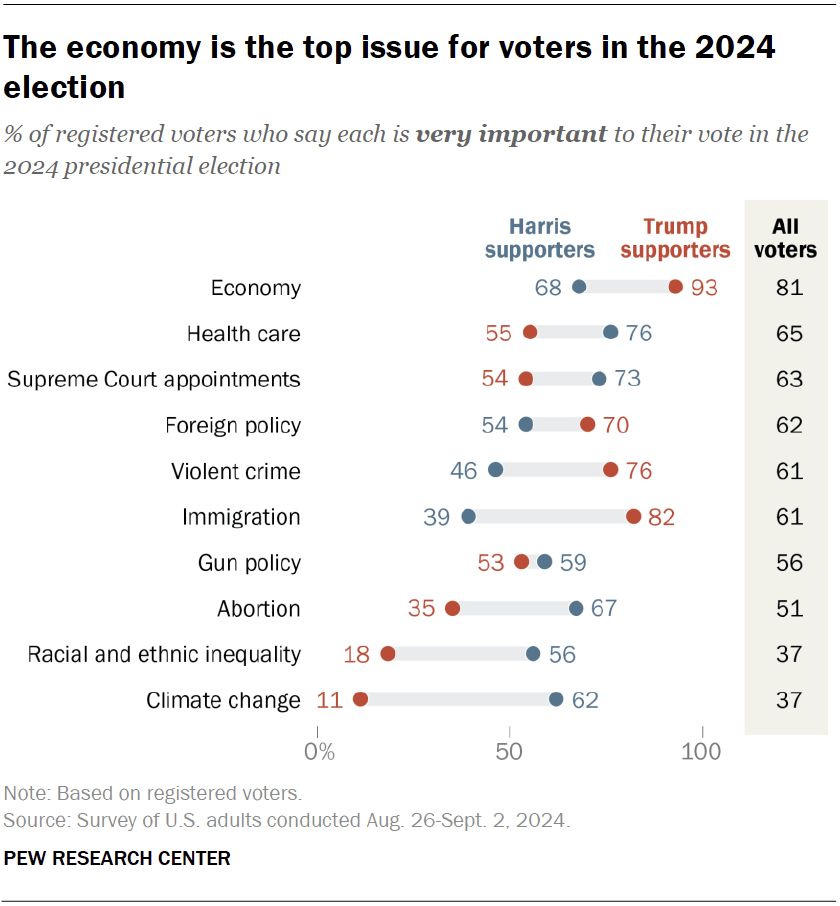
One thing the political polls agree on is the number one concern on the minds of voters. It’s the economy. It is ALWAYS the economy.

The problem, at least for Vice President Harris, is that what voters call the economy is not what economists call the economy. What voters mean when they say economy is prices as in, the price of a gallon of gasoline, the price of a bottle of milk, the price of a dozen eggs. Those prices are up. And as is usual, the incumbent gets the blame.

Read more

A Breath of Fresh Air

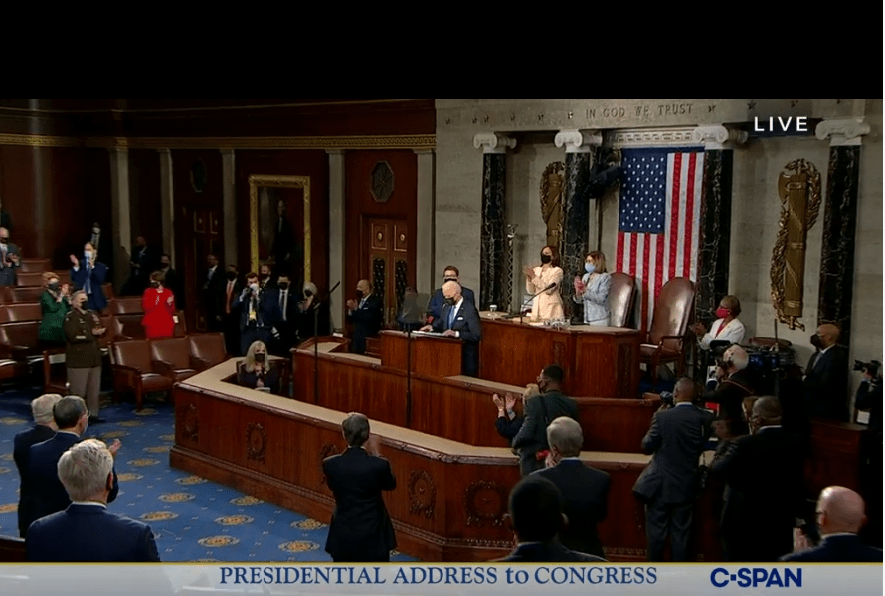
It some ways it was certainly unusual. But mostly its normalcy made it a breath of fresh air. For more than an hour President Joe Biden delivered a report to Congress, the nation, and the world on the state of the state one hundred days into his administration. He laid out the achievements already accomplished, the programs now under way, and the proposals he is sending to Congress for enactment into law.

One way the speech was unusual was that there were two women behind the president. Presiding over the joint session of Congress were Vice-President Kamala Harris, who is President of the Senate, and Nancy Pelosi, the Speaker of the House of Representatives. That was a historic first. Another way was that the chamber, which normally holds 1,600 people for these events, was limited to 200 by pandemic protocols. The audience members were socially distanced and most were masked.

Read more
« Older Entries