Category Archives: Comedy

Funerals at CBS

There are two funerals on tap this week at CBS, Inc., the company where I spent the first decade of my professional career. When I joined it in 1974, it had recently changed its name from the Columbia Broadcasting System to better reflect its position as a major media company, not just a broadcaster. Its four core lines of business were Broadcasting (TV and radio), Records (music), Publishing (books and magazines), and Musical Instruments/Toys.

One thing it did not change was its leadership. William S. Paley was the legendary media tycoon who built CBS from a small, struggling 16-station radio network into a multi-billion-dollar global broadcasting and entertainment empire. He is widely regarded as one of the founding fathers of modern American broadcasting. Paley entered the picture in September 1928, when his wealthy family bought a majority stake a struggling radio company. He was subsequently named president at just 26 years old, going on to transform the then tiny network into a media empire. In 1974, he was firmly in control.

I can’t imagine what he would think of today’s CBS. Faced with a business climate which seems to value size over all else, CBS has gone from owner to owner in the post Paley years. Today it is owned by Paramount Skydance (formally known as Paramount, a Skydance Corporation). The network’s ownership structure underwent a massive shift when Skydance Media, led by tech heir and filmmaker David Ellison, officially completed an $8 billion merger with CBS’s previous parent company, Paramount Global, on August 7, 2025. Ellison’s takeover of the storied broadcasting was aided by a cash guarantee from his father Larry. Larry Ellison, the billionaire co-founder of Oracle, played the critical role of primary financial bankroller and majority equity owner in the Skydance acquisition of Paramount Global (and by extension, CBS).

Which brings us to this week’s funerals. Not unplanned deaths. These are self-inflicted executions.

The Late Show with Stephen Colbert

First to die will be The Late Show with Stephen Colbert. It will air its final episode on May 21. The Late Show franchise originally began on August 30, 1993, when David Letterman launched the inaugural Late Show with David Letterman. It was a bold attempt for CBS to compete in the late-night hours, where NBC’s Tonight Show had reigned supreme seemingly since the beginning of time. I remember gathering with my dormmates around the communal television after a long day of classes and studying to relax with Johnny Carson. When Carson retired, Letterman, who had a program which followed Carson, seemed the heir apparent. NBC instead chose comedian Jay Leno, leaving Letterman free. CBS swooped in.

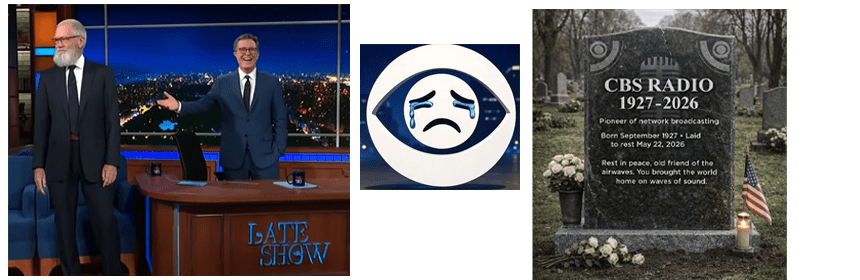
When Letterman retired in 2015, after hosting for 22 years, CBS selected Stephen Colbert, host of his own show on the Comedy Central channel, to succeed him. In the picture above you can see Letterman and Colbert, together last week to throw their own wake. What better way than by gleefully tossing CBS office furniture, including a desk chair and sofas, plus watermelons — a signature Letterman gag — off the side of the building, aimed at the target below: a giant CBS logo.

The official reason provided by CBS for canceling The Late Show is financial, though the decision is heavily shadowed by a massive corporate and political timing controversy. CBS did not reveal detailed financial information. For many the show’s cancellation carries the stench of suspected political interference. Publicly, media critics, industry insiders, and even former host Letterman have vehemently rejected the financial excuse, calling CBS executives “lying weasels” and accusing them of political cowardice.

In July 2025, Paramount paid a $16 million legal settlement to Donald Trump after he sued over how 60 Minutes edited an interview with Kamala Harris. Days later, Colbert ruthlessly mocked his own parent company on air, calling the payout a “big fat bribe”. At the exact moment Colbert made these comments, Paramount was desperately seeking crucial regulatory approval from the Trump administration’s FCC for its $8 billion merger with Skydance Media. Just days after Colbert’s monologue, CBS stunned the industry by canceling the show. Weeks later, the FCC approved the multibillion-dollar Skydance merger. Trump later gloated publicly on social media, bragging that Colbert had been “fired.”

CBS Radio News

The second funeral will be held at the end of the Friday. On that day CBS permanently shuts down CBS News Radio, brining a historic 99-year era of American broadcasting to a sudden end.

Sometime when I was in grade school, I set my clock radio to wake me up at 7AM Chicago time. The radio was tuned to WBBM, the CBS owned station. At that time, I heard The CBS World News Roundup. I have started my day with that broadcast most days since. That is something in the neighborhood of 65 years. But the CBS News Roundup, and the CBS News Hourly reports at the top of every hour of every day, can trace their history back to 1928. This shutdown, ordered by Larry Ellison’s pick as Editor-in-Chief of CBS News, Bari Weiss, completely dismantles the original foundation of William Paley’s media empire and eliminates all remaining jobs within the radio news division.

Finances again are blamed. Legacy media has been heavily battered by years of declining advertising revenue and shifting listener habits as audiences steadily migrated toward podcasts, social media, and digital streaming platforms. But creative leadership could have explored options. The audio medium of radio is perfect for podcasts and streaming. The new bosses at CBS clearly had their eye only on the issue of paying down the Ellison’s debt. The shutdown functions as part of a larger 6% staff reduction across the entire CBS News workforce under the network’s new Paramount Skydance corporate ownership.

There was a time when the government insisted broadcasters devote time to news and public affairs. And they insisted content be fair and balanced and provide opportunities for differing viewpoints to be heard. This was the price one paid for the privilege of controlling one of the limited number of broadcast channels available, as the words of the Communications Act read, “In the public interest, convenience, and necessity.” There were also station owners who took that requirement to heart, desiring to serve their communities and their nation. Those visionaries are long gone.

The CBS Radio Network’s sudden exit leaves roughly 700 local affiliate stations nationwide without their primary hourly national news feeds. Major local all-news stations, like KNX in Los Angeles, WBBM in Chicago, and WWJ in Detroit, had to immediately assure listeners that local reporting would continue while they frantically negotiated new contracts with national syndication competitors like ABC News, Fox News, or NBC News.

Media historians and former network legends have reacted with grief, with former CBS Evening News anchor Dan Rather lamenting, “It’s another piece of America that is gone”. Until this final week, CBS News Radio was the absolute last of the three original national U.S. radio networks (alongside NBC and the Mutual Broadcasting System) still operating under its original parent brand.

The World News Roundup was the longest-running continuous program in broadcast history. And the network famously invented modern wartime reporting with Edward R. Murrow’s London Blitz broadcasts.

I will have to find another way to start my day.

#####

“La-di-da, la-di-da, la-la.”

I fell for Diane Keaton the minute I heard her speak that line in Annie Hall. She won the Oscar for Best Actress for her performance as the title character in Woody Allen‘s 1977 classic. Keaton’s wardrobe, her own creation, started a whole new trend of women utilizing men’s clothing that made a mark on fashion and popular culture that survives today.

The film won the Academy Award for Best Picture. Allen won for Best Director and shared with Marshall Brickman the award for Best Original Screenplay.

Read more

It is a Nice Idea

Free speech is a pain in the rear. Always has been. Always will be.

It is a nice idea. If you have freedom of speech, you have the right to say whatever is on your mind without fear of repercussions. But there is a rub. It also means the guy standing next to you has freedom of speech. That means he can say whatever is on his mind, even if you find it to be abhorrent, disgusting, threatening and maybe even dangerous.

The men who designed our government met in secret and wrote a historic document detailing the structure of the national state and enumerating the powers and responsibilities of its parts. When the document was made public, the people were not pleased. They demanded a guarantee of their rights be written into the document.

Read more

Two Megalomaniacs Walk into a Bar……

The bromance that brought Donald Trump and Elon Musk together seemed like an unlikely combination from the start. The real estate mogul turned politician, and the technology entrepreneur turned richest man on the planet both tended to absorb all the oxygen in any room they inhabited. It was hard to envision that both could occupy the same space at the same time for long.

Still, the speed and violence of the inevitable explosion of the relationship was breathtaking. In the space of a single day, the man who wreaked havoc on the federal government, and the man who encouraged him and gave him the authority to act in violation of law and Constitution were calling each other names on their respective social media sites and threatening retribution.

Read more

Bob Newhart

Embed from Getty Images

I was in grade school on the south side of Chicago when I began listening to the radio. It was AM in those days, and the format was Top Forty. There were two big stations in Chicago, WLS and WCFL. Since they both played the same music, they differentiated themselves by the personalities of their disc jockeys. One did a lot of comedic bits and spotlighted local comedians. And one of those was Bob Newhart.

Read more

Charles Osgood

I heard him long before I met him. I remember sitting in the cafeteria CBS had set up in the basement of New York’s Madison Square Garden to feed the hundreds of staff members it had brought to the 1976 Democratic National Convention. Believe it or not, in those days the political conventions meant something and, in part because of legal requirements, they were extensively covered by broadcasters.

Just two years out of journalism school, I had been sent by my employer, WBBM-TV, the CBS owned station in my hometown Chicago, to manage our coverage. Along with me was a terrific video crew and a wonderful reporter who needed no supervision and little assistance, and an anchorman who definitely needed both. Those are stories for another day. Today, I just want to talk about the voice.

Read more

Peter Schickele

I still remember the first time I heard the music of P.D.Q. Bach. On the program at New York’s Town Hall were the Echo Sonata for Two Unfriendly Groups of Instruments and the Schleptet in E♭ major. I was immediately hooked.

Each piece was introduced by Professor Peter Schickele of the Music Pathology Department, University of Southern North Dakota at Hoople. Schickele claimed to have discovered the work of P.D.Q, who he described as the 21st and least of the children of the great baroque composer Johann Sebastian Bach. Here is where things get a little dicey. J.S. Bach was certainly prolific. But he stopped at 20 children. And while there is a Hoople in North Dakota, there is no university there. I should have noted that the program listed P.D.Q.’s dates as “(1807–1742)?

Read more