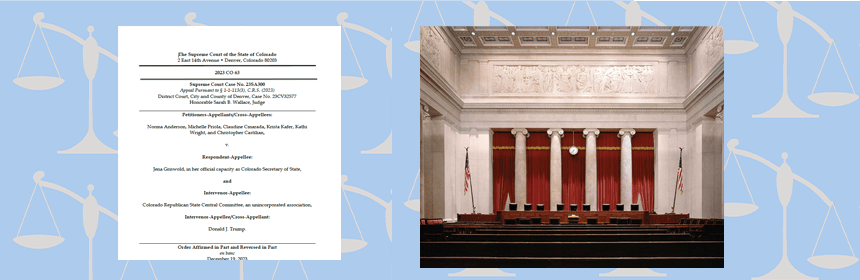
There are reasons why journalists usually write analysis and commentary only after a breaking event has settled. Today Maine’s Secretary of State, Shenna Bellows, disqualified former President Donald Trump from appearing on the state’s 2024 Republican primary ballot. Her decision was based on the 14th Amendment of the US Constitution, which prohibits anyone who has “engaged in insurrection or rebellion” against the United States from holding office.
(L-R) Dr. Claudine Gay, President of Harvard University, Liz Magill, President of University of Pennsylvania, Dr. Pamela Nadell, Professor of History and Jewish Studies at American University, and Dr. Sally Kornbluth, President of Massachusetts Institute of Technology, testify before the House Education and Workforce Committee at the Rayburn House Office Building on December 05, 2023, in Washington, DC. The Committee held a hearing to investigate antisemitism on college campuses.
Let me give you a piece of advice. If someone asks you if calling for the genocide of the Jewish people violates the standards of your organization, the answer is “Yes!” Do not equivocate. Do not hesitate. Do not turn to your lawyer and ask for a legal brief balancing the right of free expression against the fighting words involved in a call for the violent elimination of a race of people. Just say, “Yes!”
For two weeks I have wanted nothing more than to look to the sky and scream like a banshee. Even though I long ago concluded I would never get an answer.
For two weeks I have sat down to write. And been unable to start. I am supposed to write. That is what I do. I am supposed to explain, to educate, to stimulate thought and debate. But nothing came. It has been as if the Hamas terrorist attack on Israel placed my brain into suspension and froze my fingers.
How do you explain the inexplicable? What lesson can be learned from a demonstration of cruelty so overwhelming that it leaves one shell shocked both literally and figuratively? Except that human history includes so many examples of this kind of barbarism that I must wonder why we should be allowed to continue to defile the planet by our very existence.
Dianne Feinstein, senior Senator from California, passed away over the weekend at the age of ninety. The last year was not easy for Senator Feinstein. Frail and ailing, she spent several months at her home in San Francisco. When she finally returned to the Senate, she was wheelchair bound and appeared at time to be unsure of her surroundings. It was not a fitting end and many, including me, wondered if the rules of Congress are such that they force infirm representatives to remain on the job after they were no longer able to do the job.
It was my last year of grade school, and I faced all the usual crises. My family was about to move about five miles closer to the center of the city because my parents wanted me to attend a different high school than the one serving our current neighborhood. I was about to lose most of my grade school friends because only two others were switching to the same high school. And for some reason the girls, who I had recently become interested in, were not so much interested in our current hero, The Man from U.N.C.L.E., Napoleon Solo, played by Robert Vaughn. They had eyes only for the blood sidekick Illya Kuryakin, played by David McCallum.
McCallum died yesterday in New York City at the age of ninety.
Right on the money. Just as planned, NASA’s OSIRIS-REx satellite dropped its sample capsule on the Utah desert where it was quickly recovered. It should contain a sample taken from the asteroid Bennu.
The NASA recovery teamtook the sample container from the OSIRIS-REx satellite to a temporary clean room on the Department of Defense’s Utah Test and Training Range.
The clean room was set up specifically for this purpose and was ready to receive the capsule. The sample container was secured and the area around it was deemed safe before the recovery process began. The team placed the 100-pound capsule into a metal cradle and wrapped it in multiple sheets of Teflon and then a tarp. The capsule was then wrapped in a harness and secured to one end of a 100-foot cable hanging from a helicopter. The helicopter transported the capsule to the temporary clean room on base.
In the clean room, the capsule will be disassembled and packaged in parts for transport to NASA’s Johnson Space Center in Houston, its permanent home. Scientists will analyze the rocks and soil from the sample for the next two years at a dedicated clean room inside Johnson Space Center. The sample will also be divided up and sent to laboratories around the globe, including OSIRIS-REx mission partners at the Canadian Space Agency and Japanese Aerospace Exploration Agency.
On Sunday September 24, 2023, just before noon eastern time, a sample capsule containing about one pound of the asteroid Bennu should arrive in Utah. Go ahead. Back up. Read it again. Amidst all the angst of our everyday lives, which is the usual subject of this column, we have a wonder like that to contemplate.
The capsule will have come from the OSIRIS-REx spacecraft. OSIRIS-REx was launched on September 8, 2016, flew past Earth on September 22, 2017, and rendezvoused with Bennu on December 3, 2018. It spent the next two years analyzing the surface to find a suitable site for landing.
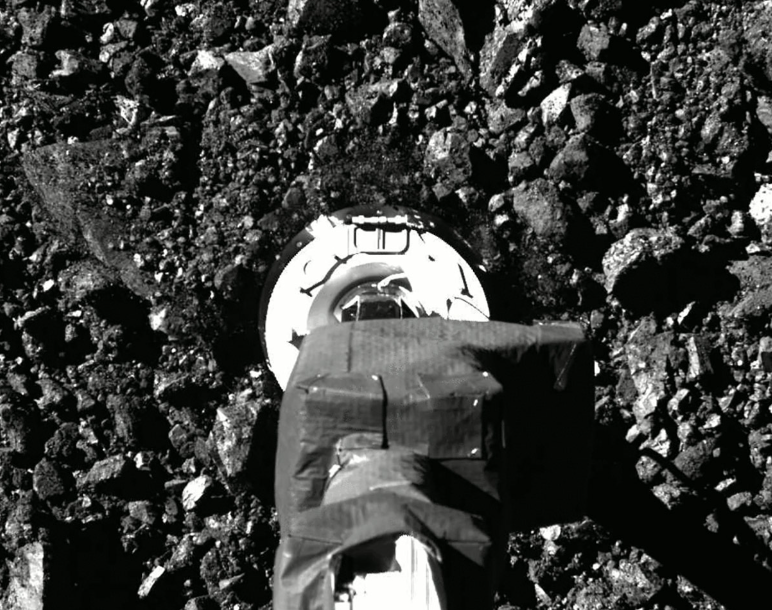
On October 20, 2020, OSIRIS-REx touched down on Bennu and successfully collected a sample. Though some of the sample escaped when the flap that should have closed the sampler head was jammed open by larger rocks, NASA is confident that they were able to retain between 400 g and over 1 kg of sample material, more than the 60 g (2.1 oz) minimum for success.
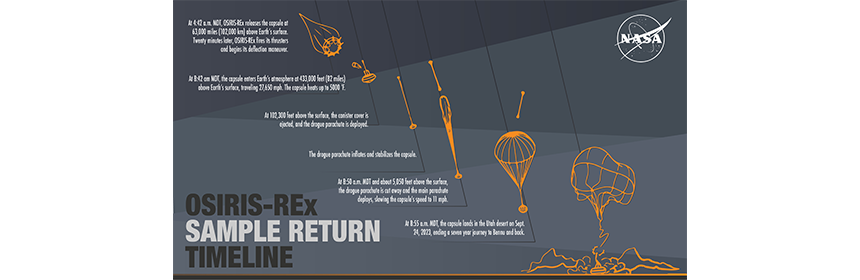
The sample capsule will be released when the spacecraft reaches an altitude of 63,000 miles above the Earth’s surface. The capsule will then be sent spinning towards the atmosphere below and will pierce Earth’s atmosphere at 10:42 a.m. EDT, coming to rest near a military base in the Utah desert. A recovery team will board four helicopters and head out into the desert to retrieve the capsule as quickly as possible to avoid contaminating the sample with Earth’s environment. Once located and packaged for travel, the capsule will be flown via helicopter to a temporary clean room on the military range, where it will undergo initial processing and disassembly in preparation for its journey by aircraft to NASA’s Johnson Space Center in Houston, where the sample will be documented and distributed for analysis to scientists worldwide.
There have been previous missions that have returned samples from outer space to Earth. Between 1969 and 1971, the Apollo program carried out six missions to the surface of the moon. The astronauts brought back a total of 842 pounds of lunar rocks, core samples, pebbles, sand, and dust from the lunar surface.
NASA’s Stardust mission, launched in 1999, flew past the comet Wild 2, collecting thousands of dust particles from the comet’s coma and returning them to Earth for laboratory analysis. Japan’s Hayabusa, launched in 2003, successfully returned samples from the asteroid 25143 Itokawa in 2010. Japan’s Hayabusa 2 returned samples from asteroid 162173 Ryugu in 2020.
If successful, OSIRIS-REx will be the first United States spacecraft to return samples from an asteroid.
All these missions have significantly contributed to our understanding of asteroids and the early solar system. The samples returned by these missions provide valuable insights into the composition, structure, and history of asteroids, as well as clues about the formation of our solar system and the origins of life on Earth.
Bennu was chosen as the target of this study because it is a “time capsule” from the birth of the Solar System. Bennu has a very dark surface and is classified as a B-type asteroid, a sub-type of the carbonaceous C-type asteroids. Such asteroids are considered primitive, having undergone little geological change from their time of formation. In particular, Bennu was selected because of the availability of pristine carbonaceous material, a key element in organic molecules necessary for life as well as representative of matter from before the formation of Earth. Organic molecules, such as amino acids, have previously been found in meteorite and comet samples, indicating that some ingredients necessary for life can be naturally synthesized in outer space.
Which doesn’t mean we will find a place we can relocate to in our neighborhood any time soon.