Dolly Parton
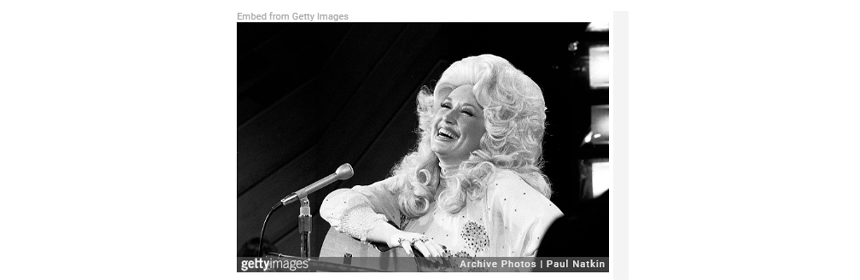
Often when I read the term “icon,” which means a person worthy of veneration, used to describe someone who has died I wonder if the accolade isn’t being overused. This is not one of those times.
Dolly Parton died on Tuesday in Nashville, surrounded by the people she loved. She was 80 years old. When the news broke, something happened that almost never happens anymore. Tributes came from everywhere. Country legends and rock stars. Faith leaders and Hollywood notables. Democrats and Republicans, all saying the same thing. In this terribly divided nation in a terribly divided world Dolly Parton passes away, and for a few days we agree on something. We agreed on Dolly, an icon to be mourned as a member of our own family.
Dolly was one-of-a-kind. That’s the exact definition of another often-misused word, “unique.” Unique cannot be qualified, a grammatical error that drives me up the wall every time I read it. The word applies, unqualified and unadorned to Dolly Parton. And that’s another thing. The proper second reference is “Parton.” Why can’t I bring myself to call her anything but “Dolly?” I never met her. But I think of her as a friend I wish I’d had.
Imagine having 11 Grammy awards, 3 Emmys, 25 no. 1 hit Billboard singles, and after you’re gone, no one is talking about that. They are just talking about how genuine and kind you were and about the impact you made on the world. How amazing.
Dolly was born in 1946 in a one-room cabin in the Smoky Mountains of East Tennessee, the fourth of twelve children. Her family was, by her own description, “dirt poor.” Her father paid the doctor with a sack of cornmeal. She grew up wearing clothes her mother stitched together. One coat, sewn from rags, became one of the most famous songs she ever wrote. Her father, Robert Lee, was one of the smartest people she ever knew, and he never learned to read or write. She carried that her whole life.
She wrote more than three thousand songs. “Jolene.” “Coat of Many Colors.” “9 to 5.” “I Will Always Love You,” which became, in Whitney Houston’s recording, the best-selling single by a solo woman in history. Seven decades on stage.
She was merry about her public persona and invented a Dolly who would be famous forever. She said she modeled her look on the “town tramp.” She famously said, “It costs a lot of money to look this cheap.” Asked by a young fan how long it took to do her hair Dolly exclaimed, “How do I know? I’m not there.”
She could have rested on those achievements and on her riches. Instead, she put as much effort into her philanthropy as she did into entertaining. She built a theme park, “Dollywood,” in the Tennessee hills that employs thousands of the people she grew up with. She became the wealthiest woman in the history of country music, and she did it while being underestimated at every turn by people who saw the wig and the rhinestones and missed the mind underneath. In 2020, she contributed $1 million to Vanderbilt University for virus research, which helped kick-start Moderna’s Covid-19 vaccine.
In 1995, thinking about her father and all the doors that stay closed to a person who can’t read, she started mailing free books to children in her home county. One book a month, from birth until age five, addressed not to the parents but to the child, so that a little kid in a cabin like the one she grew up in would get something in the mail with their own name on it. That program became the Imagination Library. It has now given away more than 300 million books across five countries.
Britain was one of those countries. The day after Dolly died the Band of the Coldstream Guards (the King’s Guard) played “9 to 5” outside Buckingham Palace in her honor. She once said, when they lay her down, she’d be thinking of the Imagination Library. And she made sure it wouldn’t end with her. Her team says she worked right up until the day she died and spent her last years building a plan to keep the books coming for decades.
Dolly turned her success and made it into a machine for lifting other people up. In her home county, she watched kids drop out of high school. She started offering every student who stayed and graduated a check for five hundred dollars. The dropout rate, in a place where it had always been stubbornly high, fell through the floor.
She never identified as a Republican or a Democrat. Only as a “hypo-crat,” she joked. She glittered with authenticity and empathy. The Democratic Socialists of America saluted her. Donald Trump said, “There has never been anyone like her, and never will,” before lowering flags to half-staff in her honor. Twice, the Trump administration offered her the Presidential Medal of Freedom, the government’s highest civilian honor. Both times, she turned it down. When President Joe Biden took office, Parton said, his administration contacted her about it, too, but she didn’t accept. “If I take it,” she explained, “I’ll be doing politics.” Anyway, Parton added, she didn’t deserve it.
Her fans are young and old, working-class and wealthy. They live in tiny towns and big cities. She was deeply religious but never proselytized. She asked, “Who are we to judge?” “I don’t criticize and condemn,” Parton once said. “I love and accept.”
Her film work was natural and honest. Her co-stars praised her professionalism. The included Jane Fonda, Lily Tomlin, Burt Reynolds, Sylvester Stallone, Julia Roberts and Queen Latifah. Among the films, “9 to 5” (1980), “The Best Little Whorehouse in Texas’”(1982). “Rhinestone” (1984). “Steel Magnolias” (1989). “Joyful Noise” (2012).
“There are few finer songwriters, male or female, that have ever lived,” said the pop singer Pink in her 2022 speech inducting Parton into the Rock & Roll Hall of Fame. She called her “one of the greatest storytellers of our time, of any time.” “She crafted heartbreaking and soul-stirring stories about the lives of people often overlooked,” Pink added. Parton’s songs, she noted, make up “a narrative of painful, beautiful, poetic melodic commentary on what it’s like to be human, and what it’s like to be a woman in America.”
Play the music. Screen the films. Mark the passing of an icon.
#####



 Scott Gurvey's Public Offerings