Category Archives: Obituary

Funerals at CBS

There are two funerals on tap this week at CBS, Inc., the company where I spent the first decade of my professional career. When I joined it in 1974, it had recently changed its name from the Columbia Broadcasting System to better reflect its position as a major media company, not just a broadcaster. Its four core lines of business were Broadcasting (TV and radio), Records (music), Publishing (books and magazines), and Musical Instruments/Toys.

One thing it did not change was its leadership. William S. Paley was the legendary media tycoon who built CBS from a small, struggling 16-station radio network into a multi-billion-dollar global broadcasting and entertainment empire. He is widely regarded as one of the founding fathers of modern American broadcasting. Paley entered the picture in September 1928, when his wealthy family bought a majority stake a struggling radio company. He was subsequently named president at just 26 years old, going on to transform the then tiny network into a media empire. In 1974, he was firmly in control.

I can’t imagine what he would think of today’s CBS. Faced with a business climate which seems to value size over all else, CBS has gone from owner to owner in the post Paley years. Today it is owned by Paramount Skydance (formally known as Paramount, a Skydance Corporation). The network’s ownership structure underwent a massive shift when Skydance Media, led by tech heir and filmmaker David Ellison, officially completed an $8 billion merger with CBS’s previous parent company, Paramount Global, on August 7, 2025. Ellison’s takeover of the storied broadcasting was aided by a cash guarantee from his father Larry. Larry Ellison, the billionaire co-founder of Oracle, played the critical role of primary financial bankroller and majority equity owner in the Skydance acquisition of Paramount Global (and by extension, CBS).

Which brings us to this week’s funerals. Not unplanned deaths. These are self-inflicted executions.

The Late Show with Stephen Colbert

First to die will be The Late Show with Stephen Colbert. It will air its final episode on May 21. The Late Show franchise originally began on August 30, 1993, when David Letterman launched the inaugural Late Show with David Letterman. It was a bold attempt for CBS to compete in the late-night hours, where NBC’s Tonight Show had reigned supreme seemingly since the beginning of time. I remember gathering with my dormmates around the communal television after a long day of classes and studying to relax with Johnny Carson. When Carson retired, Letterman, who had a program which followed Carson, seemed the heir apparent. NBC instead chose comedian Jay Leno, leaving Letterman free. CBS swooped in.

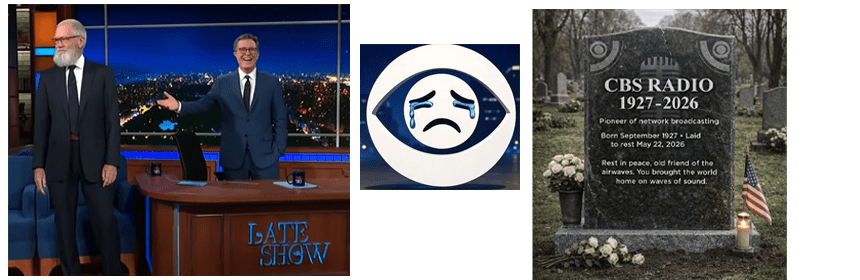
When Letterman retired in 2015, after hosting for 22 years, CBS selected Stephen Colbert, host of his own show on the Comedy Central channel, to succeed him. In the picture above you can see Letterman and Colbert, together last week to throw their own wake. What better way than by gleefully tossing CBS office furniture, including a desk chair and sofas, plus watermelons — a signature Letterman gag — off the side of the building, aimed at the target below: a giant CBS logo.

The official reason provided by CBS for canceling The Late Show is financial, though the decision is heavily shadowed by a massive corporate and political timing controversy. CBS did not reveal detailed financial information. For many the show’s cancellation carries the stench of suspected political interference. Publicly, media critics, industry insiders, and even former host Letterman have vehemently rejected the financial excuse, calling CBS executives “lying weasels” and accusing them of political cowardice.

In July 2025, Paramount paid a $16 million legal settlement to Donald Trump after he sued over how 60 Minutes edited an interview with Kamala Harris. Days later, Colbert ruthlessly mocked his own parent company on air, calling the payout a “big fat bribe”. At the exact moment Colbert made these comments, Paramount was desperately seeking crucial regulatory approval from the Trump administration’s FCC for its $8 billion merger with Skydance Media. Just days after Colbert’s monologue, CBS stunned the industry by canceling the show. Weeks later, the FCC approved the multibillion-dollar Skydance merger. Trump later gloated publicly on social media, bragging that Colbert had been “fired.”

CBS Radio News

The second funeral will be held at the end of the Friday. On that day CBS permanently shuts down CBS News Radio, brining a historic 99-year era of American broadcasting to a sudden end.

Sometime when I was in grade school, I set my clock radio to wake me up at 7AM Chicago time. The radio was tuned to WBBM, the CBS owned station. At that time, I heard The CBS World News Roundup. I have started my day with that broadcast most days since. That is something in the neighborhood of 65 years. But the CBS News Roundup, and the CBS News Hourly reports at the top of every hour of every day, can trace their history back to 1928. This shutdown, ordered by Larry Ellison’s pick as Editor-in-Chief of CBS News, Bari Weiss, completely dismantles the original foundation of William Paley’s media empire and eliminates all remaining jobs within the radio news division.

Finances again are blamed. Legacy media has been heavily battered by years of declining advertising revenue and shifting listener habits as audiences steadily migrated toward podcasts, social media, and digital streaming platforms. But creative leadership could have explored options. The audio medium of radio is perfect for podcasts and streaming. The new bosses at CBS clearly had their eye only on the issue of paying down the Ellison’s debt. The shutdown functions as part of a larger 6% staff reduction across the entire CBS News workforce under the network’s new Paramount Skydance corporate ownership.

There was a time when the government insisted broadcasters devote time to news and public affairs. And they insisted content be fair and balanced and provide opportunities for differing viewpoints to be heard. This was the price one paid for the privilege of controlling one of the limited number of broadcast channels available, as the words of the Communications Act read, “In the public interest, convenience, and necessity.” There were also station owners who took that requirement to heart, desiring to serve their communities and their nation. Those visionaries are long gone.

The CBS Radio Network’s sudden exit leaves roughly 700 local affiliate stations nationwide without their primary hourly national news feeds. Major local all-news stations, like KNX in Los Angeles, WBBM in Chicago, and WWJ in Detroit, had to immediately assure listeners that local reporting would continue while they frantically negotiated new contracts with national syndication competitors like ABC News, Fox News, or NBC News.

Media historians and former network legends have reacted with grief, with former CBS Evening News anchor Dan Rather lamenting, “It’s another piece of America that is gone”. Until this final week, CBS News Radio was the absolute last of the three original national U.S. radio networks (alongside NBC and the Mutual Broadcasting System) still operating under its original parent brand.

The World News Roundup was the longest-running continuous program in broadcast history. And the network famously invented modern wartime reporting with Edward R. Murrow’s London Blitz broadcasts.

I will have to find another way to start my day.

#####

Ted Turner 1938-2026

Some people are visionaries. Some people are great leaders. Few people can do both at the same time. Ted Turner was one of those special people.

In the wake of his death on May 6 at the age of 87, much has been written about his brash in-your-face style. I never met or worked for him. But I have many friends and colleagues who did. To a person, they sing his praises as a tough but fair leader. That he was a visionary is clear when you consider his impact on media in general and journalism in particular.

I remember sitting in the WBBM-TV newsroom in Chicago in 1979, when Turner announced his plans for CNN, the Cable News Network. I was a writer and producer at the CBS owned station and most of the people in our newsroom though Turner’s idea was crazy. I thought otherwise.

Turner has already had a major impact on the media landscape. The 1970s saw the spread of cable television systems across the nation. These stations repeated the broadcasts of the TV stations in their markets, offering better TV pictures but little else. Turner saw an opportunity. That’s what visionaries do.

Operating out of Atlanta, in 1970 Turner bought WJRJ-TV, a struggling UHF station launched in 1967. He renamed it WTCG (Turner Communications Group), jokingly claiming it stood for “Watch This Channel Grow”. On December 17, 1976, Turner used a satellite to beam WTCG’s signal nationwide, creating the first nationally distributed independent station. He allowed the cable companies to use it for free. He made money selling what was now advertising for a nation-wide audience. In 1979, the call letters were changed to WTBS. Over the years, it used various brands like “SuperStation WTBS,” “TBS Superstation,” and finally just “TBS”.

That was just the start.

Turner’s defining achievement was CNN, the Cable News Network. which he launched in 1980. At a time when television news was confined to fixed evening broadcasts, he gambled that audiences would want a constant stream of reporting, and he was right. CNN’s live coverage of the Persian Gulf War made the network a global force and helped normalize the modern era of 24-hour news.

He was never content with one success. Turner expanded into entertainment with TNT, Cartoon Network, and Turner Classic Movies after acquiring valuable film and animation libraries. He also bought the Atlanta Braves, giving the city a beloved team and tying his name to Atlanta’s rise as a major sports and media center.

Turner’s public image was as memorable as his business record. He was outspoken, impatient with convention, and comfortable being controversial. That directness earned him the nickname “The Mouth of the South,” but it also reflected a confidence that helped him bet on ideas others dismissed.

Beyond media, Turner devoted much of his later life to philanthropy and conservation. He gave about $1 billion to establish the United Nations Foundation, co-founded the Nuclear Threat Initiative, and used his land holdings to support wildlife restoration, especially bison conservation.

He also became one of the country’s great landowners and a passionate advocate for the natural world. His ranches, herds, and preservation efforts made him a larger-than-life figure in environmental circles, while projects like Captain Planet reflected his desire to teach younger generations about stewardship.

In his final years, Turner lived with Lewy body dementia, which he disclosed in 2018. Even as his health declined, his influence remained visible in the media world he helped create and in the institutions that grew from his philanthropy. He is survived by his children, grandchildren, and great-grandchildren. Turner had three wives, including the Oscar winning actress Jane Fonda. They all survive him.

Turner’s life was marked by audacity, reinvention, and outsized effect. He turned cable television into a global platform, made philanthropy part of his public identity, and left behind a media landscape that still bears his imprint. For better or worse, much of modern television carries the stamp of Ted Turner. He was one-of-a-kind.

####

Rob Reiner

How do you explain the inexplicable?

It had already been a horrific weekend. On December 13 a mass shooting at Brown University’s Barus & Holley Engineering Building in Providence, Rhode Island left two students dead and nine others injured. The gunman remains at large, and a multi-agency manhunt is ongoing.

The next day a terrorist mass shooting at Bondi Beach in Sydney, Australia left at least 15 people dead and around 40 injured. The attack targeted a Jewish Hanukkah celebration and was carried out by a father-son duo inspired by Islamic State ideology. It followed an increase in antisemitic attacks in the country including one in July where an arsonist set fire to a synagogue in Melbourne while worshipers were inside.

Then came word from the trendy Brentwood section of Los Angeles. Hollywood and the rest of the world were stunned when acclaimed filmmaker Rob Reiner, 78, and his wife, photographer Michele Singer Reiner, were found dead in their home in what police described as a homicide. Authorities have since arrested their son, Nick Reiner, 32, and charged him with murder.

What do you say about the human condition when faced with that sequence of events?

The shocked reaction to the Reiners’ murder was overwhelming itself. Rob Reiner was praised not only as a great talent on both sides of the camera but also as a mentor and friend who shared that talent with a generosity rare in the cutthroat entertainment business. There was one exception which I will write about at some other time.

Earlier this year I wrote about the passing of Diane Keaton and Robert Redford and noted they appear many times on my list of favorite films. The passing of Rob Reiner leaves a similar hole in my heart.

Rob Reiner was born in the Bronx, New York in 1947. He spent his childhood in New Rochelle, where his father Carl would place his fictional family of Rob and Laura Petrie on “The Dick Van Dyke Show.”  They moved to California in the early 1960s. Like his father, Rob got his start as an actor before stepping behind the camera. His breakthrough role was Mike Stivic on “All in the Family” in 1970. Mike was the outspoken liberal son-in-law of Carroll O’Connor‘s conservative bigoted Archie Bunker. These are my first memories of Rob Reiner. Mike’s battles with Archie, written by the great Norman Lear, brought into America’s living room topics roiling the nation but up until then considered too controversial for television.

Now the list of films begins. And I will only note some my favorites. Reiner’s first feature was 1980’s “Spinal Tap,” a groundbreaking “mockumentary” that was a breakout hit. His next movie was “The Sure Thing,” a coming of age romantic comedy, followed by “Stand By Me,” based on a Stephen King story. King was also the source for “Misery,” which would be one Reiner’s biggest theatrical hits. 

My list of films also includes “The Princess Bride.” Also “A Few Good Men” and “The American President,” both written by Aaron Sorkin. “When Harry Met Sally,” my favorite rom-com, “Rumor Has It…,” and “The Bucket List.” The number is films in which Reiner acted, usually in a supporting role, are too numerous to list here.

The list of testimonials has been astonishing. I am just going to cite one, an Instagram post from Meg Ryan, who starred along with Billy Crystal in “When Harry Met Sally.”

Now I’m going to watch some movies.

#####

“La-di-da, la-di-da, la-la.”

I fell for Diane Keaton the minute I heard her speak that line in Annie Hall. She won the Oscar for Best Actress for her performance as the title character in Woody Allen‘s 1977 classic. Keaton’s wardrobe, her own creation, started a whole new trend of women utilizing men’s clothing that made a mark on fashion and popular culture that survives today.

The film won the Academy Award for Best Picture. Allen won for Best Director and shared with Marshall Brickman the award for Best Original Screenplay.

Read more

Robert Redford

If you want to take a master class in film, you need only watch the movies of Robert Redford. Redford passed away peacefully on September 16, at the age of 89, at his beloved home at Sundance in the mountains of Utah. He was more than a Hollywood icon. He was a visionary who reshaped American cinema and left an indelible mark on the cultural landscape.

Read more

Two Giants

Embed from Getty Images

We lost two giants of the entertainment world in the month of September, actors who I admired for decades. They each graced both stage and screen. And both filled their mantels with a large collection of awards.

Read more

Remembering William Anders

There is a cliche that says a picture is worth a thousand words. The picture above has generated millions of words, I’m sure. Some believe this photograph, known as “Earthrise,” is the most famous and influential photograph ever taken. It is certainly one of my favorites.

Read more
« Older Entries