Category Archives: Protest

Poof! It’s Gone. Maybe.
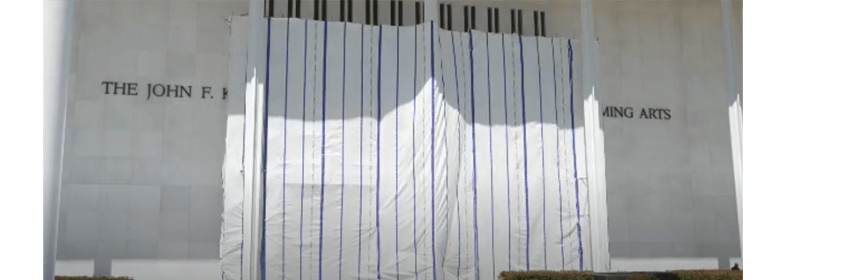
We think Donald Trump‘s name has been removed from the John F. Kennedy Center for the Performing Arts. At least, that what Trump’s handpicked board of directors told the District Court for the District of Columbia in a filing on Saturday. The removal had been ordered by the court two weeks earlier in a decision enforcing the Center’s original statutory name.

Trump’s name was added in December 2025 after he replaced the Kennedy Center’s leadership and the new board voted to rename the institution. The court found this action illegal, ruling that the board cannot unilaterally change the name of a national memorial.

In his 94-page decision, U.S. District Judge Christopher Cooper wrote, “The Kennedy Center’s organic statute makes crystal clear that the Center is to be named for President Kennedy, and it cannot bear any other formal name or public memorial based on the Board’s unilateral say-so. Congress gave the Kennedy Center its name, and only Congress can change it.”

The renaming triggered a large outcry and a boycott of the Center by patrons, performers, and donors. A crowd of several hundred people gathered on Saturday at the Center to witness the removal of Trump’s name from the exterior. Which brings us to my use of the word “maybe.”

While the Trump lettering was put up by workers on simple lifts, workers Saturday first erected an expansive scaffold in front of the lettering. Then they draped a large curtain or tarp to prevent people from watching their work. Several web cams had been pointed on the sign, transmitting the image around the world. The curtain remains up on Sunday morning. We have only the sworn statement of Trump’s board of directors that the name has been removed.

Why is the curtain still up? Perhaps Trump just couldn’t stand to see the empty space his name once filled. And didn’t want to watch his name coming down.

This is not the end of the lawsuit, which had been brought by Rep. Joyce Beatty (D-Ohio), an ex officio trustee who sued her fellow trustees for adding Trump’s name to the title of the Kennedy Center. Hours before Friday’s deadline, two courts denied the Kennedy Center’s last-ditch attempt to delay the removal, even as crews erected scaffolding next to the building.

Judge Cooper ruled at 1 p.m. that the Kennedy Center’s lawyers failed to demonstrate they were likely to win their appeal or that the center would suffer “irreparable harm” if Trump’s name were removed. At 3:46 p.m., Justice Department lawyers representing the center appealed Cooper’s denial, filing an emergency motion for a stay with the Court of Appeals for the D.C. Circuit. Shortly after 7 p.m., the appeals court denied the second attempt. But the appeal will continue.

The addition of Trump’s name sparked immediate backlash from the arts community and members of the Kennedy family, who argued that the renaming desecrated a living memorial to the assassinated president. Congress established the center in 1964, two months after Kennedy’s death, designating it “the sole national monument to his memory within the city of Washington and its environs.”

Trump’s Department of Justice, paid for by taxpayers, represents him in these cases.

Last week the Center was also sued by the Washington National Opera. The WNO performed in the Center for fifty years but decamped when Trump took over. The opera claims the Center is refusing to return more than $17 million dollars of endowment contributions, gifts and donations which it managed on behalf of the WNO.

June 16 Update

Official word from The Kennedy Center is that the tarps will stay up for the “two-year renovation” and “replacement” of the marble facade slabs. Trumpian subtext, “OK, my name may be removed, but I’m not going to let you see it!!!! Na Na Na Na-Na.” And make no mistake about it, Trump is still the Chairman of The Kennedy Center, and his “Board” are 100% partisan sycophants.  The Kennedy Center is still in mortal danger.

####

Funerals at CBS

There are two funerals on tap this week at CBS, Inc., the company where I spent the first decade of my professional career. When I joined it in 1974, it had recently changed its name from the Columbia Broadcasting System to better reflect its position as a major media company, not just a broadcaster. Its four core lines of business were Broadcasting (TV and radio), Records (music), Publishing (books and magazines), and Musical Instruments/Toys.

One thing it did not change was its leadership. William S. Paley was the legendary media tycoon who built CBS from a small, struggling 16-station radio network into a multi-billion-dollar global broadcasting and entertainment empire. He is widely regarded as one of the founding fathers of modern American broadcasting. Paley entered the picture in September 1928, when his wealthy family bought a majority stake a struggling radio company. He was subsequently named president at just 26 years old, going on to transform the then tiny network into a media empire. In 1974, he was firmly in control.

I can’t imagine what he would think of today’s CBS. Faced with a business climate which seems to value size over all else, CBS has gone from owner to owner in the post Paley years. Today it is owned by Paramount Skydance (formally known as Paramount, a Skydance Corporation). The network’s ownership structure underwent a massive shift when Skydance Media, led by tech heir and filmmaker David Ellison, officially completed an $8 billion merger with CBS’s previous parent company, Paramount Global, on August 7, 2025. Ellison’s takeover of the storied broadcasting was aided by a cash guarantee from his father Larry. Larry Ellison, the billionaire co-founder of Oracle, played the critical role of primary financial bankroller and majority equity owner in the Skydance acquisition of Paramount Global (and by extension, CBS).

Which brings us to this week’s funerals. Not unplanned deaths. These are self-inflicted executions.

The Late Show with Stephen Colbert

First to die will be The Late Show with Stephen Colbert. It will air its final episode on May 21. The Late Show franchise originally began on August 30, 1993, when David Letterman launched the inaugural Late Show with David Letterman. It was a bold attempt for CBS to compete in the late-night hours, where NBC’s Tonight Show had reigned supreme seemingly since the beginning of time. I remember gathering with my dormmates around the communal television after a long day of classes and studying to relax with Johnny Carson. When Carson retired, Letterman, who had a program which followed Carson, seemed the heir apparent. NBC instead chose comedian Jay Leno, leaving Letterman free. CBS swooped in.

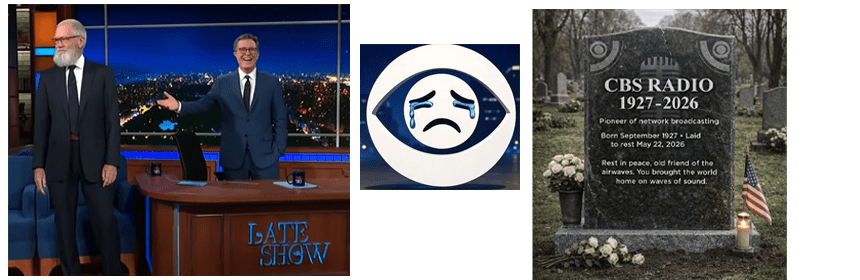
When Letterman retired in 2015, after hosting for 22 years, CBS selected Stephen Colbert, host of his own show on the Comedy Central channel, to succeed him. In the picture above you can see Letterman and Colbert, together last week to throw their own wake. What better way than by gleefully tossing CBS office furniture, including a desk chair and sofas, plus watermelons — a signature Letterman gag — off the side of the building, aimed at the target below: a giant CBS logo.

The official reason provided by CBS for canceling The Late Show is financial, though the decision is heavily shadowed by a massive corporate and political timing controversy. CBS did not reveal detailed financial information. For many the show’s cancellation carries the stench of suspected political interference. Publicly, media critics, industry insiders, and even former host Letterman have vehemently rejected the financial excuse, calling CBS executives “lying weasels” and accusing them of political cowardice.

In July 2025, Paramount paid a $16 million legal settlement to Donald Trump after he sued over how 60 Minutes edited an interview with Kamala Harris. Days later, Colbert ruthlessly mocked his own parent company on air, calling the payout a “big fat bribe”. At the exact moment Colbert made these comments, Paramount was desperately seeking crucial regulatory approval from the Trump administration’s FCC for its $8 billion merger with Skydance Media. Just days after Colbert’s monologue, CBS stunned the industry by canceling the show. Weeks later, the FCC approved the multibillion-dollar Skydance merger. Trump later gloated publicly on social media, bragging that Colbert had been “fired.”

CBS Radio News

The second funeral will be held at the end of the Friday. On that day CBS permanently shuts down CBS News Radio, brining a historic 99-year era of American broadcasting to a sudden end.

Sometime when I was in grade school, I set my clock radio to wake me up at 7AM Chicago time. The radio was tuned to WBBM, the CBS owned station. At that time, I heard The CBS World News Roundup. I have started my day with that broadcast most days since. That is something in the neighborhood of 65 years. But the CBS News Roundup, and the CBS News Hourly reports at the top of every hour of every day, can trace their history back to 1928. This shutdown, ordered by Larry Ellison’s pick as Editor-in-Chief of CBS News, Bari Weiss, completely dismantles the original foundation of William Paley’s media empire and eliminates all remaining jobs within the radio news division.

Finances again are blamed. Legacy media has been heavily battered by years of declining advertising revenue and shifting listener habits as audiences steadily migrated toward podcasts, social media, and digital streaming platforms. But creative leadership could have explored options. The audio medium of radio is perfect for podcasts and streaming. The new bosses at CBS clearly had their eye only on the issue of paying down the Ellison’s debt. The shutdown functions as part of a larger 6% staff reduction across the entire CBS News workforce under the network’s new Paramount Skydance corporate ownership.

There was a time when the government insisted broadcasters devote time to news and public affairs. And they insisted content be fair and balanced and provide opportunities for differing viewpoints to be heard. This was the price one paid for the privilege of controlling one of the limited number of broadcast channels available, as the words of the Communications Act read, “In the public interest, convenience, and necessity.” There were also station owners who took that requirement to heart, desiring to serve their communities and their nation. Those visionaries are long gone.

The CBS Radio Network’s sudden exit leaves roughly 700 local affiliate stations nationwide without their primary hourly national news feeds. Major local all-news stations, like KNX in Los Angeles, WBBM in Chicago, and WWJ in Detroit, had to immediately assure listeners that local reporting would continue while they frantically negotiated new contracts with national syndication competitors like ABC News, Fox News, or NBC News.

Media historians and former network legends have reacted with grief, with former CBS Evening News anchor Dan Rather lamenting, “It’s another piece of America that is gone”. Until this final week, CBS News Radio was the absolute last of the three original national U.S. radio networks (alongside NBC and the Mutual Broadcasting System) still operating under its original parent brand.

The World News Roundup was the longest-running continuous program in broadcast history. And the network famously invented modern wartime reporting with Edward R. Murrow’s London Blitz broadcasts.

I will have to find another way to start my day.

#####

Minneapolis, Minnesota

The reason investigations are conducted before making a judgment is because no one knows all the facts in the immediate aftermath of a tragedy.

That didn’t stop Department of Homeland Security Director Kirsti Noem from announcing within hours of the killing of a then unknown woman in Minneapolis that the woman was a domestic terrorist and that the agent of Immigration and Customs Enforcement had acted in self-defense after she ran him over with her car. The next day Vice President J.D. Vance displayed the fruits of his Yale law degree by proclaiming that the agent involved has “absolute immunity.” Vance also claimed, “She tried to stop him from doing his job. When he approached her car, she tried to hit him.”

Read more

No Kings

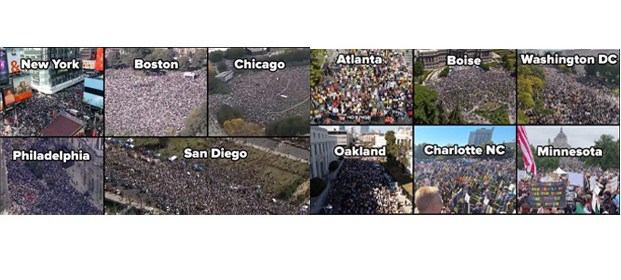
Anywhere from five to eight million people turned out for the second “No Kings” protests across the nation. The rallies took place in over 2,600 locations across the United States.

I have first or secondhand knowledge of protests in New York, Washington D.C., Chicago, Portland, San Francisco, and Los Angeles. They were peaceful. Crowds were almost jubilant at having an opportunity to voice their opposition to the actions of the Trump administration. The only place I heard Trump supporters showed up to counter the protest was Palo Alto, California. No Kings protesters refused to engage with the Trumpies, who they feared were trying to provoke them.

Read more