The Donnie-Mander

The Supreme Court, or rather the six Republican justices on the Supreme Court, have handed Donald Trump another victory. They issued a stay, blocking the order of a three-judge panel in Texas, which found the recent reapportionment of the state’s Congressional districts to be racially motivated and therefor illegal. The six, has been their pattern all year, issued their order in the dark of night on the “shadow” docket without an explanation or opinion. Greg Abbott, et al. v. League of United Latin American Citizens, et al.
The map the lower court panel blocked was seen as one of the most aggressive mid‑decade gerrymanders in recent history. The Supreme Court stay allows Texas to proceed with the new map, which analysts say could give Republicans five additional U.S. House seats in the 2026 midterms.
Gerrymandering 101
What, in a nutshell, is gerrymandering? The Encyclopedia Britannica has a wonderful explanation from which I have borrowed the graphic above. The American Constitution requires that every ten years we conduct a “census” to apportion representation in the House of Representatives. The Fourteenth Amendment, Section 2 begins, “Representatives shall be apportioned among the several States according to their respective numbers, counting the whole number of persons in each State, excluding Indians not taxed.”
Once the number of representatives is determined by the census, it is up to each state to draw the maps of legislative districts. Because the states have statewide elections for senators, governors, and to decide members of the Electoral College, there is data on how the state as a whole divides between the parties. Using the graphic above we find of a total population of fifty, thirty (60%) are orange voters while twenty (40%) are purple voters.
From that starting point, the state could draw “fair” maps which distributed the people in such a manner to generate three orange and two purple representatives, proportionate to the statewide electorate. But the state could also gerrymander, producing an outcome, using the example on the right above, of five orange and no purple representatives, or two orange and three purple representatives.
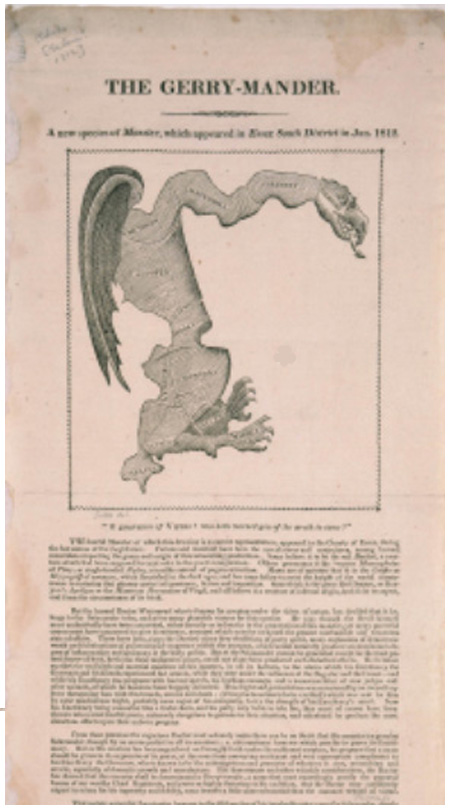
The term “gerrymander” was coined as a portmanteau of the name Elbridge Gerry and the word “salamander.” Gerry, who was the governor of Massachusetts, signed a redistricting law that redrew district lines in a way that favored his party. Critics said the new map created a weirdly shaped district which resembled a salamander. A satirical cartoon published in the Boston Gazette on March 26, 1812, popularized the word. The cartoon depicting the irregular shape helped turn a local political attack into a lasting political term.
The Donnie-Mander
The political parties have a long history of manipulating their maps to various degrees every ten years when the new census requires a reallocation of seats. But two things make this year’s manipulations unusual. First, this is a mid-census reapportionment. The last census was in 2020 with new maps taking effect in 2022 in most states. Second, this mid-census revision to the 2022 map came at the direct demand of Donald Trump. Texas’s Republican Governor Greg Abbott heeded Trump’s call and generated a new map that may add as many as five Republicans to the House in 2026. That is the map the Supreme Court now says can be put into place. With the Republican control in the House hanging on a tiny seven vote majority, Trump is clearly afraid the Democrats could gain control in the next election.
This Trump inspired Donnie-Mander, now sanctified by the Supreme Court, has set off an unprecedented arms race of mid-decade redistricting across the country. Missouri and North Carolina have passed their own Republican leaning maps. California voters approved a map designed to cancel out the Texas gains. Virginia and Maryland are working on new maps favoring Democrats. Illinois is considering one. Florida and Indiana are working on revisions on the Republican side.
National Public Radio has been keeping score on its web site. As of this writing they show a slight gain for Republicans on the basis of district voting patterns in next year’s election. Considering his atrocious polling numbers, Trump is going to need all the help he can get. The Center for Politics at the University of Virginia, one of my favorite pollsters, sees 2026 shaping up to be much too close to call.
Congress has over the years tried to set standards and take control of the redistricting process. It has never been able to pass a law to bring order out of the chaos.
The majority on the Supreme Court, by allowing these partisan mid-decade redistrictings, has created a free-for-all which is a lose-lose for the American people. But 2026 does promise to be a good show.
######



 Scott Gurvey's Public Offerings