Yearning to Breathe Free
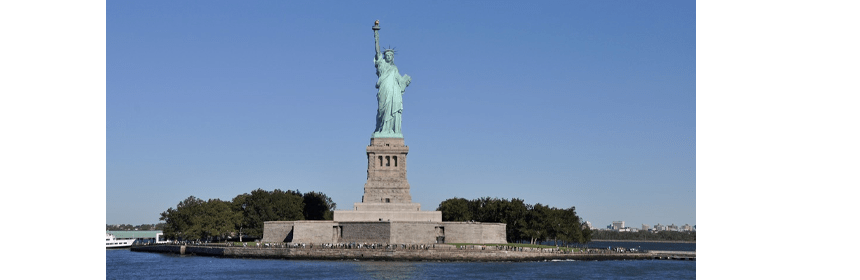
The poem on the pedestal of the Statue of Liberty in New York Harbor is a sonnet titled “The New Colossus,” written by American poet Emma Lazarus in 1883. Its famous lines, “Give me your tired, your poor, / Your huddled masses yearning to breathe free” transformed the statue from a monument of generic liberty into a worldwide symbol of immigration, refuge, and hope.
Lady Liberty was the first thing millions of immigrants saw as they arrived in the New World. “Her name,” the poem declares, is “Mother of Exiles. From her beacon-hand Glows world-wide welcome.”
Not anymore. Unless you can trace your lineage to the indigenous people of North America, and only about 2% of the current population of the United States can do so, your ancestors came from someplace else. As you contemplate the 250th anniversary of the birth of our nation, you might consider that without the welcoming arms of the United States, your personal history would be quite different.
Although the United States is a nation of immigrants, there has always been a faction which opposes it. French and Irish immigrants were targeted in the 1790s. In 1798, President John Adams signed the Alien and Sedition Acts. This extended the naturalization residency requirement from 5 to 14 years and allowed the government to deport “dangerous” open-door arrivals.
Catholics were the targets in the 1840s. Protestant Americans feared that an influx of Catholics would be loyal to the Pope rather than the U.S. government. The late 19th Century brought racial exclusion with the target being Chinese and other Asian laborers. Congress passed the Chinese Exclusion Act of 1882. It was the first major federal law to ban immigration based explicitly on race and nationality. The 20th Century brought a quota system, starting with the Immigration Act of 1924.
Modern opposition to immigration in the United States differs from historical eras by focusing heavily on border security, legal status, and federal enforcement rather than explicit racial exclusion. Under the administration of Donald Trump, the federal government has pushed measures like the “One Big Beautiful Bill” Act and the Laken Riley Act, which expand mandatory detentions, mandate higher federal funding for border walls, and limit federal benefits for even lawfully present immigrants. At this time immigration to the United States has basically stopped. With the exception of a special exception for white South Africans who claim they are being persecuted in their home country.
We as a people are deeply split on this issue. Data from Pew Research Center shows that about 52% of Americans believe current administration tactics go “too far” on deportations, highlighting a steep partisan gap. According to polling compiled by NORC, while a majority of Republicans strongly back federal agencies like Immigration and Customs Enforcement (ICE), most Democrats and independents hold unfavorable views of hardline enforcement. Conversely, a vast cross-partisan majority of voters (around 72%, according to the National Immigration Forum) favor a compromise solution pairing strict border security with a path to earned legal status for those already in the country.
Congress’s ongoing inability to pass a comprehensive, long-term immigration reform bill has left America’s immigration system broken, forcing a reliance on executive orders and courtroom battles instead of permanent laws. For decades, the standard playbook of a “grand compromise” pairing enhanced border enforcement with a pathway to legal status for undocumented immigrants has repeatedly collapsed under intense partisan polarization.
Because Congress cannot pass permanent laws, immigration policy changes drastically with every presidential administration. Borders are managed and humanitarian protections are granted or revoked entirely by executive actions, which are immediately challenged in court.
Last week the Supreme Court issued two monumental 6-3 rulings that significantly expanded the federal government’s power to enforce hardline border restrictions and strip protections from long-term residents. Both decisions split strictly along the Court’s conservative-liberal divide. They represent major legal victories for the Trump administration’s “America First” anti-immigration agenda.
Both majority opinions were written by Justice Samuel Alito. In Mullin v. Doe, dealing with Temporary Protected Status, the majority emphasized that federal courts are legally prohibited from reviewing the Department of Homeland Security’s policy decisions on TPS, rejecting arguments that the terminations were racially motivated.
“There is no judicial review of any determination of the [Secretary of Homeland Security] with respect to the designation, or termination or extension of a designation, of a foreign state under this subsection… This text is clear, and its plain meaning is very broad.”
Mullin v. Doe, Alito, Majority Opinion
The liberal justices argued that the Court bypassed critical constitutional tests regarding equal protection and executive bias. In her dissent, Justice Sonia Sotomayor called out the administration’s past derogatory statements about the affected nations.
“The references—of filth, disease, and primitiveness—are shot through with racial stereotypes and tropes… The statements fairly shout, in their racial undertones and overtones alike, that race entered into the President’s resolve to remove Haitians from this country.”
Mullin v. Doe, Sotomayor, dissenting
In Mullin v. Al Otro Lado, dealing with asylum eligibility, the conservative majority focused strictly on the literal geography of the border line under the Immigration and Nationality Act (INA).
“An alien standing in Mexico does not ‘arriv[e] in the United States’ by attempting, and failing, to set foot in this country. An alien ‘arrives in the United States’ only when he crosses the border.”
Mullin v. Otro Lado, Alito, Majority Opinion
Dissenting again, Justice Sotomayor (joined by Justices Kagan and Jackson), found the liberal minority arguing that the ruling functionally dismantles humanitarian protocols established by Congress.
The majority’s decision “blesses the Executive Branch’s decision to slam the door shut on all who are fleeing persecution, despite the detailed inspection and asylum system that Congress enacted and commands.”
Mullin v. Otro Lado, Sotomayor, dissenting
The initial effect of the first decision will be the immediate loss of TPS legal status for 350,000 people, mostly Haitian. That strips them of deportation protections and valid work permits and puts them at immediate risk of arrest and removal. The effect of a second decision clears the Trump administration to continue its current policy of turning away asylum seekers who come the U.S. borders.
Trump advisor Stephen Miller, who has led the administration’s anti-immigration policy, says the administration will move to remove the roughly 1.3 million TPS migrants, warning that “if you no longer have status in this country, then you’re supposed to be deported.” Miller’s ancestors escaped Russian pogroms and the Holocaust. He also declared, “America’s doors are closed fully to asylum seekers”, dismissing asylum applications as “fake.” Trump’s ancestors came from Germany and Scotland.
The welcome mat has been pulled up at the door of the once-shinning beacon of hope for the world.
Happy 250th.
####



 Scott Gurvey's Public Offerings