9-11 at 25
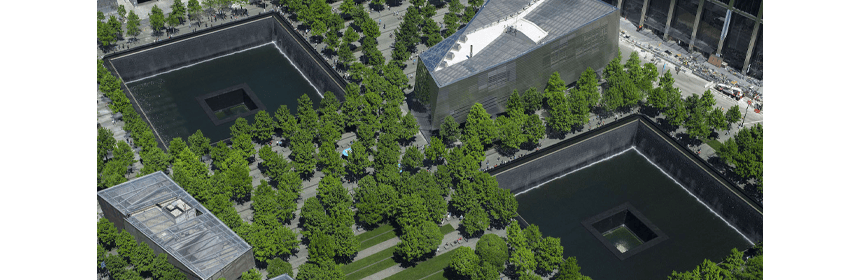
Empty holes. Water flows into them like fountains into a bottomless pit. Names of the dead engraved in the stone ringing the perimeter. It is quiet, almost serene.
This is where the twin towers stood. Until the morning of September 11, 2001.
It is not quiet at the moment. As I watch the scene on television, the plaza is packed. The grieving are reading the names of the 2,977 people who died that day at the hands of 19 terrorists who commandeered two airplanes and drove them into the World Trade Center in lower Manhattan. They also hijacked two other planes and drove them into the Pentagon in Washington, 184 died there, and into a field in Pennsylvania, where 40 died.
On September 11, 2001, I was the Bureau Chief for public television’s Nightly Business Report. Our newsroom and studio were on Trinity Place, two blocks south of Tower #2. I lived on Rector Place in Battery Park City, a community built on land reclaimed from the Hudson River using landfill from the excavation of the Trade Center site. A view of the south side of Tower #2 filled my bedroom window.
Today I regularly teach students who had not yet been born in 2001 or were so young 25 years ago that they have no direct memory of what was the most traumatic day of my life. One third of the people living in the United States today were not here on that day.
I have written about these events several times. I will not do so again now. The memories bring back images that produce nightmares. I talk to someone about that. I’ve also put down my thoughts as well as I will ever be able to and you can, if interested, read them here.
The US stock markets never opened for trading that day. Since market news accounted for half of the content of our broadcast, we canceled our report that night, which allowed the PBS NewsHour, based in Washington, DC, extra time to produce an expanded report. But in midafternoon, before the police ordered us to evacuate our office building, we were able to get a transmission link to DC, and we transmitted the pictures our brave camera crews had recorded of the disaster.
Then we turned on the lights, and I sat down on our set, looking well worn, and described what I had seen in an interview with the NewsHour‘s Ray Suarez. As it turned out, that interview was the last transmission we made from that lower Manhattan location. You can watch the entire NewsHour program here. My interview is at 24:30. Six months later, I filed an expended look back, and look ahead, for Nightly Business Report, which I’ve uploaded here.
The rebuilding which I talked about in that six-month story, did take a very long time. But it did succeed. Lower Manhattan is booming and there is little, save for the memorial at the actual Trade Center site, to remind one of the tragic events of that day. A single new tower, One World Trade Center, is as of this writing the tallest building in North America and the Western Hemisphere. Battery Park City is revitalized and renewed, and in great demand. My wife and I moved to New Jersey in 2002. We lived for twenty years in Montclair. We are now in Princeton.
I still reflect on the events of that day from time to time. Here are several disjointed observations.
There was an amazing sense of unity in the nation following the tragedy. The political parties came together in a unified way pledging to rebuild and reform. As the process proceeded, we lost much of that unified spirit. The use of federal funds to help New York City recover dissolved into the usual partisan battles. Why, some wondered, should the nation have to “bail out” New York City? That question ignores that fact that it was not New York City’s foreign policy that had drawn the ire of the terrorists who perpetrated the attack.
The attack itself has changed in our collective memory. The Canadian Broadcasting Corporation (CBC) in an internal memo leaked to the media advised its reporters not to refer to the Sept. 11 attacks as “terrorist attacks” without attribution. This political correctness is absurd.
The 9-11 attack was perpetrated by the Islamic terrorist organization al-Qaeda. The ringleader, Mohamed Atta, flew American Airlines Flight 11 into the North Tower. The Central Intelligence Agency informed President George W. Bush that its Counterterrorism Center had identified the attacks as having been the work of al-Qaeda under Osama bin Laden. In 1996 bin Laden issued the first of two fatwās (Arabic: “religious opinions”) declaring a holy war on the United States. His goal was to draw the US into a large-scale war in the Muslim world that would overthrow the existing order and establish a single Islamic state.
Intelligence services from around the world, including Russia, helped the US locate bin Laden. He was in Afghanistan and believed to be in a mountainous area known as Toro Boro. Yet he managed to escape. Bin Laden was finally located in Pakistan in 2011. He was killed there by US Special Forces. Al-Qaeda released a statement publicly acknowledging bin Laden’s death and vowing revenge. They are still out there. We should not forget.
In the wake of the 9-11 attacks, the US received unprecedented support from nations around the world. NATO invoked for the first time and only time to date its Article 5, acknowledging that an attack on one was an attack on all. This is the same NATO Donald Trump consistently ridicules, threatening to leave the alliance.
When the US closed its airspace on 9-11, Canada, in what came to be known as Operation Yellow Ribbon, took in between 225 and 240 flights at 17 airports and cared for passengers. One town, Gander, on the island of Newfoundland, took in 38 planes. Gander at the time had fewer than 10,000 residents. Yet it welcomed more than 6.,500 passengers and crews from around the world. This is what friends do, even if Trump insists on treating the Canadians as an enemy today.
Domestically, it was determined that failures by many in the US intelligence community to share information crippled efforts to detect the threat which led to 9-11. With little objection, lawmakers vastly overhauled the laws, eliminating restrictions on information sharing, creating a new super intelligence bureaucracy, and a Director of National Intelligence.
It also created a new national police agency, the Department of Homeland Security, moving into one department virtually all the federal police agencies in the nation. It also provided for an expansion of federal policing efforts to create a domestic police force which includes Immigration and Customs Enforcement (ICE), Customs and Border Protection (CBP), the Federal Emergency Management Agence (FEMA), the US Coast Guard, and the US Secret Service.
DHS employs more than 240,000 people. Its very existence reflects a new culture of anxiety and fear in the nation on which Bin Laden waged war. I would not go so far as some and say he won that war. But while he may be dead and gone, he has had a profound impact on the United States. We are different post 9-11. We are, for good or bad, forever changed.
#####
 Scott Gurvey's Public Offerings
It's so powerful how the memorial captures both the loss and the resilience of those affected. Watching the names being read always brings a lump to my throat. Do you think the memorial truly honors their memory?
LikeLike
Remote Reply
Original Comment URL
Your Profile
Why do I need to enter my profile?
This site is part of the ⁂ open social web, a network of interconnected social platforms (like Mastodon, Pixelfed, Friendica, and others). Unlike centralized social media, your account lives on a platform of your choice, and you can interact with people across different platforms.
By entering your profile, we can send you to your account where you can complete this action.
Scott, I think of you on 911 and the horror of that day. It took a common enemy to unite our nation. Wouldn’t it be nice if we would never forget how it felt to be one as a nation, but also how to work with other countries for the common good. Right now, with the potential threat of AI negating the human race, this would be a time to reach out to our fellow mankind and forget our rivalries that divide us.
LikeLike