Tag Archives: elections

R.I.P. V.R.A.

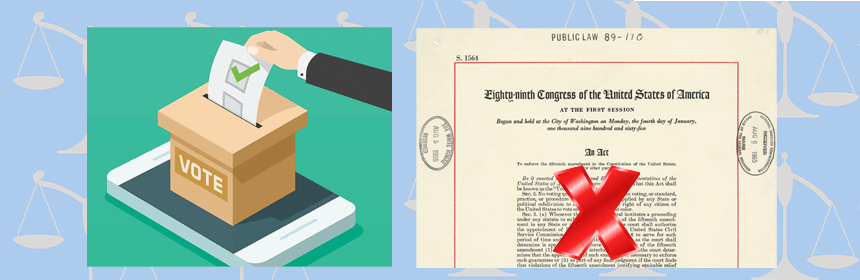
John Roberts, Chief Justice of the United States, has achieved his life goal. With the Court’s ruling in Louisiana v. Callais, he has killed the Voting Rights Act. Roberts made the destruction of the VRA of 1965 his lifelong crusade. His opposition to the Act dates back to his days as a law clerk for then Associate Justice William Rehnquist. Rehnquist notoriously wrote a memo in 1952 stating, “I think Plessy v. Ferguson was right and should be re-affirmed.” Plessy was the infamous “separate but equal” case institutionalizing racism in public schools. It was overturned by Brown v. Board of Education in 1954.

Roberts first wrote, “the way to stop discrimination on the basis of race is to stop discriminating on the basis of race” in 2007, Parents Involved in Community Schools v. Seattle School District No. 1. Since then, the quote has become a defining slogan for his judicial philosophy on race, later appearing in other landmark rulings like Students for Fair Admissions v. Harvard (2023), which ended affirmative action in university admissions.

The record of the Roberts Court is clear:

  • Shelby County v. Holder (2013): Roberts authored the 5–4 majority opinion that effectively struck down Section 5, the “preclearance” requirement for states with a history of racial discrimination. He argued that the coverage formula was based on “decades-old data and eradicated practices” and that “our country has changed”.
  • Brnovich v. Democratic National Committee (2021): Roberts joined Justice Alito’s majority opinion that made it harder for plaintiffs to win Section 2 “vote-denial” cases. The ruling introduced “guideposts,” such as the “usual burdens of voting,” that limit the Act’s ability to challenge neutral-looking rules like ballot-collection bans.
  • Allen v. Milligan (2023): In a surprise to many legal observers, Roberts authored a 5–4 opinion upholding Section 2 to strike down Alabama’s congressional map for underrepresenting Black voters. He reaffirmed the Gingles precedent, stating that the law remains a vital tool against discriminatory redistricting.
  • Louisiana v. Callais (2026): Most recently, the Court ruled 6–3 that creating two majority-Black districts in Louisiana violated the Equal Protection Clause. Critics argue this decision, supported by Roberts, may effectively signal the end of Section 2’s power to protect minority voting strength against partisan gerrymandering.

Roberts’s position is hard to argue with on its face. The problem is that his view of the world does not match reality. Roberts let Justice Samuel Alito do the dirty work of writing the opinion in Louisiana v. Callais. Alito used Roberts’s rose-colored glasses.

Alito wrote that “things have changed dramatically” in the South and used that as a basis for concluding that the relevant protections of the Voting Rights Act are no longer needed in the way they once were. Quite a stretch for someone who claims to be an “originalist.” The framing echoes language Roberts had used in Shelby County to gut Section 5 of the VRA — Roberts had written that “voter turnout and registration rates now approach parity” and that “blatantly discriminatory evasions of federal decrees are rare.” Research shows that ruling led to hundreds of new laws which had the effect of restricting voting.

This is reminiscent of a metaphor used by the late Justice Ruth Bader Ginsburg, dissenting in Shelby County. Ginsburg called that decision equivalent to “throwing away your umbrella in a rainstorm because you are not getting wet.”

What is striking here is not this view of the current state of race relations in the country. It is that this view is being used as a justification for the Court’s action at all. The conservative majority is in full lawmaking mode here, a position it hypocritically denies it assumes. In fact, in the time since the 2022 Dobbs decision on abortion, the conservatives have been rewriting precedent with abandon and placing themselves in what is traditionally the role of the elected branches.

Justice Elena Kagan argued in her Louisiana v. Callais dissent that the majority opinion renders Section 2 of the VRA “all but a dead letter.” Kagan wrote that Section 2 had been “repeatedly, and overwhelmingly, reauthorized by the people’s representatives in Congress,” and that only Congress — not the Court — has the right to declare it no longer needed.

Alito insists the Court did not completely strike down section 2. But the Court significantly reworked the 40-year-old framework established in Thornburg v. Gingles, making three changes that will collectively make it much harder for voters of color to bring cases under Section 2 of the VRA. First, illustrative maps submitted by plaintiffs must meet all of a jurisdiction’s political objectives, including partisan goals. Second, evidence of racially polarized voting must control for partisan preferences. Third, in the “totality of circumstances” phase, plaintiffs must present strong evidence of present-day intentional racial discrimination — historical evidence of past discrimination carries much less weight.

I came of age during the turbulent 1960s with protests, sometimes violent, over the issues of Civil Rights, Woman’s Rights, and the war in Vietnam. Only one of three Americans alive today was alive then. Still, I am surprised to find so many students have failed to learn from the history of those days. Apparently, the conservatives on the Supreme Court have never learned or forgotten that history as well.

The Voting Rights Act was a major victory. It provided a mechanism to remedy the nearly total lack of Black Americans serving in Congress from the southern states, which had significant Black populations. Congress determined that was due to what were called Jim Crow laws, enacted in southern states, making it difficult for Blacks to vote in spite of the Fifteenth Amendment. Congress reauthorized the Act in 2006, extending it until 2031, finding it was still necessary. The vote in Congress was nearly unanimous.

The Court now substitutes its wishes for those of Congress, a pure exercise of judicial activism. In the immediate aftermath, Louisiana suspended its May 16 primary to allow the legislature to draw a new map, and Alabama filed an emergency motion seeking to stay a court order that had required it to maintain two majority-Black districts. A new era, call it Jim Crow 2.0, has arrived.

#####

Happy New Year!

We already know how 2025 has ended. Donald Trump has made it a wall-to-wall disaster with his illegal exercise of power with the goal of trashing the government and sweeping aside the norms of law and reason by which we have governed for 250 years. Even on New Year’s Eve he has vetoed a bipartisan law aimed at providing drinking water to tens of thousands. He has also reposted social media attacks on the memory of Tatiana Schlossberg, the granddaughter of President John F. Kennedy, who tragically died of cancer at the age of 35.

These acts of retribution, jealously, and sheer cruelty are standard procedure for Trump, who seems to draw perverse pleasure from these vile acts.

But there is hope that 2026 can be different. the new year is also an election year. That means we the people get a chance to reverse the mistake made in 2024 and strengthen the roadblocks that keep Trump from putting a crown on his head. in 2025 the Republican majority in Congress abdicated its traditional role as legislative partner and overseer of the executive. But every member of the House of Representatives faces reelection in 2026. So does one-third of the members of the Senate. Voters can make their disapproval heard loud and clear.

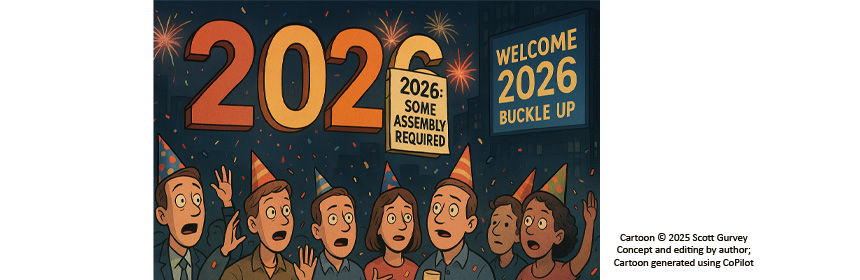
Buckle up. 2026 will be a rough ride. But we can make a difference. Some assembly will be required.

Happy New Year!

#####

The Donnie-Mander

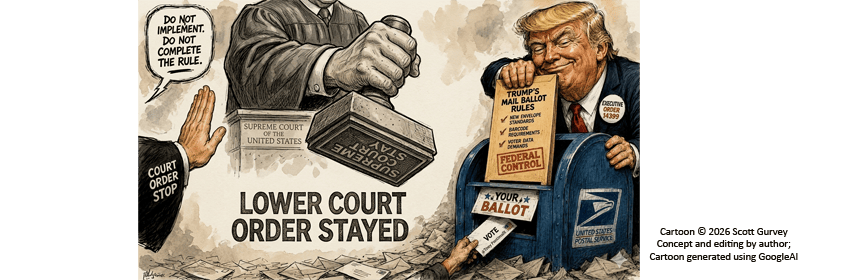
The Supreme Court, or rather the six Republican justices on the Supreme Court, have handed Donald Trump another victory. They issued a stay, blocking the order of a three-judge panel in Texas, which found the recent reapportionment of the state’s Congressional districts to be racially motivated and therefor illegal. The six, has been their pattern all year, issued their order in the dark of night on the “shadow” docket without an explanation or opinion. Greg Abbott, et al. v. League of United Latin American Citizens, et al.

The map the lower court panel blocked was seen as one of the most aggressive mid‑decade gerrymanders in recent history. The Supreme Court stay allows Texas to proceed with the new map, which analysts say could give Republicans five additional U.S. House seats in the 2026 midterms.

Gerrymandering 101

What, in a nutshell, is gerrymandering? The Encyclopedia Britannica has a wonderful explanation from which I have borrowed the graphic above. The American Constitution requires that every ten years we conduct a “census” to apportion representation in the House of Representatives. The Fourteenth Amendment, Section 2 begins, “Representatives shall be apportioned among the several States according to their respective numbers, counting the whole number of persons in each State, excluding Indians not taxed.”

Once the number of representatives is determined by the census, it is up to each state to draw the maps of legislative districts. Because the states have statewide elections for senators, governors, and to decide members of the Electoral College, there is data on how the state as a whole divides between the parties. Using the graphic above we find of a total population of fifty, thirty (60%) are orange voters while twenty (40%) are purple voters.

From that starting point, the state could draw “fair” maps which distributed the people in such a manner to generate three orange and two purple representatives, proportionate to the statewide electorate. But the state could also gerrymander, producing an outcome, using the example on the right above, of five orange and no purple representatives, or two orange and three purple representatives.

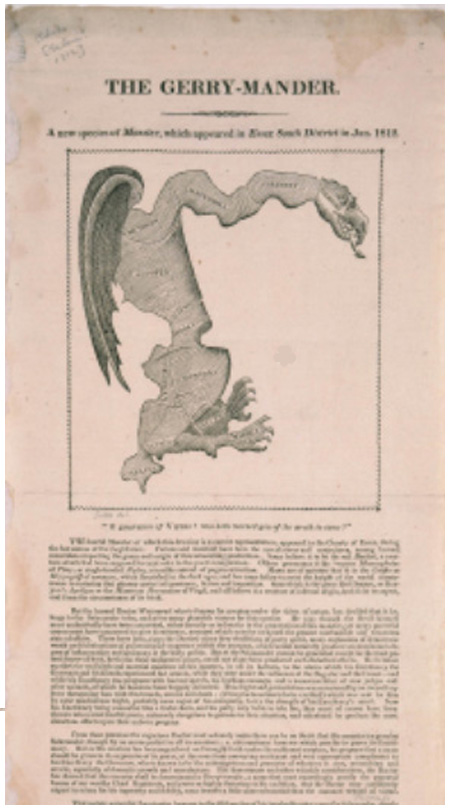
The term “gerrymander” was coined as a portmanteau of the name Elbridge Gerry and the word “salamander.” Gerry, who was the governor of Massachusetts, signed a redistricting law that redrew district lines in a way that favored his party. Critics said the new map created a weirdly shaped district which resembled a salamander. A satirical cartoon published in the Boston Gazette on March 26, 1812, popularized the word. The cartoon depicting the irregular shape helped turn a local political attack into a lasting political term.

The Donnie-Mander

The political parties have a long history of manipulating their maps to various degrees every ten years when the new census requires a reallocation of seats. But two things make this year’s manipulations unusual. First, this is a mid-census reapportionment. The last census was in 2020 with new maps taking effect in 2022 in most states. Second, this mid-census revision to the 2022 map came at the direct demand of Donald Trump. Texas’s Republican Governor Greg Abbott heeded Trump’s call and generated a new map that may add as many as five Republicans to the House in 2026. That is the map the Supreme Court now says can be put into place. With the Republican control in the House hanging on a tiny seven vote majority, Trump is clearly afraid the Democrats could gain control in the next election.

This Trump inspired Donnie-Mander, now sanctified by the Supreme Court, has set off an unprecedented arms race of mid-decade redistricting across the country. Missouri and North Carolina have passed their own Republican leaning maps. California voters approved a map designed to cancel out the Texas gains. Virginia and Maryland are working on new maps favoring Democrats. Illinois is considering one. Florida and Indiana are working on revisions on the Republican side.

National Public Radio has been keeping score on its web site. As of this writing they show a slight gain for Republicans on the basis of district voting patterns in next year’s election. Considering his atrocious polling numbers, Trump is going to need all the help he can get. The Center for Politics at the University of Virginia, one of my favorite pollsters, sees 2026 shaping up to be much too close to call.

Congress has over the years tried to set standards and take control of the redistricting process. It has never been able to pass a law to bring order out of the chaos.

The majority on the Supreme Court, by allowing these partisan mid-decade redistrictings, has created a free-for-all which is a lose-lose for the American people. But 2026 does promise to be a good show.

######

The One That Counts

Donald Trump‘s dance card is filling up. Trump has now been indicted by a third grand jury, this time for his actions following the 2020 election. Trump is accused of attempting to stop the peaceful transfer of power and deny the right of American citizens to elect their president. There has never been anything like this in the history of the United States. The outcome will determine what kind of a nation we want to be.

This is the Case that Counts

In a series of investigations, two previous indictments, two impeachments, and several civil lawsuits, Trump has been accused of crimes committed as president and after he left office. The charges range from business fraud to the illegal retention of classified material to the destruction of evidence.

Read more

The Fox Lies Channel

Here’s a shocker. The people on the Fox News Channel lie. They knowingly lie. They lie all the time. Anyone with the common sense to distinguish between fact and fiction has known this for a long time. But the facts were never so clear as they are in a recent court filing by Dominion Voting Systems.

Here are the basic facts:

  • Dominion Voting Systems is suing Fox News for $1.6 billion for spreading false claims that Dominion rigged the 2020 presidential election.
  • A new court filing shows that Fox anchors and executives privately ridiculed former President Trump’s lies about the election even while promoting them on air.
  • The filing also reveals that Fox ignored warnings from its own staff, experts, and lawyers that the claims were baseless and harmful.
  • The filing includes internal emails, text messages, and transcripts that show how Fox hosts and guests knowingly spread misinformation to boost ratings and appease Trump.
Read more

Our House is a Mess

For the first time in one hundred years, the House of Representatives could not elect a Speaker on the first ballot.

As the 118th Congress convenes, the first order of House business is the election of a new speaker — and current Republican leader Kevin McCarthy of California is being stymied by a group of GOP hardliners demanding concessions.

To win the gavel, McCarthy needs a majority of the members-elect who are present and voting. But because the GOP holds only a five-seat advantage, a small number of defections is so far stopping McCarthy from gaining the office he’s long sought. In fact, on the first two ballots McCarthy lost his caucus by nineteen votes. That grew to twenty votes on the third ballot. The Democrats were united through it all, supporting minority leader Hakeem Jeffries of New York with their 212 votes.

The House can conduct no other business until a speaker is chosen. For the first time in a century, the vote is requiring multiple rounds.

I’ve said it before, and I’ll say it again. The Republicans are too divided to govern, The Democrats are too stupid to get elected.

Updates as appropriate.

#####

GOP ∞ – Democracy 0 – Roberts 😉

The racist party scored another infinite victory in the United States Senate with all 50 Republicans voting against even discussing legislation to overhaul election law in America. Of course the Constitution says in case of a tie vote the Vice President, currently Democrat Kamala Harris, breaks the tie. But this democratic majority rules standard doesn’t apply here because this wasn’t a vote on passing into law the “For the People Act.” This was a “motion to proceed to consideration.” This little bit of nonsense, known as a cloture vote, requires a three-fifths vote. A 50-50 tie doesn’t cut it. You won’t find this “filibuster” rule in the Constitution either. It has been a tool of the racists for years.

The law would protect voting rights, end partisan gerrymandering, establish new ethics rules for federal officials, and curb big money in politics. No wonder it didn’t stand a chance. Republican senate leader Mitch McConnell called it a “power grab” by Democrats.

Read more