Category Archives: Uncategorized

US at 250

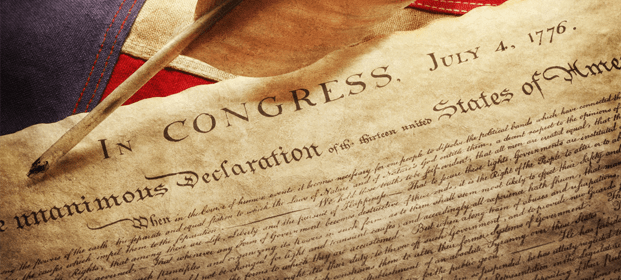
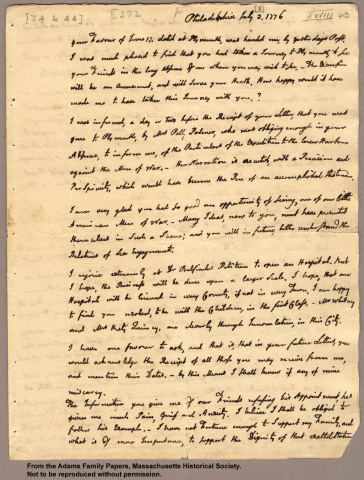
“The Second Day of July 1776, will be the most memorable Epocha, in the History of America. I am apt to believe that it will be celebrated, by succeeding Generations, as the great anniversary Festival. It ought to be commemorated, as the Day of Deliverance by solemn Acts of Devotion to God Almighty. It ought to be solemnized with Pomp and Parade, with Shews, Games, Sports, Guns, Bells, Bonfires and Illuminations from one End of this Continent to the other from this Time forward forever more.”

John Adams, Letter to Abigail Adams, July 3, 1776

John Adams, by far the most prescient of the founders, described Independence Day in this letter sent to his wife Abigail on July 3rd, 1776. He got most of it right.

Adams predicted that the anniversary of American independence would be celebrated forever. He expected July 2 to become Independence Day because that was the day Congress approved Virginia’s resolution that the thirteen colonies declare their independence from England. Instead, we celebrate July 4, the date on which the text of the Declaration of Independence was approved and eventually printed with that date. But his description, parades, bells, fireworks (“illuminations”), bonfires, sports, and public celebrations, closely resembles how we celebrate the Fourth of July today.

Adams foresaw the growth of the United States of America to span the continent from west coast to east. And his letter to Abigail captures his confidence that the new nation would endure as a great nation among those of the world.

I often wonder, in this age of divisiveness, if we have fulfilled Adams’s dreams. The United States is unquestionably the world leader in many respects. It has the world’s biggest economy. It has grown dramatically in population. It has expanded to stretch from one ocean to the next. It claims to have the most powerful military, although it doesn’t seem to be able to keep a strait essential to the world’s energy supply open. It certainly outspends the next dozen or so countries on that military. Adams foresaw those things and I think on those points the United States today would please him.

But he would be less pleased to discover that his biggest fears have also come to pass. He wrote of the dangers facing the new republic. His biggest fear came not from without, but from within. He warned that avarice could produce leaders who put personal gain over the needs of the people. He predicted that under certain circumstances, factions succumbing to greed for power and money could infect multiple branches of government and defeat the system of checks and balances the framers wrote into the Constitution in 1787. I do not believe he would be pleased with the current state of affairs in Washington.

The Declaration was always a contradiction. It famously contains what the great biographer Walter Isaacson calls, “The Greatest Sentence Ever Written.” Yet the author of, ““We hold these truths to be self-evident, that all men are created equal, that they are endowed by their Creator with certain unalienable Rights, that among these are Life, Liberty, and the pursuit of Happiness,” Thomas Jefferson, was a slaveholder throughout his entire life, as were many of the Revolutionary era leaders.

Jefferson listed slavery as one of the evils brought to the new world by the King of England. But that sentence was removed from the Declaration during the final debate. Jefferson later wrote it was the price for gaining the acquiesce of South Carolina and Georgia to the independence resolution.

Slavery wasn’t abolished until the 13th Amendment was ratified in 1865, after the Civil War. Voting rights for women didn’t arrive until the 20th century, with ratification of the 19th Amendment in 1920.

Many people believe the nation should work toward unity, the assimilation of the various immigrant groups which have arrived on our shores in waves over the years. This is what I call the “great melting pot” strategy. This may be the answer in other countries, where the population is homogeneous and it is easy to be loyal to a race or a land. The United States has never been that. Unless you can trace your lineage to the indigenous people, and only about two per cent of the population can, then you trace your roots to someplace else. We expect immigrants to be loyal to the country, and history proves they are. Yet we retain as important parts of our identity those aspects of heritage which our ancestors brought to these shores.

There is no question that this diversity, a word the present administration sees as obscene, adds to our divisions. But history proves it is also a source of great strength. We should embrace the diversity of our people. We should strive toward tolerance and understanding of fellow Americans who have stories which are different than our own. Our diversity makes it clear that the people who are Americans choose to be Americans. I see in the continuing clamor of people from all over the world to immigrant to the United States evidence that we are doing something right.

For me the obvious contradiction between the words of the Declaration and reality is resolved by viewing the Declaration we celebrate today as aspirational, rather than literal. The document was a statement of profound principles and ideals, rather than a word-for-word reflection of 1776 reality. It remains so to this day as we strive to, in the words of the great preamble to the Constitution, “form a more perfect union.” For me, that gives hope that we can come closer to our goals. Someday.

“You will think me transported with Enthusiasm but I am not.—I am well aware of the Toil and Blood and Treasure, that it will cost Us to maintain this Declaration, and support and defend these States.—Yet through all the Gloom I can see the Rays of ravishing Light and Glory. I can see that the End is more than worth all the Means. And that Posterity will tryumph in that Days Transaction, even altho We should rue it, which I trust in God We shall not.”

John Adams. 1776

Do we see on the occasion of our 250th birthday John’s rays of ravishing light and glory?

Do we agree with Adams, that the end is more than worth all the trials and tribulations, the blood and the treasure? That the end is more than worth all the means?

It’s up to us now. And to the generations to come.

Happy Birthday America.

####

Poof! It’s Gone. Maybe.

We think Donald Trump‘s name has been removed from the John F. Kennedy Center for the Performing Arts. At least, that what Trump’s handpicked board of directors told the District Court for the District of Columbia in a filing on Saturday. The removal had been ordered by the court two weeks earlier in a decision enforcing the Center’s original statutory name.

Trump’s name was added in December 2025 after he replaced the Kennedy Center’s leadership and the new board voted to rename the institution. The court found this action illegal, ruling that the board cannot unilaterally change the name of a national memorial.

In his 94-page decision, U.S. District Judge Christopher Cooper wrote, “The Kennedy Center’s organic statute makes crystal clear that the Center is to be named for President Kennedy, and it cannot bear any other formal name or public memorial based on the Board’s unilateral say-so. Congress gave the Kennedy Center its name, and only Congress can change it.”

The renaming triggered a large outcry and a boycott of the Center by patrons, performers, and donors. A crowd of several hundred people gathered on Saturday at the Center to witness the removal of Trump’s name from the exterior. Which brings us to my use of the word “maybe.”

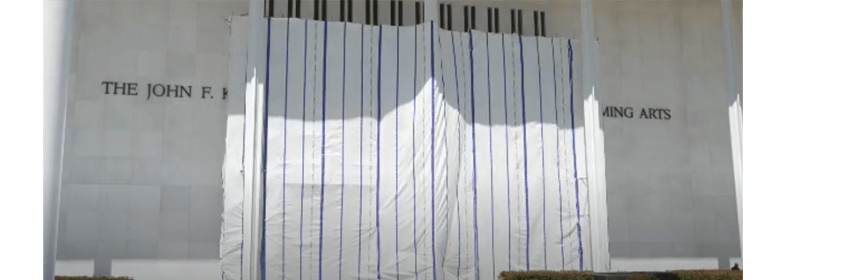
While the Trump lettering was put up by workers on simple lifts, workers Saturday first erected an expansive scaffold in front of the lettering. Then they draped a large curtain or tarp to prevent people from watching their work. Several web cams had been pointed on the sign, transmitting the image around the world. The curtain remains up on Sunday morning. We have only the sworn statement of Trump’s board of directors that the name has been removed.

Why is the curtain still up? Perhaps Trump just couldn’t stand to see the empty space his name once filled. And didn’t want to watch his name coming down.

This is not the end of the lawsuit, which had been brought by Rep. Joyce Beatty (D-Ohio), an ex officio trustee who sued her fellow trustees for adding Trump’s name to the title of the Kennedy Center. Hours before Friday’s deadline, two courts denied the Kennedy Center’s last-ditch attempt to delay the removal, even as crews erected scaffolding next to the building.

Judge Cooper ruled at 1 p.m. that the Kennedy Center’s lawyers failed to demonstrate they were likely to win their appeal or that the center would suffer “irreparable harm” if Trump’s name were removed. At 3:46 p.m., Justice Department lawyers representing the center appealed Cooper’s denial, filing an emergency motion for a stay with the Court of Appeals for the D.C. Circuit. Shortly after 7 p.m., the appeals court denied the second attempt. But the appeal will continue.

The addition of Trump’s name sparked immediate backlash from the arts community and members of the Kennedy family, who argued that the renaming desecrated a living memorial to the assassinated president. Congress established the center in 1964, two months after Kennedy’s death, designating it “the sole national monument to his memory within the city of Washington and its environs.”

Trump’s Department of Justice, paid for by taxpayers, represents him in these cases.

Last week the Center was also sued by the Washington National Opera. The WNO performed in the Center for fifty years but decamped when Trump took over. The opera claims the Center is refusing to return more than $17 million dollars of endowment contributions, gifts and donations which it managed on behalf of the WNO.

June 16 Update

Official word from The Kennedy Center is that the tarps will stay up for the “two-year renovation” and “replacement” of the marble facade slabs. Trumpian subtext, “OK, my name may be removed, but I’m not going to let you see it!!!! Na Na Na Na-Na.” And make no mistake about it, Trump is still the Chairman of The Kennedy Center, and his “Board” are 100% partisan sycophants.  The Kennedy Center is still in mortal danger.

####

Inflation!

Grocery prices

Go ahead. Tell me the higher prices we see staring back at us every day at the grocery store and the gas pump are just a temporary thing. I dare you.

The latest inflation report shows that price pressures heated up again in May, with the Consumer Price Index rising 0.5% month‑over‑month and 4.2% year‑over‑year, the highest annual rate since April 2023. That 4.2% figure matched economists’ expectations, but it still marks a clear acceleration from April’s 3.8% pace. The monthly increase was driven heavily by energy costs, which jumped 3.9% in May and are up 23.5% over the past year, reflecting the ongoing impact of the Iran conflict on global oil markets. Gasoline alone surged 7% in May and more than 40% compared with a year ago, accounting for the majority of the overall CPI increase.

Core inflation—which excludes food and energy—remained more subdued. Core CPI rose 0.2% for the month and 2.9% year‑over‑year, both in line with forecasts and cooler than April’s monthly reading. That suggests underlying inflation pressures are not spiraling, even as headline inflation is being pushed higher by energy. Some categories even showed mild relief: core commodities slipped 0.1%, and food prices rose only 0.2% on the month, though they remain 3.1% higher than a year ago. Still, essentials like electricity and medical care continue to climb at rates above 3%, contributing to the financial strain many households feel.

The report lands at a delicate moment for the Federal Reserve. Markets widely expect the Fed to hold rates steady at its June 17 meeting, but policymakers will be parsing this data closely for signs of persistent inflation. With headline inflation back above 4% and energy‑driven pressures unlikely to ease immediately, the Fed faces a tricky balance: acknowledge the progress in core inflation without ignoring the renewed squeeze on consumers. For households, the picture is similarly mixed—some categories are stabilizing, but the basics of daily life remain noticeably more expensive than a year ago.

The new Fed Chair, Kevin Warsh, faces a sharp collision between immense political pressure to cut interest rates and May’s hot inflation report that makes a rate reduction nearly impossible. The European Central Bank just raised rates, saying the risk of inflation caused by the shock rising energy prices must be countered.

Add to that the report on Producer Prices for May. The PPI captures inflation at the wholesale level—before costs reach consumers. PPI rose 1.1% month‑over‑month, matching the prior month but exceeding expectations of 0.7%. It rose 6.5% year‑over‑year, slightly above the 6.4% consensus and up from 5.7% previously.

Combined with rising unemployment claims, in spite of the positive employment numbers for May, these reports point to a cooling labor market but persistent inflation. That is the Federal Reserve’s nightmare.

As for Donald Trump, across multiple on‑camera exchanges, Trump responded to questions about inflation by saying:

“You know what I really love? I love the inflation.”

“The numbers were great… I love the inflation.”

Donald Trump, International Business Times UK

He later told the New York Post that he meant he “loved” that inflation wasn’t even higher, arguing his comments were taken out of context. He said the inflation spike is a temporary consequence of the U.S.-Iran war, and insisted inflation will “come down like a rock” once the war in Iran ends.

Two notes. The consensus among economists is that even if the war were to end today, it will take months if not a year for prices to recover. And also, Trump has repeatedly predicted an end to the war he started more than 100-days ago. CNN has put together a devastating video montage.

We shall see.

####

Economic Conundrum

The May Employment Situation Report released by the Bureau of Labor Statistics (BLS) handily beat expectations, with the U.S. economy adding 172,000 nonfarm payroll jobs. Economists had forecasted a much more modest gain of roughly 80,000 to 85,000 jobs, making this a significant upside surprise.

Read more

Funerals at CBS

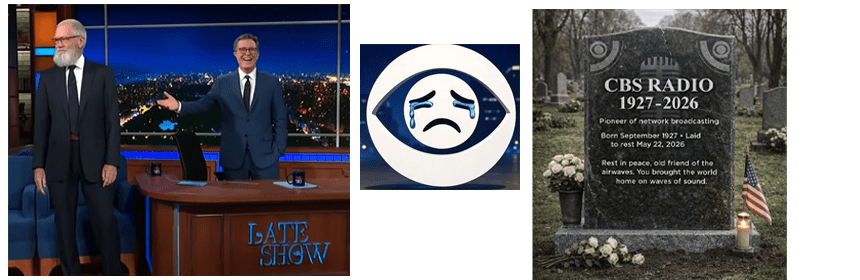
There are two funerals on tap this week at CBS, Inc., the company where I spent the first decade of my professional career. When I joined it in 1974, it had recently changed its name from the Columbia Broadcasting System to better reflect its position as a major media company, not just a broadcaster. Its four core lines of business were Broadcasting (TV and radio), Records (music), Publishing (books and magazines), and Musical Instruments/Toys.

Read more

R.I.P. V.R.A.

John Roberts, Chief Justice of the United States, has achieved his life goal. With the Court’s ruling in Louisiana v. Callais, he has killed the Voting Rights Act. Roberts made the destruction of the VRA of 1965 his lifelong crusade. His opposition to the Act dates back to his days as a law clerk for then Associate Justice William Rehnquist. Rehnquist notoriously wrote a memo in 1952 stating, “I think Plessy v. Ferguson was right and should be re-affirmed.” Plessy was the infamous “separate but equal” case institutionalizing racism in public schools. It was overturned by Brown v. Board of Education in 1954.

Read more

Hot Off the Griddle

He’s in the groove. Donald Trump finally has his production line going and he’s serving up indictments like he’s working the griddle at the local fast-food joint.

On October 9, a federal grand jury in the Eastern District of Virginia indicted New York Attorney General Letitia James on charges of bank fraud and making false statements to a financial institution. The charges relate to allegations involving a mortgage loan. James is the second name on Trump’s revenge list. The same judicial district run by the same US Attorney indicted former FBI director James Comey last week. Just like the Comey case, the James indictment came over opposition from career prosecutors.

Read more
« Older Entries