That Damn Debt
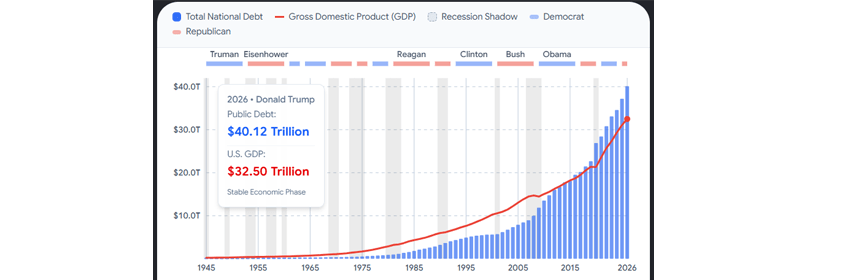
The official U.S. total public debt outstanding breached $40 trillion for the first time in history. It stands at $40,047,426,000,000 according to data released by the U.S. Department of the Treasury. It has increased by about three trillion dollars since January 20, 2025, when the current administration took office.
Considering how much he likes to brag about setting records you’d think Donnie Trump would be in front of the cameras proclaiming, “Biggest debt in history! No one has ever seen a debt as big as this. America is first! We’re winning.”
Instead, fearless leader is attending auto races and showing off his new helipad, $5 million dollars’ worth of big, ugly, granite adorned with his name and sitting on the White House lawn. Something else a future president will have to remove.
Trump left it to Treasury Secretary Scott Bessent to downplay the event, blame the record debt on Joe Biden, and insist the economy will “grow” out of it. The problem with that is obvious. The economy is growing at a rate of about 2%. The debt is growing at the rate of about 6%. As they say, the math ain’t mathin’.
To be fair, as the graph above makes clear, the debt has been growing steadily for decades under both Republican and Democratic administrations. Some of that is growth. Some of that is inflation. The key to watch is not the total debt amount but the ratio of debt to the nation’s total economic output, the GDP. The debt-to-GDP ratio compares a country’s total government debt to its gross domestic product (GDP). It shows a country’s ability to pay back its debts. The U.S. debt-to-GDP ratio is now roughly 124% to 125%.
Trump has stated dozens of times across his campaigns and presidencies that he would control, reduce, or completely eliminate the national debt and federal deficit, famously vowing during his 2016 campaign to wipe out the entire national debt within eight years. Despite these promises, Trump legislative actions, such as the 2017 and 2025 tax cuts, caused substantial increases in annual budget deficits and the overall national debt.

As this graph shows, there is a pattern which began in the Reagan years. The Republicans cut taxes without cutting spending. That increases the annual budget deficit and accelerates increases in the debt. Democrats take control and reduce the deficit, only to have the Republicans repeat the trend the next time they get in control. (By the way, I had AI assistance in doing the actual drawing, but I am responsible for finding the numbers and designing both graphs. The numbers come from the Federal Reserve and the Department of Commerce.).
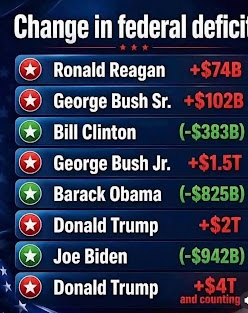
While Republicans like to blame Democrats for the debt, the facts don’t bear that out.
This graphic summarizes the changes in the total debt going all the way back to the Reagan administration. It was then that I first heard the term “trickle-down economics.” The idea was that if you cut taxes for the top backets, they will spend more money, and the effects will pass down to the people in lower brackets. It sounded good to me at the time. But the evidence since has shown it doesn’t work. Nothing trickles. The rich just get richer and the gap between the rich and the rest of us grows larger.
To finance the debt the government borrows money., It does that by issuing securities, Treasury Notes and Bonds. The interest rate it pays is the “cost” of borrowing. More borrowing, more securities. To convince investors to keep buying trillions of dollars in new debt, the U.S. government must offer competitive interest rates. The 10-year treasury yield is currently about 4.7%. The bond market is struggling to meet the demand.
Bessent is doubling long-term government bond buybacks to curb rising rates and inject liquidity into the debt market. On August 19, 2026, the Treasury Department shocked Wall Street by announcing it will increase its buyback operations for 10-year to 30-year bonds to at least $4 billion per operation, up from the previous $2 billion cap. Bessent is executing a strategy he calls a “Treasury Twist“. By purchasing less-liquid, older (“off-the-run”) long-term bonds, the Treasury removes overall duration from the market. To fund these purchases, the Treasury issues short-term bills. This shifts supply to parts of the yield curve better equipped to absorb it. Critics argue that the sudden, unscheduled policy shift disrupts the Treasury’s traditional framework of being regular and predictable, causing further investor anxiety.
Bessent’s action is like putting a Band-Aid on a wound that needs a torniquet. He has joined Trump in an alternate reality. The market isn’t buying it.
When the government borrows hundreds of billions each month, it competes directly with private borrowers for capital. The massive government demand can push up overall interest rates across the entire economy. This means Americans end up paying significantly more for mortgages, auto loans, credit cards, and business loans.
And just like a household credit card, a larger balance means a larger monthly minimum payment. Net interest payments are quickly becoming one of the largest single components of the federal budget. Every dollar spent on interest is a dollar that cannot be spent on infrastructure, national defense, scientific research, tax cuts, or programs like Social Security and Medicare.
If investors eventually begin to worry that the U.S. will never be able to pay back its debt through normal revenues (taxes), they may fear that the government will simply print more money to cover the gap. Flooding the global economy with dollars to inflate away the debt devalues the currency. For us everyday Americans, this manifests as persistent, long-term inflation, reducing the purchasing power of our hard-earned savings and wages.
Time for Donnie and Bessent to play another round of golf.
#####

