John Roberts is annoyed. I had picked a stronger word, but Merriam-Webster says my word is considered vulgar in both Britian and the United States, so I chickened out.
Please take note. When the Chief Justice of the United States is annoyed he clearly expects us all to pay heed. I spent all of three seconds taking heed. And then began laughing uncontrollably.
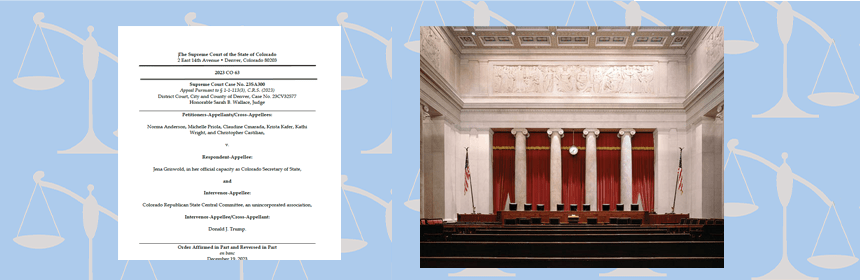
One thing is clear about this year’s election for president. The Supreme Court intends to cast its vote. The Court, driven by the conservative majority, rushed to hand Donald Trump a victory the day before Super Tuesday, the day fifteen states, including Colorado, hold primary elections. It even went as far as to announce on a Sunday that it would be handing down a ruling the next day. And it leaked the subject so loudly every story that night predicted it would be a decision in Trump v. Anderson.
In Trump v. Anderson, all nine justices agreed that states lack the power to enforce Section 3 of the 14th Amendment against presidential candidates. All nine justices ruled in favor of Trump on this question. I’d like to pat myself on the back here because I predicted this outcome not long ago. I’d like to, but I won’t, because nearly every other court watcher made the same prediction.
(L-R) Dr. Claudine Gay, President of Harvard University, Liz Magill, President of University of Pennsylvania, Dr. Pamela Nadell, Professor of History and Jewish Studies at American University, and Dr. Sally Kornbluth, President of Massachusetts Institute of Technology, testify before the House Education and Workforce Committee at the Rayburn House Office Building on December 05, 2023, in Washington, DC. The Committee held a hearing to investigate antisemitism on college campuses.
Let me give you a piece of advice. If someone asks you if calling for the genocide of the Jewish people violates the standards of your organization, the answer is “Yes!” Do not equivocate. Do not hesitate. Do not turn to your lawyer and ask for a legal brief balancing the right of free expression against the fighting words involved in a call for the violent elimination of a race of people. Just say, “Yes!”
Following its tradition of recent years, the Supreme Court of the United States spent the last few weeks of June releasing its most controversial decisions of the term. It then adjourned for its usual three-month vacation. This is the last of a series of posts analyzing those decisions.
As is their habit, the reporters who cover the Supreme Court of the United States wrote summarizing the court’s decisions for the term that ended in of June. Some surprised me in concluding that this term was less traumatic than the last. Those of that view concluded that the Court was mindful of the decline in public respect for the institution that followed the 2022 decision, Dobbs v. Jackson Women’s Health, overturning the fifty-year-old precedent holding that women had the right to control matters of their own reproductive health.
It is true, the decisions of the term just ended avoided the use of the term “overruled” the conservative supermajority applied with such glee in Dobbs. But I see little to cheer in their recent work. They have continued to erode at rights Americans have taken for granted. And they do with without regard for precedent, without deference to the elected branches, and without consideration for the principle that their jurisprudence be as limited as possible. Instead, they have set themselves up as the most powerful branch of government, the final arbiters of the most fundamental elements of our social intercourse. We have entered the age of SCOTUS uber alles.
Following its tradition of recent years, the Supreme Court of the United States spent the last few weeks of June releasing its most controversial decisions of the term. It then adjourned for its usual three-month vacation. This is part of a series of posts analyzing those decisions.
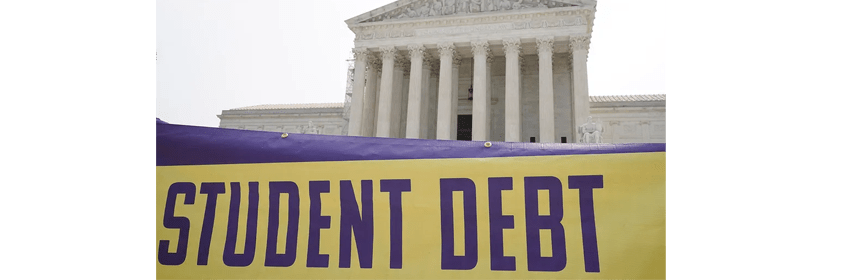
On the last day of the term the Supreme Court ruled 6-3 in Biden v. Nebraska that the Biden administration’s student loan forgiveness plan was unconstitutional. The plan, which would have forgiven up to $20,000 in student debt for borrowers with incomes below $125,000, was based on the Higher Education Relief Opportunities for Students Act (HEROES Act), a 2003 law that allows the government to provide relief to recipients of student loans during a national emergency.
Following its tradition of recent years, the Supreme Court of the United States spent the last few weeks of June releasing its most controversial decisions of the term. It then adjourned for its usual three-month vacation. This is part of a series of posts analyzing those decisions.
The Supreme Court’s conservative supermajority did not end its assault on precedent with its new rules on abortion last term and affirmative action in the term just ended. In the eight years since the court ruled in Obergefell v. Hodgesthat the right to marry is a fundamental right guaranteed to same-sex couples by both the Due Process Clause and the Equal Protection Clause of the Fourteenth Amendment the surviving dissenters in that case, Justices Samuel Alito, Clarence Thomas, and Chief Justice John Roberts have been plotting revenge. Thomas, in his concurrence to last year’s Dobbs v. Jackson Women’s Health opinion stripping American women of their reproductive rights explicitly invited a fresh challenge to Obergefell.
Following its tradition of recent years, the Supreme Court of the United States spent the last few weeks of June releasing its most controversial decisions of the term. It then adjourned for its usual three-month vacation. This is the first of a series of posts analyzing those decisions.
Continuing its steady march back to the 19th Century, the conservative supermajority on the Supreme Court has effectively ended affirmative action on the basis of race in college admissions, a policy used for more than 40 years to make campuses more diverse. The two schools at the center of this decision, Harvard, America’s oldest private university, and the University of North Carolina, the oldest public one, had programs considered the gold standard in affirmative action plans.




 Scott Gurvey's Public Offerings