I heard him long before I met him. I remember sitting in the cafeteria CBS had set up in the basement of New York’s Madison Square Garden to feed the hundreds of staff members it had brought to the 1976 Democratic National Convention. Believe it or not, in those days the political conventions meant something and, in part because of legal requirements, they were extensively covered by broadcasters.
Just two years out of journalism school, I had been sent by my employer, WBBM-TV, the CBS owned station in my hometown Chicago, to manage our coverage. Along with me was a terrific video crew and a wonderful reporter who needed no supervision and little assistance, and an anchorman who definitely needed both. Those are stories for another day. Today, I just want to talk about the voice.
I still remember the first time I heard the music of P.D.Q. Bach. On the program at New York’s Town Hall were the Echo Sonata for Two Unfriendly Groups of Instruments and the Schleptet in E♭ major. I was immediately hooked.
Each piece was introduced by Professor Peter Schickele of the Music Pathology Department, University of Southern North Dakota at Hoople. Schickele claimed to have discovered the work of P.D.Q, who he described as the 21st and least of the children of the great baroque composer Johann Sebastian Bach. Here is where things get a little dicey. J.S. Bach was certainly prolific. But he stopped at 20 children. And while there is a Hoople in North Dakota, there is no university there. I should have noted that the program listed P.D.Q.’s dates as “(1807–1742)?“
This is nuts. That’s all I could think as I listened to D. John Sauer, an attorney for Donald Trump, with Trump sitting in the front row of the courtroom, tell a panel of the United States Court of Appeals for the District of Columbia that it should overturn a decision of the district court and dismiss the federal indictment against Trump for crimes connected to the January 6, 2020, mob assault on Congress.
To recap, on August 1, 2023, Special Counsel Jack Smith charged Trump with four federal criminal counts after a grand jury investigation into Trump’s attempt to overturn the 2020 election, culminating in the January 6th insurrection. In October 2023, Trump claimed in the case that he had absolute immunity from prosecution for actions he took as president but Judge Tanya S. Chutkan, the trial judge in the case, rejected (opinion here) Trump’s claim, finding that “neither the Constitution nor American history supported the contention that a former president enjoyed total immunity from prosecution.” Trump appealed the ruling.
When we last visited the Clown Show, in January of 2023, we were talking about the farce the Republicans put on trying to elect a Speaker of the House of Representatives. Kevin McCarthy of California finally won the post on a historic fifteenth ballot. But power really lay with roughly fifteen right-win radical Republicans, who battled McCarthy relentlessly.
I took a break from this subject as the GOP stumbled though one of the least productive House sessions on record. Now it’s time to catch up.
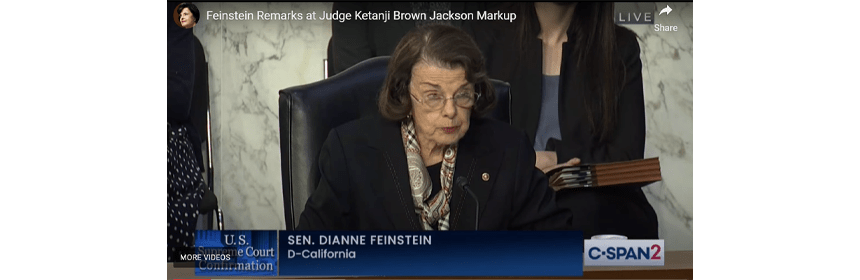
Dianne Feinstein, senior Senator from California, passed away over the weekend at the age of ninety. The last year was not easy for Senator Feinstein. Frail and ailing, she spent several months at her home in San Francisco. When she finally returned to the Senate, she was wheelchair bound and appeared at time to be unsure of her surroundings. It was not a fitting end and many, including me, wondered if the rules of Congress are such that they force infirm representatives to remain on the job after they were no longer able to do the job.
It was my last year of grade school, and I faced all the usual crises. My family was about to move about five miles closer to the center of the city because my parents wanted me to attend a different high school than the one serving our current neighborhood. I was about to lose most of my grade school friends because only two others were switching to the same high school. And for some reason the girls, who I had recently become interested in, were not so much interested in our current hero, The Man from U.N.C.L.E., Napoleon Solo, played by Robert Vaughn. They had eyes only for the blood sidekick Illya Kuryakin, played by David McCallum.
McCallum died yesterday in New York City at the age of ninety.
On Sunday September 24, 2023, just before noon eastern time, a sample capsule containing about one pound of the asteroid Bennu should arrive in Utah. Go ahead. Back up. Read it again. Amidst all the angst of our everyday lives, which is the usual subject of this column, we have a wonder like that to contemplate.
The capsule will have come from the OSIRIS-REx spacecraft. OSIRIS-REx was launched on September 8, 2016, flew past Earth on September 22, 2017, and rendezvoused with Bennu on December 3, 2018. It spent the next two years analyzing the surface to find a suitable site for landing.
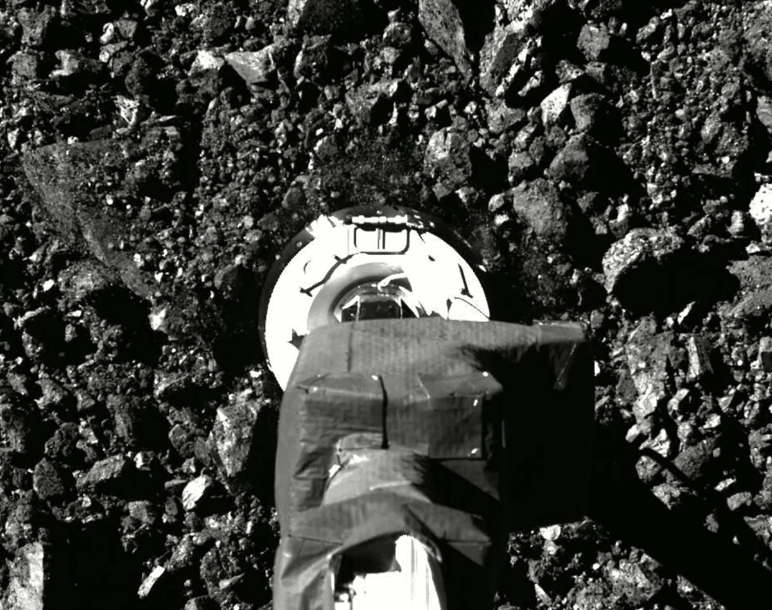
On October 20, 2020, OSIRIS-REx touched down on Bennu and successfully collected a sample. Though some of the sample escaped when the flap that should have closed the sampler head was jammed open by larger rocks, NASA is confident that they were able to retain between 400 g and over 1 kg of sample material, more than the 60 g (2.1 oz) minimum for success.
The sample capsule will be released when the spacecraft reaches an altitude of 63,000 miles above the Earth’s surface. The capsule will then be sent spinning towards the atmosphere below and will pierce Earth’s atmosphere at 10:42 a.m. EDT, coming to rest near a military base in the Utah desert. A recovery team will board four helicopters and head out into the desert to retrieve the capsule as quickly as possible to avoid contaminating the sample with Earth’s environment. Once located and packaged for travel, the capsule will be flown via helicopter to a temporary clean room on the military range, where it will undergo initial processing and disassembly in preparation for its journey by aircraft to NASA’s Johnson Space Center in Houston, where the sample will be documented and distributed for analysis to scientists worldwide.
There have been previous missions that have returned samples from outer space to Earth. Between 1969 and 1971, the Apollo program carried out six missions to the surface of the moon. The astronauts brought back a total of 842 pounds of lunar rocks, core samples, pebbles, sand, and dust from the lunar surface.
NASA’s Stardust mission, launched in 1999, flew past the comet Wild 2, collecting thousands of dust particles from the comet’s coma and returning them to Earth for laboratory analysis. Japan’s Hayabusa, launched in 2003, successfully returned samples from the asteroid 25143 Itokawa in 2010. Japan’s Hayabusa 2 returned samples from asteroid 162173 Ryugu in 2020.
If successful, OSIRIS-REx will be the first United States spacecraft to return samples from an asteroid.
All these missions have significantly contributed to our understanding of asteroids and the early solar system. The samples returned by these missions provide valuable insights into the composition, structure, and history of asteroids, as well as clues about the formation of our solar system and the origins of life on Earth.
Bennu was chosen as the target of this study because it is a “time capsule” from the birth of the Solar System. Bennu has a very dark surface and is classified as a B-type asteroid, a sub-type of the carbonaceous C-type asteroids. Such asteroids are considered primitive, having undergone little geological change from their time of formation. In particular, Bennu was selected because of the availability of pristine carbonaceous material, a key element in organic molecules necessary for life as well as representative of matter from before the formation of Earth. Organic molecules, such as amino acids, have previously been found in meteorite and comet samples, indicating that some ingredients necessary for life can be naturally synthesized in outer space.
Which doesn’t mean we will find a place we can relocate to in our neighborhood any time soon.





 Scott Gurvey's Public Offerings