It’s Still the Economy, Stupid

One thing the political polls agree on is the number one concern on the minds of voters. It’s the economy. It is ALWAYS the economy.
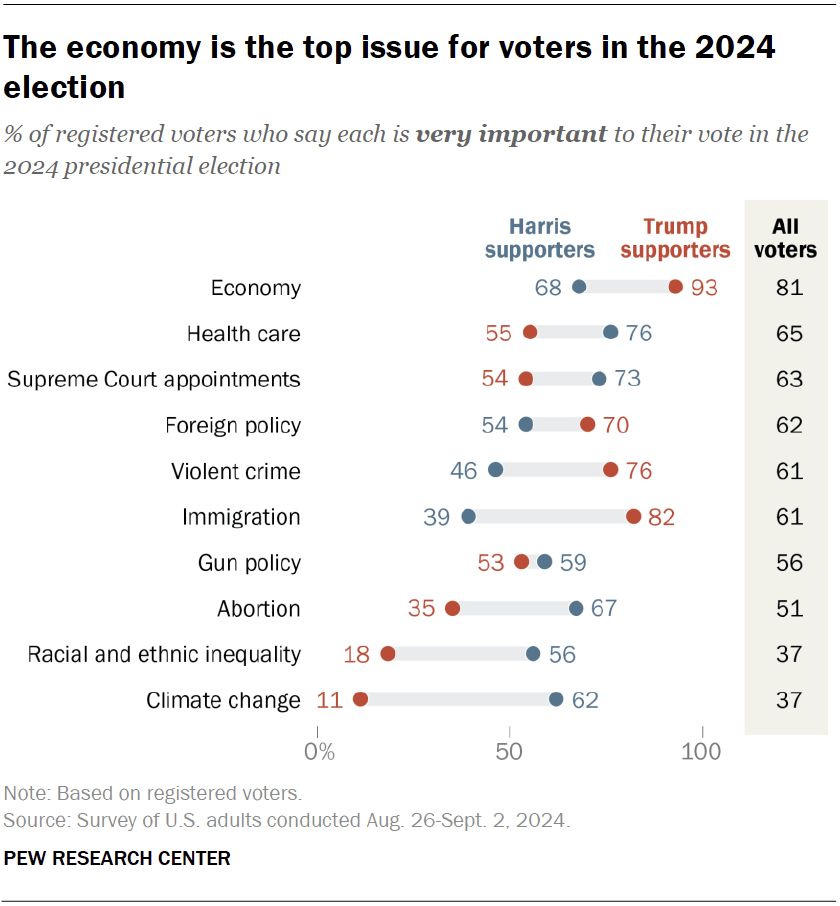
The problem, at least for Vice President Harris, is that what voters call the economy is not what economists call the economy. What voters mean when they say economy is prices as in, the price of a gallon of gasoline, the price of a bottle of milk, the price of a dozen eggs. Those prices are up. And as is usual, the incumbent gets the blame.
Here are the facts. There is no question that prices are up since Trump left office. Prices almost ALWAYS go up. The Federal Reserve, which is charged with keeping the rate of price increases, called inflation, moderate, sets a goal of two percent inflation per year. The is just about where we are as election day approaches.
Even as inflation has been slowing during his bid to get reelected, former President Donald Trump has been hammering Democrats on the issue. And Trump has continued to tout the economy during his own tenure as president. He called the pre-COVID economy “the best our country would ever do.”
While inflation did hit a four-decade high in 2022, by a wide variety of measures, job growth, wages even adjusting for inflation, and the pace at which entrepreneurs start small businesses, the post-pandemic economy beats the pre-COVID economy handily. Some prices did fall during the Covid crisis because the crisis caused a two-month long recession, from February to April 2020. Despite its brief duration, it was one of the deepest recessions, with significant drops in GDP and a sharp rise in unemployment.
So that’s the Trump solution for cutting inflation. Just trigger a recession and throw millions of people out of work. I am not blaming Trump for Covid. But comparisons have shown that the Trump administration’s delayed response to Covid cost the United States twice as many lives and twice as many dollars per capita as other industrialized nations. The Trump campaign does not talk about that.
If you look carefully at the numbers, the Trump campaign’s blame game does not hold up.
Jobs
The number of workers on private sector and government payrolls, as compiled by the Labor Department, grew by 225,522 on average from October 2022 through July 2023. In the pre-pandemic era, from February 2017 through February 2020, average monthly job growth was 180,351. The number of employed Americans returned to its pre-pandemic level in September 2022.
Who Is Working?
Not only has the number of jobs created monthly been higher, but a key measure of who is working has also improved since the pandemic. The so-called “prime age” employment to population ratio, the proportion of workers between 25 and 54 with jobs, has hit 80.9% twice since the pandemic, most recently in July. Under Trump, it peaked at 80.6% in January 2020. The last time the measure was higher than July’s reading was in March 2001. Focusing on the 25 to 54 age range gets rid of distortions due to phase-of-life discrepancies, like college attendance or retirement.
Earnings
On wages, median weekly earnings are higher than before the pandemic, even after adjusting for inflation. According to the Labor Department, after earnings (measured in 1983 dollars) bounced up during the pandemic because lower-wage workers were more likely to be sent home, median real earnings dipped and then peaked post-pandemic at $371 in the fourth quarter of 2023. Before the pandemic, in the first quarter of 2020, the measure peaked at $367. In the most recent reading in the second quarter of 2024, it was slightly higher, at $368. It’s true prices have gone up, but people’s incomes have gone up more.
More Small Businesses
One indirect measure of optimism has been consistently higher under Biden-Harris than Trump. That’s people’s willingness to start new small businesses. As measured by the U.S. Census Bureau, monthly small business formation under Trump before the pandemic peaked in December 2019, with 314,337 new business applications.
But formation of small businesses has remained well above the pre-pandemic peak, even after September 2022, when overall employment was back to its pre-COVID level. Small business formation peaked at 475,689 new business applications under Biden in July 2023, and in July of this year, it was still at 420,802. Forty-nine of the 50 states today have more businesses than at any time under Trump.
In sum, the American economy is doing well, the post-Covid recovery has been better than most countries, and it is the envy of the world.
A Failure to Communicate
Still, the New York Times/Siena Poll of likely voters released on October 8 reported 75% of respondents said the economy was fair or poor. A study by The Guardian showed that Kamala Harris’s specific economic policies are more popular than Trump’s in a blind test, but 54% of respondents to a Gallup poll released on October 9, thought that Trump would manage the economy better than Harris would. The Harris campaign has not been able to communicate the economic facts effectively. And both our teachers and news media have failed miserably to educate the voters.
Looking Forward
Harris has promised to continue the economic policies of the Biden-Harris administration and focus on cutting costs for families. She has called for a federal law against price gouging on groceries during times of crisis, cutting taxes for families, and enabling Medicare to pay for home health aides. She has proposed $25,000 in down payment assistance for first-time homebuyers and promised to work with the private sector to build 3 million new housing units by the end of her first term.
The Committee for a Responsible Federal Budget, which focuses on the direct effect of policies on the federal debt, estimated that Harris’s plans would add $3.5 trillion to the debt.
Trump has promised to extend his 2017 tax cuts for the wealthy and corporations and to impose a 10% to 20% tariff across the board on imported goods and a 60% tariff on goods from China. Trump insists that the foreign countries pay the tariffs. He is either lying or simply wrong.
Tariffs are taxes paid by American consumers, and economists predict such tariffs would cost an average family more than $2,600 a year. Overall, the effect of these policies would be to shift the weight of taxation even further toward middle-class and lower-class Americans and away from the wealthy.
The Committee for a Responsible Federal Budget estimates that Trump’s plans would add $7.5 trillion to the debt.
Furthermore, Trump promises to deport millions of immigrants. In March, the Peterson Institute for International Economics said the immigrants Trump is targeting are vital to U.S. businesses. The study says Trump’s deportations, tariffs, and vow to take control of the Federal Reserve could make the America’s gross domestic product as much as 9.7% lower than it would be without those policies, employment could fall by as much as 9%, and inflation would climb by as much as 7.4%
The choice, at least on the issue of the economy, should be a no-brainer.
#####
 Scott Gurvey's Public Offerings
Well and thoroughly said 🧐
LikeLike