The Supremes Vote
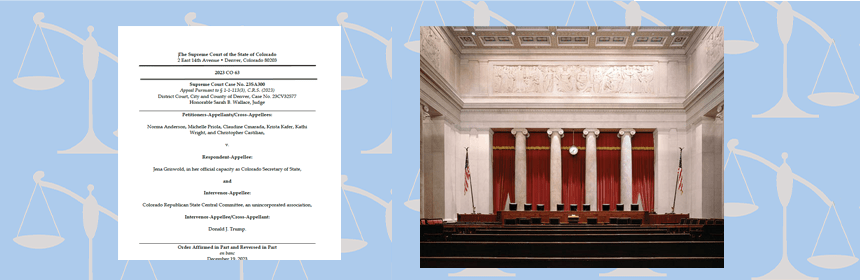
One thing is clear about this year’s election for president. The Supreme Court intends to cast its vote. The Court, driven by the conservative majority, rushed to hand Donald Trump a victory the day before Super Tuesday, the day fifteen states, including Colorado, hold primary elections. It even went as far as to announce on a Sunday that it would be handing down a ruling the next day. And it leaked the subject so loudly every story that night predicted it would be a decision in Trump v. Anderson.
In Trump v. Anderson, all nine justices agreed that states lack the power to enforce Section 3 of the 14th Amendment against presidential candidates. All nine justices ruled in favor of Trump on this question. I’d like to pat myself on the back here because I predicted this outcome not long ago. I’d like to, but I won’t, because nearly every other court watcher made the same prediction.
The case centered around whether former President Trump could be barred from the ballot using a rarely invoked provision of the 14th Amendment. The Colorado Supreme Court had previously ordered the exclusion of Trump from the Republican primary ballot in the state. This U.S. Supreme Court decision reverses that ruling.
The key issue was whether Section 3 of the Fourteenth Amendment, which addresses insurrection and rebellion, applied to Trump’s eligibility to run for president again. The Court held that Congress, rather than individual states, is responsible for enforcing Section 3 against federal officeholders and candidates. In legalize, it is not self-executing. Therefore, Trump can appear on presidential ballots this year, putting an end to efforts to ban him under this constitutional provision.
As I predicted, the Court would not sit by while some states denied Trump access to the ballot while others permitted his name to appear. Maine and Illinois had followed Colorado in removing him. A dozen other states had ruled in Trump’s favor.
The ruling warned of the dangers of a “patchwork” of decisions around the country that could send elections into chaos if state officials had the freedom to determine who could appear on the ballot for president. “The result could well be that a single candidate would be declared ineligible in some states, but not others, based on the same conduct,” the ruling said.
Minutes after the ruling, Trump hailed the decision in an all-capital letters post on his social media site, writing, “Big win for America!!!”
But was this a win for the Supreme Court? I think not.
In making its ruling, the Court cited Section 5 of the 14th Amendment, which reads, “The Congress shall have power to enforce, by appropriate legislation, the provisions of this article.” They read section 5 as requiring congressional action to implement section 3. But textualism be damned, the language does not say that. And does not put the power to enforce solely in the hands of Congress. The five conservative judges are simply making it up.
They should have just stopped there. Instead, they tossed their historic deference to the states overboard. Colorado was ruling on a state election. And a primary election at that. They also never reviewed Colorado’s judgment finding that Trump had engaged in an insurrection. As a matter of litigation history, that finding of fact, supported by extensive evidence, remains valid. What they did was in effect to destroy section 3 of the thirteenth amendment. Insurrectionists are now free to try to overthrow the government one year and, if you fail, you can always run for election next year.
That the three liberal justices objected to what they branded, “overreach,” is no surprise. What did surprise is that Justice Amy Coney Barrett agreed with that assessment. Barrett, the sixth member of the conservative majority, was Trump’s third and final nominee to the Court.
In her short concurring opinion, Barrett did everything a good conservative textualist is not supposed to do, acknowledging that the Court was playing politics rather than interpreting the law. “The Court has settled a politically charged issue in the volatile season of a Presidential election. Particularly in this circumstance, writings on the Court should turn the national temperature down, not up,” Barrett wrote. “For present purposes, our differences are far less important than our unanimity: All nine Justices agree on the outcome of this case. That is the message Americans should take home.”
I think not. What Americans should take home is that the Court remains highly politicized and that textualism, originalism, or whatever the conservatives call it, is a farce.
Meanwhile, what five of the six conservative judges have done here is to throw fourteenth amendment law under the bus. The fourteenth amendment forms the constitutional framework for civil rights and prohibits the states from depriving any person of life, liberty, or property without due process of law and from denying anyone equal protection under the law. Many of these lawsuits are filed at the state level. Absent explicit federal legislation, there is no telling how future civil rights and equal protection cases will fare.
The campaigning by the Court, or at least the conservative majority, continues unabated. It hurried to decide this “disqualification” case, rendering its opinion just sixty days after the Colorado Supreme Court ruled. That allowed Trump his “victory lap” the day before a major election.
At the same time the Court is dragging its feet deciding Trump’s absurd position that a president has “total immunity” from prosecution after he leaves office. Both the United States District Court and the Court of Appeals for the District of Columbia has unanimously rejected that argument. Judge Tanya Chutkan, the trial judge in the case, wrote “neither the Constitution nor American history supported the contention that a former president enjoyed total immunity from prosecution.” The late President Richard Nixon’s acceptance of a pardon following his resignation is a case in point.
The Supremes have refused to expedite Trump’s appeal in the immunity case, despite a request by the Special Counsel. It will not even hold an oral argument until the week of April 22. Meanwhile, it stayed trial proceedings by the district court until it rules. The justices are obviously playing along with Trump’s strategy of delay, delay, delay. Most observers think it unlikely Trump will be tried on felony charges from his role in the January 6, 2021, insurrection before the election.
Should Trump regain the White House, one of his first orders of business will undoubtably be to order “his” Justice Department to dismiss the federal cases against him.
Who said justice delayed is justice denied? I can name six names.
#####
 Scott Gurvey's Public Offerings
To make this short, when we play politics, we tend to overlook who it will hurt without interpreting what the constitution really says, instead we put our on interpretation on it to fit our needs, not the needs of the people it’s supports. as we change the law to suit someone who believes it supposed to suit his purpose is a abomination. Playing God will spin this country into complete disorder and confusion. If we the people can’t speak for ourselves, then who will. The Demi-God or the real Lord for people’s rights!! 🙏🏿😇
LikeLike