They Do It Again
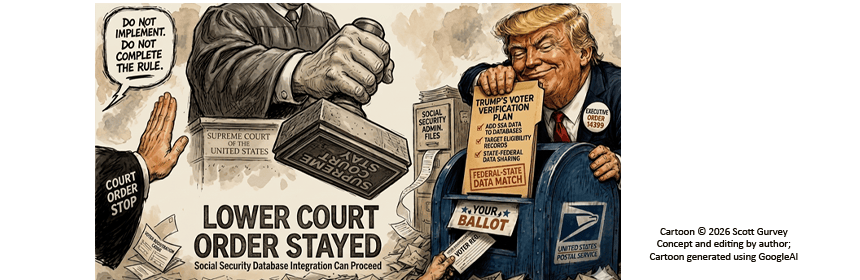
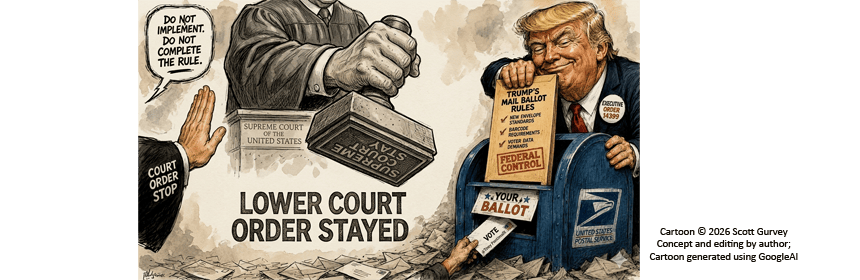
With just 39 days to go before the midterm elections the conservative majority on the Supreme Court couldn’t keep its hands off the ballot box. Once more they have used its secret shadow docket to overrule two detailed lower court decisions, allowing their patron Donnie Trump to include records from the Social Security Administration (SSA) in the Department of Homeland Security’s Systematic Alien Verification for Entitlements (SAVE) database made available to state offices. This allows states to request bulk searches using full or partial SSNs and linked SSA’s master files to verify citizenship for voter registration. Critics fear that states could use the system to purge large numbers of valid voters from their rolls ahead of the midterm elections.
The decision is bad because the Court should not be getting involved in elections, which the Constitution makes clear is, absence legislative action by Congress, a matter for the states to administer. Trump has in fact been pushing Congress to take such action but has failed to get new laws enacted in spite of a majority in both the Senate and the House. Once again, the conservative Court majority just can’t resist tipping the scales in favor of their president.
On the other hand, the order in Department of Homeland Security v. League of Women Voters is not expected to have much of an impact on this November’s election. That is because states are not required to use the federal system, as they might be is a new federal law was anacted, and there is little interest among local and state election officials for it, because it has mistakenly flagged U.S. citizens as noncitizens in past searches.
The Court majority, clearly embarrassed by criticism of its use of the emergency docket to render significant judgments without explanation has, at least, been writing short explanations in recent actions. In this case they wrote that a lower-court ruling which had blocked the administration from rolling out the system was improper because it inhibited “the federal government’s efforts to assist state and local agencies in the proper administration of the midterm elections.”
The emergency ruling was unsigned and gave no vote count, but the court’s three liberal justices joined in dissent, making the 6-3 party line vote obvious. In that 12-page dissent, Justice Ketanji Brown Jackson wrote that the majority’s decision created the conditions for some states to cancel the voter registrations of at least some recently naturalized citizens or to force them to provide proof of citizenship before voting.
“The harm caused by burdening or disenfranchising even a few lawful voters outweighs the nonexistent harm that the government experiences when it is prevented from taking an action that it likely lacks the authority to take,” she wrote, joined by Justices Sonia Sotomayor and Elena Kagan.
Federal law establishes a 90-day “quiet period” before elections, in which wide-scale changes to state voter rolls cannot be made. The provision is meant to avert last-minute chaos in elections and is expected to prevent states from kicking large numbers of voters off their rolls in the weeks leading up to the midterm. Even the majority recognized that the 90-day rule “limits the potential impact” of the court’s action. However, the majority added that states should have the ability to use the federal system to make inquiries about voters on a case-by-case basis.
The conservatives on the Court could have left this matter alone. But that is not their style. The primary issues remain to be hammered out in the lower courts, as they should be. The real threat will be to the election for president in 2028.
Interestingly, the Court also unanimously blocked a Republican-backed congressional map in Missouri for a third time, People Not Politicians v Robert Onder, reverting the state to its 2022 map boundaries for November. With this action the Supremes rejected an appeal backed by the Republicans and the Trump administration, stating that Missouri must conduct its 2026 congressional election using the 2022 map lines following a state court determination that the newer map required voter referendum approval.
It has been a busy summer for the Court. The regular Court term doesn’t even start until October 5!
#####