Tag Archives: voting

They Do It Again

With just 39 days to go before the midterm elections the conservative majority on the Supreme Court couldn’t keep its hands off the ballot box. Once more they have used its secret shadow docket to overrule two detailed lower court decisions, allowing their patron Donnie Trump to include records from the Social Security Administration (SSA) in the Department of Homeland Security’s Systematic Alien Verification for Entitlements (SAVE) database made available to state offices. This allows states to request bulk searches using full or partial SSNs and linked SSA’s master files to verify citizenship for voter registration. Critics fear that states could use the system to purge large numbers of valid voters from their rolls ahead of the midterm elections.

The decision is bad because the Court should not be getting involved in elections, which the Constitution makes clear is, absence legislative action by Congress, a matter for the states to administer. Trump has in fact been pushing Congress to take such action but has failed to get new laws enacted in spite of a majority in both the Senate and the House. Once again, the conservative Court majority just can’t resist tipping the scales in favor of their president.

On the other hand, the order in Department of Homeland Security v. League of Women Voters is not expected to have much of an impact on this November’s election. That is because states are not required to use the federal system, as they might be is a new federal law was anacted, and there is little interest among local and state election officials for it, because it has mistakenly flagged U.S. citizens as noncitizens in past searches.

The Court majority, clearly embarrassed by criticism of its use of the emergency docket to render significant judgments without explanation has, at least, been writing short explanations in recent actions. In this case they wrote that a lower-court ruling which had blocked the administration from rolling out the system was improper because it inhibited “the federal government’s efforts to assist state and local agencies in the proper administration of the midterm elections.”

The emergency ruling was unsigned and gave no vote count, but the court’s three liberal justices joined in dissent, making the 6-3 party line vote obvious. In that 12-page dissent, Justice Ketanji Brown Jackson wrote that the majority’s decision created the conditions for some states to cancel the voter registrations of at least some recently naturalized citizens or to force them to provide proof of citizenship before voting.

“The harm caused by burdening or disenfranchising even a few lawful voters outweighs the nonexistent harm that the government experiences when it is prevented from taking an action that it likely lacks the authority to take,” she wrote, joined by Justices Sonia Sotomayor and Elena Kagan.

Federal law establishes a 90-day “quiet period” before elections, in which wide-scale changes to state voter rolls cannot be made. The provision is meant to avert last-minute chaos in elections and is expected to prevent states from kicking large numbers of voters off their rolls in the weeks leading up to the midterm. Even the majority recognized that the 90-day rule “limits the potential impact” of the court’s action. However, the majority added that states should have the ability to use the federal system to make inquiries about voters on a case-by-case basis.

The conservatives on the Court could have left this matter alone. But that is not their style. The primary issues remain to be hammered out in the lower courts, as they should be. The real threat will be to the election for president in 2028.

Interestingly, the Court also unanimously blocked a Republican-backed congressional map in Missouri for a third time, People Not Politicians v Robert Onder, reverting the state to its 2022 map boundaries for November. With this action the Supremes rejected an appeal backed by the Republicans and the Trump administration, stating that Missouri must conduct its 2026 congressional election using the 2022 map lines following a state court determination that the newer map required voter referendum approval.

It has been a busy summer for the Court. The regular Court term doesn’t even start until October 5!

#####

The Trump Court’s Summer

The Supreme Court is only two thirds of the way through its three-month summer vacation. But the conservative majority has kept busy facilitating Donald Trump‘s marauding destruction of the institutions of the government, both physical and abstract. In so doing they have supported his strategy to wreak havoc on the nation, sowing a path of destruction so quickly his opponents can’t mount a defense quickly enough to stop him from achieving his goals. Their embarrassingly rash decisions make a mockery of the judicial process and the rule of law.

Mail-In Ballots

Using the tool of the Executive Order Trump has directed the United States Postal Service to deliver mail-in ballots only to people on a federal list of voters. Never mind the fact that the Constitution assigns to the states control over the election process absent specific legislation passed by Congress. Never mind the fact that the law establishing the USPS charges it with delivering the mail and little more, making any attempt by that organization to restrict the mailing of ballots by the states and their return by the voters illegal. Never mind the fact that in spite of  Trump’s whining that mail-in ballots lead to election fraud not a single court has ever found such fraud affecting the outcome of an election. The Supreme Court members who Trump refers to as “my judges” interrupted their summer vacation to do his bidding.

The Executive Order has been challenged in multiple courts. Several issued injunctions, stopping the order from being implemented pending a full court review. This is known as preserving the status quo and with less than 60 days until the election, agrees with past challenges to election law and procedure.

Which sent Trump running, as he has done so many times before, to “his” judges. They found, on their emergency docket and without any formal brief or public arguments, that the status quo meant don’t interfere with Trump while the case is pending. This stands the entire concept on temporary injunctions on its ear. Trump v. California was decided on a strictly partisan vote, 6-3.

A whistleblower report to Congress from inside the USPS says the service is rushing out “untested” technology that could “derail” the upcoming election. State officials, in many cases about to send out their mail ballots, have no idea how they should respond to the order’s requirements. They only know they face criminal charges for failure to comply.

That is clearly what the conservative majority wants. They did caution that their order was preliminary and not a final decision on whether the administration’s order “will necessarily be lawful” once the plans are complete. “On that score, time will tell,” the majority said in the 10-page, unsigned order. But of course, the election will have come and gone and who knows how many voters will have been kept from casting their ballots by Trump’s action. Which is what he wants. The Court could have dealt with the substantive issues right then and there and eliminated the uncertainly. But that is not their plan.

Justice Ketanji Brown Jackson, with a separate 23-page dissent, considered the merits. “The President does not have any legal authority to require that elections be conducted in accordance with his preferences,” she says, “or to withhold delivery of mail-in ballots that are not formatted consistent with the President’s wishes.”

The Ballroom

And then comes the matter of the ballroom. Everyone who has ever rented a place to live knows full well the lease does not give you the right to damage the place, least you sacrifice your security deposit and be subject to a lawsuit for additional damages. So, what do you think “We the People,” landlords of The White House, should charge Donald Trump? He has trashed the joint from end to end.

The West Wing offices have been gilded to look like the French Palace of Versailles. The lawns and gardens have been paved over like a roadside motel. And the East Wing has been totally destroyed and rising in its place is some sort of monstrosity which will dwarf the historic residence the people loan every four years to their president.

The conservative majority which dominates the Court won’t stop it.

Again, a district court granted an injunction to stop the building pending a full hearing on the key question, “Can a president do what he wants with the White House?” Again, the conservatives on the Supreme Court stayed the injunction, finding that preserving the status quo meant letting Trump continue pending the court hearings. Trump has the workers on the job 20 hours day with the clear expectation that he will have his giant ballroom finished before the court issues a final ruling. That is characterized by another French term, a fait accompli.

In July 2025, the White House said the ballroom would be funded by private donations and cost about $200 million. Later, the cost was adjusted to $400 million. Now, the price tag is closer to $600 million, according to contractor invoices, and about half will be paid by taxpayers. No surprise. The ballroom will be built with missile-resistant columns and a drone-proof roof. What will it cost if the next president decides to pull it down?

The Supreme Court’s shadow docket ruling, National Park Service v National Trust for Historic Preservation, didn’t address the legality of the project. Lower courts said the construction required congressional approval. The decision focused on whether the plaintiff, the National Trust for Historic Preservation, had the standing to bring a lawsuit. The trust had to show that the ballroom’s planned construction would, among other things, cause board member Alison Hoagland “harm.” How can a building inflict pain, and how could such suffering be quantified?

In a declaration, Hoagland wrote: “I would suffer both professional and personal injuries, including to my aesthetic, cultural, and historical interests.” Hoagland, a historian, said she enjoyed walking past the White House and feared that Trump’s addition would distort the building’s character.

This shadow docket ruling was so disgusting even Chief Justice John Roberts couldn’t stomach it, breaking with his five conservative collogues to join the liberals 5-4 and writing the dissent.

Wrote Roberts, “The White House is not just any building, and — when it comes to historic preservation — Hoagland is not just any person. In failing to appreciate as much, the Court misconceives the plaintiff’s injury, allowing the Executive’s likely infringement of the Legislature’s power of the purse and authority to regulate federal property in the District of Columbia to continue.”

The Trump administration didn’t go through the usual review process. But the Republican-controlled Congress, as usual, is not willing to do anything about it. Trump’s desire seems to be to remake Washington in his image. And to leave his name and likeness on as many parts of the government as possible.

An overhaul of the East Potomac Golf Links is about to begin. Trees are already facing the axe. A 250-foot triumphal arch will, according to the White House, start construction within weeks. Trump threatens to tear down the Kennedy Center unless he can put his name back up under the name of the fallen president.

Designed by Trump. Approved by nobody.

#####

R.I.P. V.R.A.

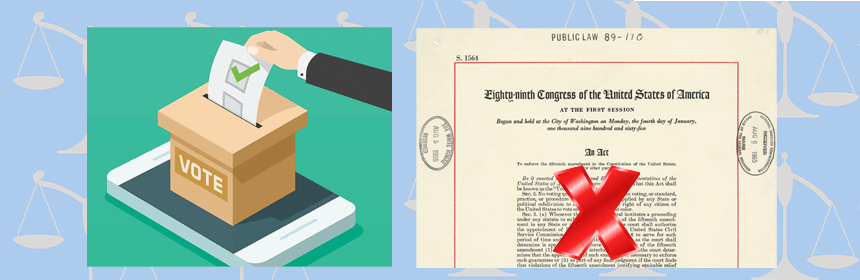
John Roberts, Chief Justice of the United States, has achieved his life goal. With the Court’s ruling in Louisiana v. Callais, he has killed the Voting Rights Act. Roberts made the destruction of the VRA of 1965 his lifelong crusade. His opposition to the Act dates back to his days as a law clerk for then Associate Justice William Rehnquist. Rehnquist notoriously wrote a memo in 1952 stating, “I think Plessy v. Ferguson was right and should be re-affirmed.” Plessy was the infamous “separate but equal” case institutionalizing racism in public schools. It was overturned by Brown v. Board of Education in 1954.

Read more

GOP ∞ – Democracy 0 – Roberts 😉

The racist party scored another infinite victory in the United States Senate with all 50 Republicans voting against even discussing legislation to overhaul election law in America. Of course the Constitution says in case of a tie vote the Vice President, currently Democrat Kamala Harris, breaks the tie. But this democratic majority rules standard doesn’t apply here because this wasn’t a vote on passing into law the “For the People Act.” This was a “motion to proceed to consideration.” This little bit of nonsense, known as a cloture vote, requires a three-fifths vote. A 50-50 tie doesn’t cut it. You won’t find this “filibuster” rule in the Constitution either. It has been a tool of the racists for years.

The law would protect voting rights, end partisan gerrymandering, establish new ethics rules for federal officials, and curb big money in politics. No wonder it didn’t stand a chance. Republican senate leader Mitch McConnell called it a “power grab” by Democrats.

Read more