One thing is clear about this year’s election for president. The Supreme Court intends to cast its vote. The Court, driven by the conservative majority, rushed to hand Donald Trump a victory the day before Super Tuesday, the day fifteen states, including Colorado, hold primary elections. It even went as far as to announce on a Sunday that it would be handing down a ruling the next day. And it leaked the subject so loudly every story that night predicted it would be a decision in Trump v. Anderson.
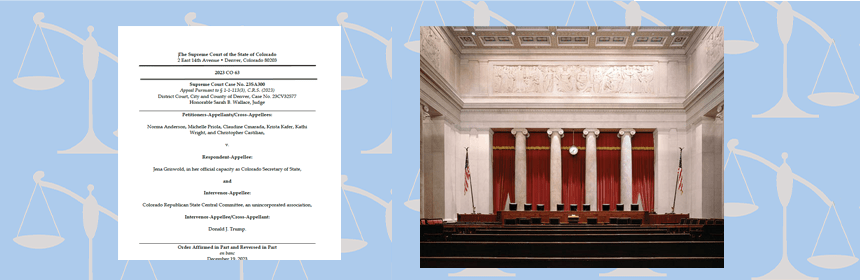
In Trump v. Anderson, all nine justices agreed that states lack the power to enforce Section 3 of the 14th Amendment against presidential candidates. All nine justices ruled in favor of Trump on this question. I’d like to pat myself on the back here because I predicted this outcome not long ago. I’d like to, but I won’t, because nearly every other court watcher made the same prediction.
I remember vividly the decision of the United States Supreme Court in Bush v. Gore, 531 U.S. 98 (2000). The Supremes had opined on elections many times before. But this was the first time the top court literally decided an election, stopping the ballot counting process still under way in Florida, and declaring George W. Bush the winner and 43rd President of the United States.
Moreover, it came to its decision by a party-line vote of 5 to 4. That led many to question the validity of the decision, which was based on the determination that the vote counting in Florida would violate the due process clause of the Fourteenth Amendment. Note I wrote “would” rather than “did”. The Bush Court apparently consulted a soothsayer and reached its conclusion based on a prediction, not an actual event. We can never know if it was right.
This is nuts. That’s all I could think as I listened to D. John Sauer, an attorney for Donald Trump, with Trump sitting in the front row of the courtroom, tell a panel of the United States Court of Appeals for the District of Columbia that it should overturn a decision of the district court and dismiss the federal indictment against Trump for crimes connected to the January 6, 2020, mob assault on Congress.
To recap, on August 1, 2023, Special Counsel Jack Smith charged Trump with four federal criminal counts after a grand jury investigation into Trump’s attempt to overturn the 2020 election, culminating in the January 6th insurrection. In October 2023, Trump claimed in the case that he had absolute immunity from prosecution for actions he took as president but Judge Tanya S. Chutkan, the trial judge in the case, rejected (opinion here) Trump’s claim, finding that “neither the Constitution nor American history supported the contention that a former president enjoyed total immunity from prosecution.” Trump appealed the ruling.
There are reasons why journalists usually write analysis and commentary only after a breaking event has settled. Today Maine’s Secretary of State, Shenna Bellows, disqualified former President Donald Trump from appearing on the state’s 2024 Republican primary ballot. Her decision was based on the 14th Amendment of the US Constitution, which prohibits anyone who has “engaged in insurrection or rebellion” against the United States from holding office.
Oh, I tried. I tried to write about the horrible fire in Maui. I tried to write about elite universities. I tried to write about artificial intelligence. And I tried to write about the ongoing strike of writers and actors in Hollywood.
But before I could publish, it happened again. Donald Trump. Back to the top of page one. Unavoidable.
Donald Trump and eighteen others were indicted in Georgia on Monday over their efforts to overturn his 2020 election loss in the state. Prosecutors used a statute normally associated with mobstersto accuse the former president, his lawyers, and other aides of a “criminal enterprise” to keep him in power.
The nearly 100-page indictment details dozens of acts by Trump or his co-indictees to undo his defeat, including asking Georgia’s Republican secretary of state to find enough votes for him to win, harassing an election worker who faced down false claims of fraud, and attempting to persuade Georgia lawmakers to ignore the will of voters and appoint a new slate of electors favorable to Trump.
I’ve said it before, and I’ll say it again. I love sharing with you my opinion, something I was rarely able to do in my many years with CBS, NBC, and PBS where my task was to present the unvarnished facts of events without commentary. But I still try as hard as I can to make sure my opinions are clearly opinions, and my facts are accurate. I also work to provide you with links to primary sources, which I implore you to read for yourselves. I remain shocked at how many Americans can’t be bothered reading documents or watching videos and instead adopt the viewpoint of whatever talking head they favor from whatever cable or internet source provides the echo chamber in which they hear the views they are predisposed to believe without a challenging word to raise doubts or questions.
Please read the indictment, here. And listen to the whole one-hour recording of Trump’s phone call on January 2, 2021, with Georgia Secretary of State Brad Raffensperger, here. Do the work. Then you can decide what it means.
“The indictment alleges that rather than abide by Georgia’s legal process for election challenges, the defendants engaged in a criminal racketeering enterprise to overturn Georgia’s presidential election result,” Fulton County District Attorney Fani Willis, whose office brought the case, said at a late-night news conference. Willis’ investigation stretched over two and a half years.
The Georgia case is significantly different from the two cases previously filed in federal court by Special Counsel Jack Smith. Willis’s expansive detailing of events and use of laws (“RICO“) usually employed to go after mob bosses, will allow Fulton County prosecutors to tell the jury a story of a wide conspiracy to reverse election results in multiple states and build a compelling narrative of Trump’s actions in concert with numerous accomplices. But the logistics of putting Trump on trial along with eighteen other people, each of whom may file pretrial motions, in a racketeering indictment so complex and multilayered could result in many pre-trial motions and delay. Even so, Willis has asked the court to schedule a trial in March.
There are many interesting legal issues raised in this indictment. And whether I like it or not we will probably consider several of them in the months ahead. But first I expect you to do your homework.
For now, some quick observations. Trump’s defense, and those of many of his co-indictees, center around the idea that all he was doing was exercising his first amendment right to speak freely and criticize the election results. Another defense is that Georgia, in this indictment, and the federal government in the two indictments it has filed, is criminalizing conduct which is not criminal.
That’s where the “RICO” business comes in. RICO stands for the “Racketeering Influenced and Corrupt Organizations” Act. It was a groundbreaking piece of legislation passed in the United States in 1970 with the goal of financially crippling the Mafia. The act provides for extended criminal penalties and a civil cause of action for acts performed as part of an ongoing criminal organization. More than thirty states, including Georgia, have passed state RICO statutes based on the federal law.
Willis explained that “overt acts are not necessarily crimes under Georgia law in isolation but are alleged to be acts taken in furtherance of the conspiracy. Many occurred in Georgia, and some occurred in other jurisdictions and are included because the grand jury believes they were part of the illegal effort to overturn the results of Georgia’s 2020 presidential election.”
The Georgia charges have the potential to accomplish something that the federal indictment does not, holding people other than Trump accountable for what happened. The other eighteen defendants, accused of being members of a criminal enterprise, include lawyers, political operatives, state Republican Party officials, and even a Justice Department official. The indictment charges Rudy Giuliani, the former New York mayor who served as Trump’s personal attorney after the election, Mark Meadows, Trump’s White House Chief of Staff, and several other Trump advisers, including lawyers John Eastman, Sidney Powell, Jenna Ellis, and Kenneth Chesebro. Some of these are believed to be unindicted and unnamed co-conspirators in the federal cases.
The Georgia indictment reads like a story, a tale the public should find easy to understand. The recorded telephone call speaks for itself and has been available for the public to hear for more than a year. The indictment specifically accuses Trump with making false statements and writings for a series of claims he made to Raffensperger and other state election officials, including that up to 300,000 ballots “were dropped mysteriously into the rolls” in the 2020 election, that more than 4,500 people voted who weren’t on registration lists and that a Fulton County election worker, Ruby Freeman, was a “professional vote scammer.”
Giuliani, meanwhile, is charged with making false statements for allegedly lying to lawmakers by claiming that more than 96,000 mail-in ballots were counted in Georgia despite there being no record of them having been returned to a county elections office, and that a voting machine in Michigan wrongly recorded 6,000 votes for Biden that were in fact cast for Trump.
Another defendant, Stephen Cliffgard Lee, is alleged to have traveled to Ruby pFreeman’s home “with intent to influence her testimony.” Freeman and her daughter Shaye Moss testified to Congress last year about how Trump and his allies acquired surveillance footage from November 2020 to accuse both women of committing voter fraud, allegations that were quickly debunked yet spread widely across conservative media. Both women, who are Black, faced death threats.
Trump has personally used his social media platform to attack Willis and other prosecutors, describing them as “vicious, horrible people” and “mentally sick.” He has referred to Willis, who is Black, as the “racist DA from Atlanta.” His 2024 campaign included her in a recent video attacking prosecutors investigating Trump. Willis has raised concerns about security as her investigation has progressed, citing Trump’s “alarming” rhetoric and the racist threats she and her staff have received. Trump has also attacked the judges. He may be put on notice at his arraignment that further inflammatory posts could lead to his imprisonment pending trial.
And unlike the federal courts, where cameras are forbidden, the Georgia courts are generally open to cameras and live coverage of the trial in Georgia is likely. That will put the spotlight, usually reserved for Trump, on prosecutors and the legal process. The public proceedings may be just what the country needs.
I really did not want to write about Donald Trump again so soon. I hate the way Trump dominates the news. I hate the way he steals our attention when we should be facing up to our challenges. I hate the way he sucks all the oxygen out of a room when his name is just mentioned. But Trump loves the attention, and he won’t stop attracting it. The danger our democracy faces from Trump is so great it is incumbent on anyone who values truth to speak out.
Trump was arraigned on Thursday, August 3rd, on four federal felony counts arising out of his action to retain his office even though he had lost his bid for reelection. He pled not guilty, and he was allowed to leave on what is known as a personal appearance bond. That bond doesn’t require that a defendant put up any money unless they violate the terms of the release or fail to show up in court.
Donald Trump‘s dance card is filling up. Trump has now been indicted by a third grand jury, this time for his actions following the 2020 election. Trump is accused of attempting to stop the peaceful transfer of power and deny the right of American citizens to elect their president. There has never been anything like this in the history of the United States. The outcome will determine what kind of a nation we want to be.
This is the Case that Counts
In a series of investigations, two previous indictments, two impeachments, and several civil lawsuits, Trump has been accused of crimes committed as president and after he left office. The charges range from business fraud to the illegal retention of classified material to the destruction of evidence.


 Scott Gurvey's Public Offerings