John Roberts is …
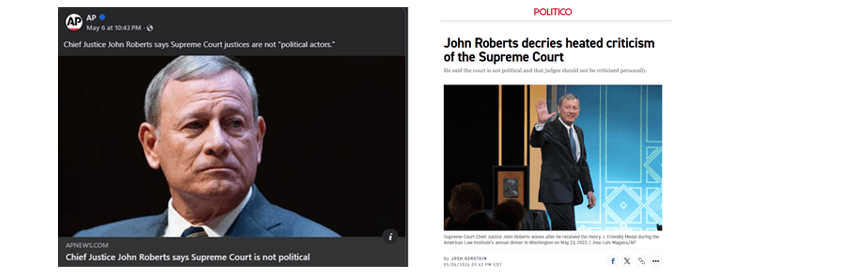
John Roberts is displeased. John Roberts is exasperated. John Roberts is frustrated. John Roberts is annoyed. John Roberts is irked. John Roberts is any other of the many synonyms my thesaurus suggested instead of the word I originally used, which it found to be “vulgar.”
What has the Chief Justice of the United States in high dudgeon (I thought of that one myself) is the reaction to the Court’s recent decision in Louisiana v. Callais, which drove a stake through the heart of the only section of the Voting Rights Act of 1965 the Court had not previously decimated. With the vote falling along party lines, many critics condemned the decision as racist and political.
Speaking to a conference of judges and lawyers from the 3rd U.S. Circuit in Pennsylvania, Roberts never mentioned the case, or any other, by name, but said the Court is “simply not part of the political process.”
“I think, at a very basic level, people think we’re making policy decisions, we’re saying we think this is how things should be, as opposed to what the law provides,” Roberts said. “I think they view us as purely political actors, which I don’t think is an accurate understanding of what we do.” He complained that people treat the Court with “hostility.” And his only nod to the fact that the outcry came in the wake of this latest decision was to say, “One thing we have to do is make decisions that are unpopular.”
I don’t know what is worse. That Roberts actually believes what he says. Or that he knows it’s a lie but thinks we are stupid enough to believe it.
Let us acknowledge, the idea of a nonpartisan, neutral court handing down rulings with no guiding light beyond their own jurisprudence is a long-running myth in American history. The court has and always will be a political institution. Yet in my lifetime, I have watched the Court drift farther and farther to the right. Away from the principals of individual rights which it had once protected.
The current conservative majority on the Court has also tossed aside precedent cases with abandon. Think of Dobbs, which overturned a fifty-year precedent on women’s rights. And it has increasingly placed itself in a position to make policy, a function that properly belongs with the elected branches of government which the Court now routinely ignores.
The Voting Rights Act was not one of the everlasting laws which lay on the books for centuries. It has been repeatedly reviewed and reauthorized by Congress, with the reauthorizations signed by the President. Most recently, it was reauthorized in 2006 and extended to 2031, when it was due for another review. This is the way the people’s voice is heard. The elected branches consider and enact the laws. This was a policy decision, whether the Chief agrees or not. There is no logic to a Supreme Court that decides, twenty years after a Congressional review, that the law is no longer to be enforced.
It was a blatantly political act. The proof immediately demonstrated as Louisiana and Tennessee moved to redraw their districts without waiting for the next regular reapportionment. This is what Donald Trump, afraid of losing his majority in Congress, begged the states where Republicans control the government to do. In each case, the new maps will affect districts currently held by people of color. People who just happen to be Democrats.
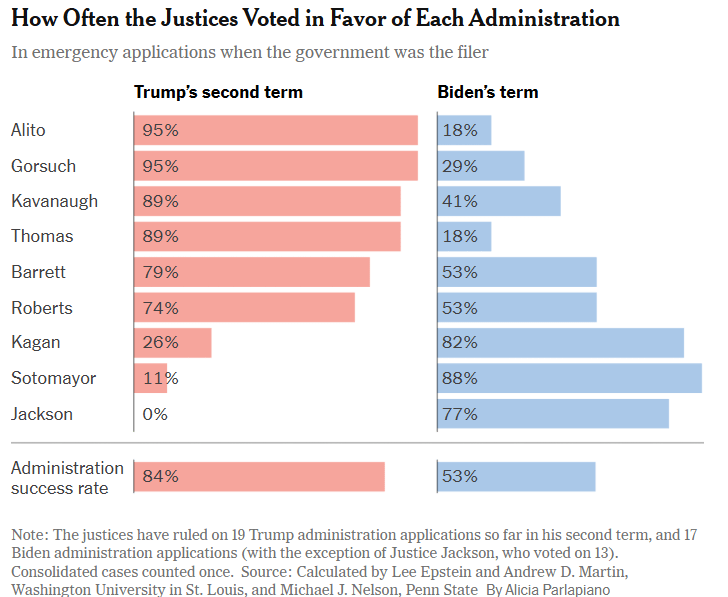
The New York Times in September 2025, analyzed the emergency applications made to the Supreme Court during the Biden and second Trump administrations. Their reporting shows the political bias of the Justices. Yes, it works both ways. But Trump has made far more use of the so-called “shadow” docket in his second term. His applications far outnumber those of Biden. And Trump has won most of them, usually on party-line votes.
If there is any doubt as to the partisanship of the current Supreme Court, take note once again at Louisiana v. Callais. Under normal Supreme Court procedure, the clerk waits 25 days to send the orders down, allowing for a motion for reconsideration to be filed. Immediately following the April 29, 2026, ruling, a group of voters asked the Court to bypass the usual 25-day waiting period, (Rule 45), arguing that the Louisiana legislature needed to move quickly to draw a new map for the 2026 elections.
On May 4, 2026, Justice Samuel Alito, the author of the Louisiana decision (also Dobbs), granted this request, allowing the judgment in Callais v. Louisiana to be sent down immediately, clearing the way for a new, Republican-favored map to be drawn. The three liberal dissenters screamed bloody murder. The Court itself it says it only expedites orders a few times a decade. Of course, this was one of those times because it was necessary for the majority to achieve its partisan goals. The Court’s partisan decisions have immediate consequences.
It is also worth noting that Alito’s written opinion exposes his hypocrisy. Just last December, in other voting rights case decided along partisan lines, Alito wrote, “The District Court improperly inserted itself into an active primary campaign, causing much confusion and upsetting the delicate federal-state balance in elections. (Abbott v. League of United Latin American Citizens. 2025), I guess confusion is only a problem if it benefits people of color. It is fine if it benefits White voters.
The partisan action by the nation’s highest court is being copied down the line. Yesterday Tennessee enacted a new congressional map that carves the city of Memphis into three separate parts. The Republican-led legislature used a strategy known as “cracking” to split Memphis—a majority-Black city and the state’s last remaining Democratic stronghold—among three predominantly white, Republican-leaning districts. By mixing the city’s voters of color with white suburban and rural populations, the map effectively dilutes the voting power of the minority community and is expected to eliminate the state’s only Democratic seat in Congress.
In Virginia, a state like Louisiana and Tennessee, was a Confederate state which permitted slavery, the state’s supreme court struck down a voter-approved redistricting amendment, upholding a lower court ruling that had declared the measure unconstitutional less than 24 hours after last week’s special election and briefly halted its implementation. The vote was 4-3, four Republicans outvoting three Democrats on the bench.
Let everyone understand what has happened here. In the wake of the Supreme Court’s decisions killing the Voting Rights Act, EVERY former Confederate state is moving to completely eliminate Black representatives. This should be more than enough proof that voting rights still need protection and racism is far from gone in this country. The Court effectively said the Fifteenth Amendment guarantees members of the minority the right to vote. But it does not guarantee them the right to have their vote count.
We are in the middle of a partisan redistricting war. We have the Court of John Roberts to thank.
I don’t care if he is angry. So am I.
####
 Scott Gurvey's Public Offerings
Pingback: The Supremes 2026 | Scott Gurvey's Public Offerings