The Supremes: Student Debt
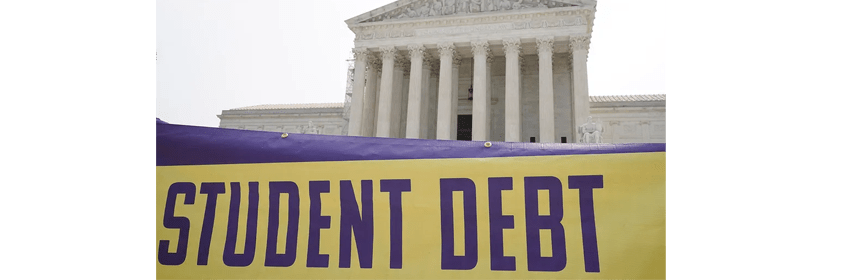

Following its tradition of recent years, the Supreme Court of the United States spent the last few weeks of June releasing its most controversial decisions of the term. It then adjourned for its usual three-month vacation. This is part of a series of posts analyzing those decisions.
On the last day of the term the Supreme Court ruled 6-3 in Biden v. Nebraska that the Biden administration’s student loan forgiveness plan was unconstitutional. The plan, which would have forgiven up to $20,000 in student debt for borrowers with incomes below $125,000, was based on the Higher Education Relief Opportunities for Students Act (HEROES Act), a 2003 law that allows the government to provide relief to recipients of student loans during a national emergency.
The Supreme Court opinion, written by Chief Justice John Roberts held that the HEROES Act did not authorize the Biden administration to forgive student debt on such a large scale. The opinion argued that the law’s language was too narrow to allow for such broad forgiveness. The court also found that the Biden administration had not met the requirements for issuing waivers and modifications under the HEROES Act.
Roberts Invokes the French Revolution
The HEROES Act, Roberts wrote, gives the secretary of education the power to “waive or modify” laws and regulations governing the student-loan programs. Roberts said “modify” means to make “modest adjustments and additions to existing provisions, not transform them.” The debt-relief program, Roberts said, instead “created a novel and fundamentally different loan forgiveness program.” The plan “modifies” student-loan laws and regulations, Roberts wrote, “only in the same sense that the French Revolution ‘modified’ the status of the French nobility — it has abolished them and supplanted them with a new regime entirely.”
Roberts rebuked the Biden administration directly, writing, “The question here is not whether something should be done; it is who has the authority to do it.” Roberts invoked the “major questions” doctrine, which is the idea that if Congress wants to give an administrative agency the power to make decisions of vast economic or political significance, it must say so clearly. Here, Roberts said, the HEROES Act did not authorize the debt-relief program at all, much less clearly.
Roberts next took a shot at his liberal colleagues, who joined in a dissent written by Justice Elena Kagan, “It has become a disturbing feature of some recent opinions,” Roberts wrote, “to criticize the decisions with which they disagree as going beyond the proper role of the judiciary.” But this decision, Roberts said, relied on “traditional tools of judicial decision making.” Although “[r]easonable minds may disagree with our analysis, [w]e do not mistake this plainly heartfelt disagreement for disparagement. It is important that the public not be misled either. Any such misperception would be harmful to this institution and our country.”
I must admit to a certain ambivalence when it comes to the student debt problem. I’m not alone in this. While public sentiment learned toward favoring affirmative action and LGBTQ rights, it leans against student loan debt forgiveness. My parents paid for my college tuition, and I am forever grateful for that. I paid my tuition for two graduate degrees. But I did that with the help of government guaranteed loans which were paid off on time as agreed. I do not see why it is fair to forgive the loans of others.
On the other hand, the student loan program has had deficiencies from its start as part of the National Defense Education Act of 1958. It was a cold war era program designed to improve education in response to the Soviet Union’s scientific advances, in particular, the launch of Sputnik, the first man made satellite.
Congress could have created the program within the Treasury Department, which already had similar facilities, and could have accomplished the task at a low cost. But Congress as usual decided to placate the banking industry, so the banks made the loans with the government guaranteeing payment and paying the administrative costs.
There was no incentive to keep costs low or to perform a robust risk analysis on borrowers or the schools that would receive the funds. In many cases borrowers could not refinance if interest rates fell, as they did during the banking crisis beginning in 2008. In addition, a substantial portion of the loans went to “for profit” educational institutions of questionable quality. Many of these schools enticed students with false statistics on job prospects for graduates. A sizable number went bankrupt, leaving the debt still owed to the banks. I do favor assistance for student victims of that fraud.
The Court’s Motive
But the Supreme Court’s decision here had nothing to do with the merits of the student loan program and everything to do with reining in the power of the executive branch. In recent years, the court’s conservative majority has worked to strike down several executive actions, including President Obama’s Deferred Action for Childhood Arrivals (DACA) program and President Trump’s travel ban.
The key point here is that the Court grants itself the power to decide if the guidance Congress has proved is clear and specific enough.
The debate about the balance of power between branches of government has been going on since the days of the farmers. Some argue that Congress is delegating too much power to the executive branch, while others argue that the executive branch needs to be given more flexibility to respond to changing circumstances in modern times. The court’s opinion in this case does nothing to settle this issue.
#####
 Scott Gurvey's Public Offerings