Election 2024 and the Supremes
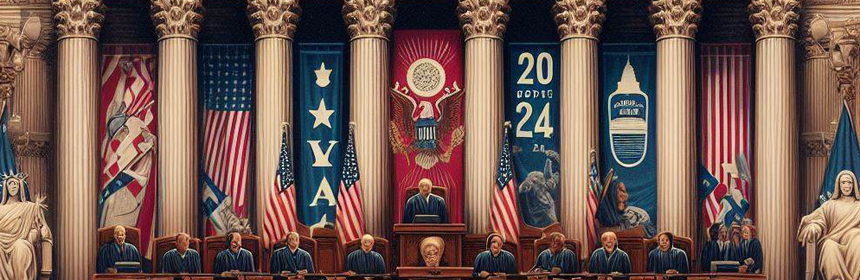
I remember vividly the decision of the United States Supreme Court in Bush v. Gore, 531 U.S. 98 (2000). The Supremes had opined on elections many times before. But this was the first time the top court literally decided an election, stopping the ballot counting process still under way in Florida, and declaring George W. Bush the winner and 43rd President of the United States.
Moreover, it came to its decision by a party-line vote of 5 to 4. That led many to question the validity of the decision, which was based on the determination that the vote counting in Florida would violate the due process clause of the Fourteenth Amendment. Note I wrote “would” rather than “did”. The Bush Court apparently consulted a soothsayer and reached its conclusion based on a prediction, not an actual event. We can never know if it was right.
This started a trend that has found an increasingly conservative court rendering increasingly political decisions in areas where, traditionally, it had trended lightly. The 5-4 decision hurt the Court’s credibility with the public. We are about to see just how far the justices will go in controlling the presidential election of 2024.
Trump v. Anderson
First up is Trump v Anderson, Supreme Court Docket 23-719. We listened to live oral arguments on February 8. Yes, listened, not watched. The Supreme Court still refuses to let We the People watch it while it does the People’s work. You can hear the argument here.
At issue is a decision by the state of Colorado that Donald Trump’s name cannot appear on the Republican Party primary ballot because he is not eligible for election to another term as president because of his actions during the January 6, 2020, Capitol attack. The Colorado case, which I discussed in an earlier post, turns on the finding that Trump engaged in an “insurrection.”
Other states have considered the issue and reached different conclusions. That raises the prospect that Trump could appear on the ballot in some states but not others. Trump asked the Supreme Court to resolve the conflicts.
What Should Happen? If the conservatives currently controlling the Court are true to their word the answer is, “Nothing.” This isn’t an election for president. It isn’t even an election for presidential electors. It is an election in which Colorada voters who have registered an affinity for the Republic party are indicating to their party which candidate they would like the electors the party puts on the ballot to declare their allegiance to.
I know that’s a mouthful but that’s the way it is. This is not a federal election. It’s not even a state election. It’s a party election. The Constitution does not say a thing about parties. The framers didn’t want political parties to play a role in the government they were creating. If the conservatives on the Court really believe their preaching about “textualism”, “originalism”, and “strict constructionism” they would decline to rule on this case and leave it, the Constitution being silent on the matter, up to the states. That is exactly what they did in Dobbs v. Jackson when they overturned fifty years of precedent and decided the literal life or death of a pregnant woman could be determined by which state she lives in.
What Will Happen? Not what I suggest above. Chief Justice Roberts noted during the argument that if Colorado could remove Trump from the ballot, another state, where Republicans presumably held political power, could remove President Biden’s name from the ballot. The Supremes have several available ways out of this chaos. But I suggest it to make a point that the conservatives are hypocrites. To get out of this mess they will have to turn their backs on textualism.
They can rule that the insurrection clause does not apply to the president or vice-president. There is some evidence the authors meant to exclude them. They could also find that Trump did not “engage” in an insurrection or rebellion. To do that the Court would have to throw out the findings of the Colorado trial court, which held an extensive hearing and considered hundreds of pages of evidence before reaching the conclusion that Trump is guilty. The Court almost always defers to the trial court on finding of fact.
Or they could cite both the due process and equal protection clauses in finding different rules in different states violate a principle of fairness. But that goes against the conservative’s recent attacks on these clauses, most noticeably in Dobbs. Dobbs threw due process under the bus, declaring Roe. v Wade was wrongly decided. The 1973 majority rested Roe on the due process clause in finding a “right fo privacy” which abortion laws violated.
What’s Next?
The next one will be harder. In United States v. Donald Trump the former president was charged in a four-count indictment with crimes because of his activities related to the January 6, 2020, riot at the Capitol.
Trump has raised a wide range of defenses, including one that a president enjoys “total immunity” against prosecution unless he is first impeached and removed from office by Congress. His motions to dismiss the complaint on that ground failed at the District Court and at the Court of Appeals. Trump is appealing to the Supreme Court. That will be the next chapter.
####
 Scott Gurvey's Public Offerings
Pingback: The Supremes Vote | Scott Gurvey