Trump’s Happy Labor Day
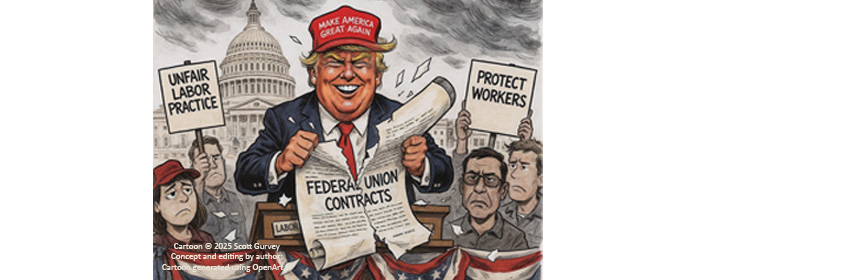
As the nation celebrates Labor Day, Donald Trump is escalating his attack on the federal workforce by trying to strip union rights from more federal employees.
Trump signed an executive order targeting workers at key federal agencies like the National Weather Service and NASA, arguing for a “national security” exemption to circumvent collective bargaining rights. This is part of Trump’s broader strategy to diminish the power of labor unions, which have long been essential advocates for workers’ rights and protections.
The move follows an earlier executive order intended to end bargaining rights for approximately one million federal workers. Labor unions, which include a diverse range of professions from nurses to park rangers, have voiced strong opposition, arguing that many workers covered by these orders do not engage in national security functions. Critics have labeled these actions as retaliatory measures against unions that have challenged Trump’s federal workforce agenda.
It is not surprising that Trump seeks to renege on contracts. The Trump organization made that part of its standard business strategy. Trump would hire contractors to work on his properties and then, when the work was done, declare that there was some problem with the work and refuse to pay the workers.
During my years as a reporter in New York, I sat through innumerable court hearings where Trump’s lawyers insisted the work was substandard and the contractors were not entitled to be paid. Almost all of these disputes ended in a settlement with Trump telling the workers they could settle for a lessor amount, say eighty cents on the dollar, or they would get nothing while he kept them in court for years. This scheme became so common few contractors would work on Trump properties.
Now Trump is extending his bad faith relationship with workers to federal employees. Trump sees federal unions as political adversaries. By undermining the collective bargaining process, Trump’s policies aim to destabilize labor representation and diminish the role of unions.
Another agency covered by the order, the U.S. Agency for Global Media, which supervises the government-funded Voice of America broadcast overseas, has already been gutted by the administration.
The first Labor Day was celebrated on September 5, 1882, in New York City, organized by the Central Labor Union and the Knights of Labor. About 10,000 workers marched from City Hall to Union Square, advocating for better working conditions and honoring the dignity of labor.
In the late 19th century, American workers faced twelve-hour days, seven-day workweeks, low wages, and unsafe conditions. Men struggled working in mines, in steel plants, and on the automobile assembly lines. Child labor was rampant, and strikes often turned violent, like the Haymarket Riot of 1886 in Chicago.
After the Pullman Strike, a nationwide railroad strike that led to violent clashes and the deaths of over a dozen workers, President Grover Cleveland signed a law making Labor Day a federal holiday on the first Monday in September. Historians believe this move was partly an effort to reconcile with the labor movement after the federal government’s suppression of the strike.
At one point 35% of the nation’s workers were union members. That is down to about 10% today. The modern, information and data age worker is less likely to join a union. Labor Day has evolved into a mix of activist tribute and leisure celebration. Parades, concerts, and cookouts mark the day, symbolizing both the strength of labor and the unofficial end of summer.
Though the holiday has become more commercialized, its roots stay in the fight for fair wages, safe workplaces, and collective bargaining rights, a legacy still relevant today. That legacy is under severe threat from the Trump administration.
#####
 Scott Gurvey's Public Offerings