Enter the Supremes
Update December 28, 2023
There are reasons why journalists usually write analysis and commentary only after a breaking event has settled. Today Maine’s Secretary of State, Shenna Bellows, disqualified former President Donald Trump from appearing on the state’s 2024 Republican primary ballot. Her decision was based on the 14th Amendment of the US Constitution, which prohibits anyone who has “engaged in insurrection or rebellion” against the United States from holding office.
Bellows was acting on challanges filed by Maine voters. One of the challenges was filed by three former elected officials in Maine: former Republican state Sens. Kimberley Rosen of Bucksport and Tom Saviello of Wilton and former Portland Mayor Ethan Strimling, a Democrat.
- Maine Decision (12-28-23)
And Then Came California
The sun hadn’t yet set in the west when word came that the California Secretary of State Dr. Shirley Weber had decided to leave former President Donald Trump’s name on the state’s primary ballot for the 2024 election. This decision was met with mixed reactions from the public and fellow politicians.
Some Democrats had urged the election official to leave him off the ballot, but the Secretary of State declined to do so. Lt. Gov. Eleni Kounalakis requested that California’s secretary of state explore “every legal option” to keep the former president out of the primary³. However, Dr. Weber decided to leave his name on the ballot. The California primary is scheduled for March 5, 2024, and the full list of candidates can be found here.
What Does It All Mean for the Supreme Court?
As is clear from the list of updates to my original column, and I anticipate more in the days ahead, the situation is fluid and confusing. The conservatives on the Supreme Court have a history promoting state’s rights. My reading of the 14th Amendment along with the rest of the Constitution and federal election law would lead one to conclude that these are state decisions.
This is especially true because these are primary elections. Both the Constitution and federal law deal with the general election. The framers never considered parties and primary elections.
That conclusion would seem to be nonsense on its face. How could we have a situation that allows Trump’s name to appear on some state ballots but not on others? The Supreme Court will almost certainly to step in and mandate a nationwide decision on Trump’s eligibility. I’m certain that decision will allow Trump’s name to appear. The question is, how do they justify it? What kind of tap dance will they do to get aroundfollow their political instinct and ignore the clear language of the documents?
The Supremes have been here before. In 2000 they decided the outcome of that year’s election for president by stepping into Florida’s vote counting process. Bush v. Gore made little legal sense. But it stood. And by the single vote of the recently departed Justice Sandra Day O’Conner, George W. became the 43rd President of the United States. Here we go again.
Update December 27, 2023
The Michigan Supreme Court today rejected an appeal aimed at barring Donald Trump from the state’s 2024 Republican primary ballot based on Section 3 of the 14th Amendment. The court upheld two lower courts’ rulings by rejecting an appeal filed by the watchdog group Free Speech For People on behalf of a group of Michigan voters. The court stated that the plaintiff’s challenge was not “ripe” on procedural grounds and did not specifically rule on whether Trump fell under the disqualification clause. The court emphasized that it would be improper to decide whether to grant a declaration that Trump is disqualified from holding the office of President of the United States at this time.
The Michigan court decision conflicts with the decision of the Colorado Courts. But because Michigan did not decide the issue on the merits of the 14th Amendment argument, it does not produce the type of conflict that would normally assure a review by the United States Supreme Court. However, added to the similar procedural rejection of the argument in Minnesota, eventual review by the Supremes still seems likely least Trump be banned from the ballot in at least one state but not in others.
- Michigan Supreme Court Opinion (12-27-23)
Original Post
Three years ago, Donald Trump had just about exhausted his legal campaign to overturn the results of the 2020 election in which Joe Biden beat him in both the popular and the Electoral College vote. Trump and others filed and lost sixty-two lawsuits contesting election processes, vote counting, and the vote certification process in 9 states (including Arizona, Georgia, Michigan, Nevada, Pennsylvania, and Wisconsin) and the District of Columbia. Nearly all the suits were dismissed or dropped due to lack of evidence.
Three years ago, Trump was arguing that the decisions of voters be set aside by the courts. Today, he argues the exact opposite. The difference? The wheels of justice turn slowly. Today, Trump finds himself facing criminal charges in New York, Florida, Washington D.C., and Georgia and a civil suit in New York. Now Trump claims the courts have no business “interfering” with the 2024 election process. He demands that the voters be allowed to make the decision on his attempt to win a second term, not the courts. There is great irony in this, although I suspect the term is over the heads of the average Trumpie.
Scotus Interruptus
It is clear from the history of the 2020 lawsuits that the Supreme Court is not thrilled in getting involved in Trump’s voluminous litigation. It turned away appeals in three separate cases on the 2020 events. Now it has refused to intervene in the normal appeals process regarding Trump’s claim that a “presidential immunity” power makes it impossible to charge him with any crimes he may have committed while president. There is no precedent for that claim. In a criminal case charging Trump with trying to subvert and overturn the 2020 election, U.S. District Court Judge Tanya Chutkan found he is not immune from prosecution under claims of presidential immunity or on constitutional grounds. The U.S. Circuit Court of Appeals for the District of Columbia will now hear Trump’s appeal first. But it is likely to wind up before the Supreme Court further down the road.
The One They Can’t Avoid
But the state of Colorado has served up a curve ball the Supreme Court will find it hard to avoid. Considering a lawsuit filed by four of the state’s voters, three registered Republicans and one independent, Colorado has decided that Trump is not eligible to run for reelection in 2024.
At operation here is the 14th Amendment to the Constitution, which says in part:
No person shall be a Senator or Representative in Congress, or elector of President and Vice-President, or hold any office, civil or military, under the United States, or under any State, who, having previously taken an oath, as a member of Congress, or as an officer of the United States, or as a member of any State legislature, or as an executive or judicial officer of any State, to support the Constitution of the United States, shall have engaged in insurrection or rebellion against the same, or given aid or comfort to the enemies thereof. But Congress may by a vote of two-thirds of each House, remove such disability.
U.S. Constitution, 14th Amendment, Section 3 Disqualification from Holding Office
Simply put, the four Colorado voters filed a civil lawsuit asking that the Colorado courts issue an order to state officials prohibiting them from placing Trump’s name on the 2024 presidential ballot because to do so would violate this provision of the 14th Amendment.
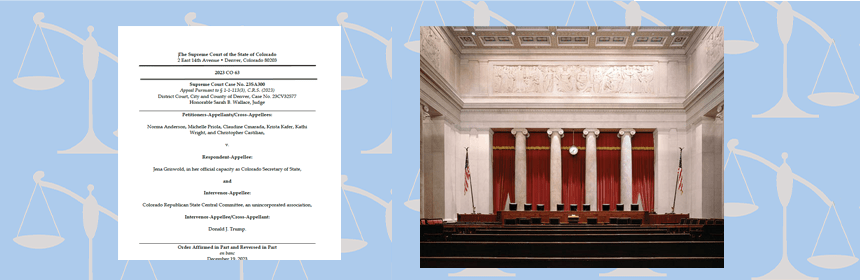
The district court held an evidentiary hearing and determined that Trump had “engaged in insurrection.” Still, it denied petitioner’s motion, its final order holding that Trump was not “an officer of the United States” as required by section 3. The Colorado Supreme Court reviewed the lower court’s fact finding and concurred with the conclusion that Trump had engaged in insurrection, based on his actions surrounding the Jan. 6, 2021, U.S. Capitol breach and riot by his supporters. It also considered and reversed the second part, holding that the president is an officer of the United States. Anderson v. Grisswold.
In the decision — which was a 4-3 ruling — the Colorado justices wrote:
“We do not reach these conclusions lightly. We are mindful of the magnitude and weight of the questions now before us. We are likewise mindful of our solemn duty to apply the law, without fear or favor, and without being swayed by public reaction to the decisions that the law mandates we reach….”
“We conclude that because President Trump is disqualified from holding the office of President under Section Three (of the 14th Amendment), it would be a wrongful act under the Election Code for the Secretary to list President Trump as a candidate on the presidential primary ballot,” the court’s majority opinion says. “Therefore, the Secretary may not list President Trump’s name on the 2024 presidential primary ballot, nor may she count any write-in votes cast for him.”
Anderson v. Grisswold.
Much as they might like to avoid it, it is a near-certainty the case will head to the U.S. Supreme Court, which has never ruled on that section of the 14th Amendment. The Colorado Supreme Court stayed its ruling until Jan. 4, the day before the deadline for the secretary of state to certify its presidential primary ballots in case an appeal is filed — in which case the state will be required to include Trump’s name on the March 5 primary ballot unless the federal justices order otherwise.
What Will They Do?
I don’t see how the Supreme Court can sidestep this one. And with six Republicans forming a supermajority, it is hard to see them setting a precedent that Trump can be kept off the ballot. But they will have to accept showing themselves to be political, hypocritical, or just plain old biased depending on the reasoning they adopt. Moves to invoke the 14th Amendment are pending in a dozen or more states.
The same right-wing pundits and legal beagles have been expressing their outrage ever since the Colorado decision was announced. Many of these same experts were discredited during the 2020 election denial litigation and some are facing liability for their efforts on Trump’s behalf. While many of their complaints can be dismissed, there are still issues to be considered.
True, there has never been a similar effort to invoke the 14th Amendment. But that does not mean it can’t be done. The reason may be that there has never been a president as contemptuous of the American system of government as Donald Trump. True, some drafts of the 14 Amendment specifically limited Section 3 to people who had been part of the Confederacy. The fact that this language does not appear in the final text does not as some have claimed lend support to a “Confederacy only” theory. Its absence in the final language is actually a good argument that the authors meant it to have wider application.
Besides, the entire theory of modern conservative constitutional interpretation is to deal with the words, and only the words, as written and understand them to mean what they meant at the time they were written. If the conservative court doesn’t follow its theory of “textualism,” “originalism,” “strict constructionism,” or whatever is the language in vogue, it will just be proof of their hypocrisy.
If the language is clear. And if the Constitution means what a majority of the Supreme Court Justices say it means, then all that is left is the question, “Did Donald Trump engage in an insurrection?” It is true that Trump has not been convicted of such a crime. But he has been charged with obstructing an official government proceeding.
The Colorado Superior Court concluded he did engage in an insurrection. The Colorado Supreme Court confirmed. The United States Supreme Court will have the benefit of the extensive evidentiary analysis of both courts. You can, and should read them for yourself:
I will add other sources here:
- Appellate Court Brief for Trump (12-23-23)
You should also check out YouTube and refresh your memory as to the events of January 6, 2021. The tradition of the Court is that it does not question the finding of facts from the courts below. Here it will have the benefit of two detailed fact-finding efforts, fully documented in the record. It will be interesting to see how the conservatives on the Supreme Court write their way out of this one.
#####
 Scott Gurvey's Public Offerings
Pingback: Election 2024 and the Supremes | Scott Gurvey