Category Archives: science

Star Stuff

On Sunday September 24, 2023, just before noon eastern time, a sample capsule containing about one pound of the asteroid Bennu should arrive in Utah. Go ahead. Back up. Read it again. Amidst all the angst of our everyday lives, which is the usual subject of this column, we have a wonder like that to contemplate.

The capsule will have come from the OSIRIS-REx spacecraft. OSIRIS-REx was launched on September 8, 2016, flew past Earth on September 22, 2017, and rendezvoused with Bennu on December 3, 2018. It spent the next two years analyzing the surface to find a suitable site for landing.
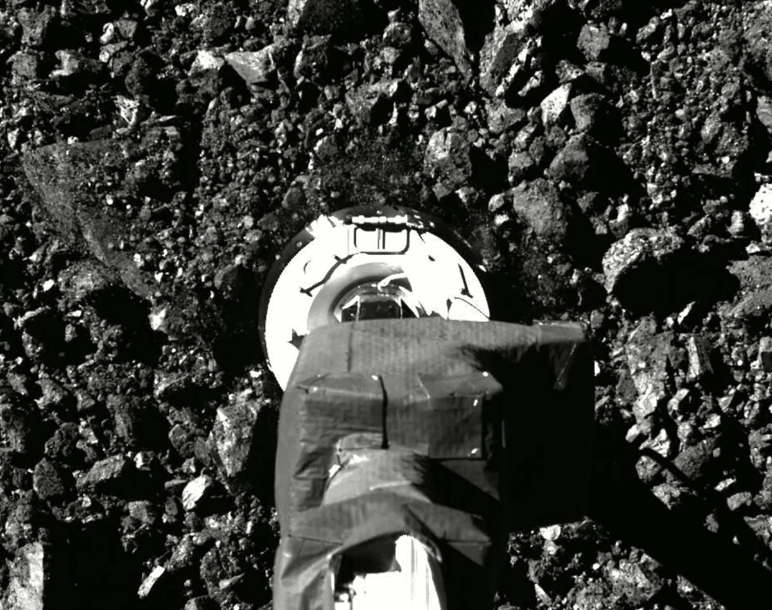
On October 20, 2020, OSIRIS-REx touched down on Bennu and successfully collected a sample. Though some of the sample escaped when the flap that should have closed the sampler head was jammed open by larger rocks, NASA is confident that they were able to retain between 400 g and over 1 kg of sample material, more than the 60 g (2.1 oz) minimum for success.


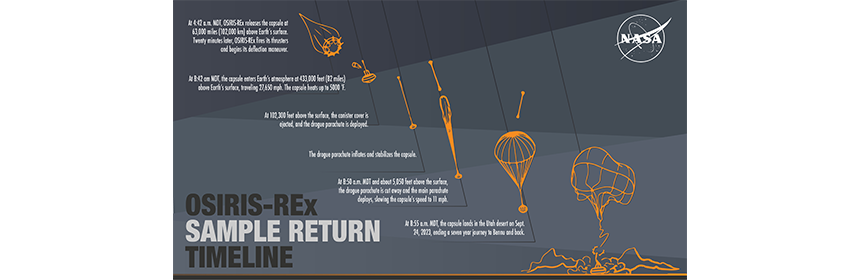
The sample capsule will be released when the spacecraft reaches an altitude of 63,000 miles above the Earth’s surface. The capsule will then be sent spinning towards the atmosphere below and will pierce Earth’s atmosphere at 10:42 a.m. EDT, coming to rest near a military base in the Utah desert. A recovery team will board four helicopters and head out into the desert to retrieve the capsule as quickly as possible to avoid contaminating the sample with Earth’s environment. Once located and packaged for travel, the capsule will be flown via helicopter to a temporary clean room on the military range, where it will undergo initial processing and disassembly in preparation for its journey by aircraft to NASA’s Johnson Space Center in Houston, where the sample will be documented and distributed for analysis to scientists worldwide.

There have been previous missions that have returned samples from outer space to Earth. Between 1969 and 1971, the Apollo program carried out six missions to the surface of the moon. The astronauts brought back a total of 842 pounds of lunar rocks, core samples, pebbles, sand, and dust from the lunar surface.

NASA’s Stardust mission, launched in 1999, flew past the comet Wild 2, collecting thousands of dust particles from the comet’s coma and returning them to Earth for laboratory analysis. Japan’s Hayabusa, launched in 2003, successfully returned samples from the asteroid 25143 Itokawa in 2010. Japan’s Hayabusa 2 returned samples from asteroid 162173 Ryugu in 2020.

If successful, OSIRIS-REx will be the first United States spacecraft to return samples from an asteroid.

All these missions have significantly contributed to our understanding of asteroids and the early solar system. The samples returned by these missions provide valuable insights into the composition, structure, and history of asteroids, as well as clues about the formation of our solar system and the origins of life on Earth.

Bennu was chosen as the target of this study because it is a “time capsule” from the birth of the Solar System. Bennu has a very dark surface and is classified as a B-type asteroid, a sub-type of the carbonaceous C-type asteroids. Such asteroids are considered primitive, having undergone little geological change from their time of formation. In particular, Bennu was selected because of the availability of pristine carbonaceous material, a key element in organic molecules necessary for life as well as representative of matter from before the formation of Earth. Organic molecules, such as amino acids, have previously been found in meteorite and comet samples, indicating that some ingredients necessary for life can be naturally synthesized in outer space.

Which doesn’t mean we will find a place we can relocate to in our neighborhood any time soon.

#####
Warnock, Geschke, and Adobe

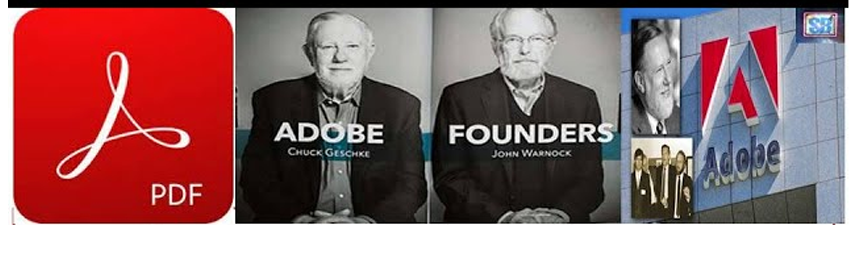
I was sorry to hear about the recent passing of John Warnock. I have a feeling many of you do not recognize that name. Nor will you recognize the name Charles Geschke, who was Warnock’s business partner and who died in 2021. But I am quite sure you recognize the name PDF. And the PDF is without question Warnock and Geschke’s greatest invention.

Warnock and Geschke were pioneers of the high-tech computer revolution. Like most successful entrepreneurs, they identified a problem and set out to solve it. Unlike most of the visionaries who made the west coast their home, Warnock and Geschke were quiet, unassuming, and shy.

In the 1990s, even though I was the New York based bureau chief for public television’s Nightly Business Report, I was allowed to travel to San Francisco every December and set up shop for a week at the Fairmont Hotel. We covered an annual Business Week conference titled, “The Digital Economy.” But we also spent a few days visiting the headquarters of Silicon Valley trailblazers and telling their stories.

Almost to a man, and they were almost all men in those days, they were thrilled to sit down in front of our camera to brag about their inventions. Warnock and Geschke were exceptions. They were happy to welcome us to the San Jose headquarters of Adobe, the company they founded in 1982. But they wanted us to interview their employees, the developers and product managers. It took a lot of persuasion to get the two founders in front of our camera. That was rare then and it remains rare today.

Warnock and Geschke met while working at the Palo Alto Research Center of Xerox, now part of SRI International. At Xerox PARC they developed a page-description language, something designers would use to instruct Xerox’s new laser printers how to draw a page. In those days virtually every different model of printer responded to a separate set of drawing commands. Warnock and Geschke’s vision was to create a standard every printer could follow. Xerox did not agree and kept their invention for use on Xerox equipment only.

So, the two left Xerox, started their own company, and created a new language which they called Postscript. A revolutionary breakthrough in printing technology, PostScript was the first printing software that enabled users to print pages that included text, line art and digitized photos. Adobe let all content creators use Postscript without a licensing fee. But they designed, and sold to the printer manufacturers, the circuits which interpreted Postscript and generated the signals the printer needed to generate the page. Apple and the Apple LaserWriter were the first company and product to use the system. With this, modern desktop publishing and word processing programs were born. By 1987, Adobe’s PostScript had become the industry-standard printer language.

Adobe did not stop there. Adobe Illustrator was released in 1987. Photoshop in 1990. The PDF came in 1993. The Portable Document Format was designed to allow the exchange of electronic versions of pages regardless of the software or device which created them or the printer or display which regenerated them without compromising the original. As Adobe’s Senior Vice President of Cloud Technology, Bob Wulff, describes it, “PDF allows the user to view a file precisely—down to the pixel, essentially, of what the author had intended.”

Today the PDF is ubiquitous:

  • PDF has become the standard file format for sharing documents. Businesses, schools, governments, and individuals use it all over the world.
  • PDF is also used to create electronic books.
  • PDF is a secure file format, which makes it ideal for sharing sensitive documents.
  • PDF is easy to use and can be viewed on any device.
  • PDF has had a major impact on the way we work and collaborate. It has made it possible for people to share documents more easily and securely.

Warnock and Geschke are gone now. But Adobe’s legacy of innovation continues. It has, for example, been actively applying artificial intelligence techniques throughout its product line. That is a story for another time. And it has revolutionized its business model. Most of its products are now in a bundle, Adobe Creative Cloud, for which Adobe charges a monthly subscription. Other companies are adopting variants of this model, known as Software as a Service.

By the way, Warnock and Geschke may have been camera shy, but once I got them to agree they produced a great interview. It almost always turned out that way when I had a reluctant subject. I checked in with both men every now and then over the years. They were pioneers of the computer age. Think about them when you print on your laser printer. They will be remembered.

#####


Recent Entries »