Tag Archives: Space

Artemis II

I held off on this. Didn’t want to jinx it. Now that the Artemis II crew is back, safe and sound after a near perfect mission, I can write about the thrill once again of seeing humans reach the moon for the first time in 53 years. With all the divisiveness and strife of today’s world, it is nice, even if just for a moment, to reflect that somethings can still be achieved in the name of all mankind.

I still remember asking my parents for permission to stay home and the watch the flight of the first living thing America sent into space. It was 1961. The passenger inside the Mercury capsule was Ham, a chimpanzee. I was in grade school. Ham paved the route. Alen Shappard followed. Eight years later Apollo 11 landed on the moon.

Eight years from first flight to the moon landing in 1969. Fifty-three years from the sixth and last moon landing, Apollo 17 in 1972, to Artemis II. How did we get so distracted, and jaded, and why did we take so long?

Those were the questions in my mind as I watched the splashdown in the Pacific off the coast of San Diego. And listened to the mostly mediocre coverage from the television networks. I thought of Walter Cronkite, Frank McGee, Roy Neal, and Jules Bergman. They had gravitas. This time around the reporters hadn’t even bothered to read the history, and they wouldn’t shut up.

Of course, they were not even born when Neil Armstrong first walked on the moon. I suppose they should be forgiven their ignorance. But it is hard to forgive their lack of homework.

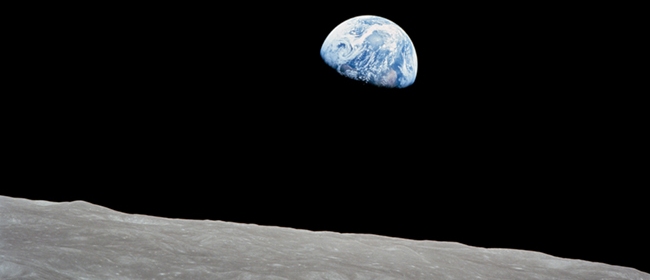
If you follow this column, you know I frequently write about space. I’ve even published here what is thought to be the best-known photograph ever taken, the “Earthrise” photo, earth in color, taken by astronaut William Anders on the Apollo 8 mission. Apollo 8 went into lunar orbit but did not land. A copy of that photograph has hung in my office for decades.

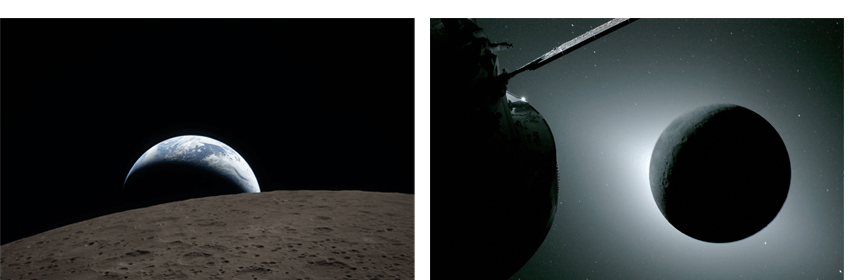
Artemis II Commander Reis Wiseman paid homage to that historic picture with what is now being called, “Earthset.” Captured on April 6, 2026, at 6:41 p.m. EDT, the image shows a crescent Earth slipping behind the rugged lunar horizon as the Orion spacecraft, named Integrity, flew over the Moon’s far side.

On the same day the Artemis II crew captured a historic total solar eclipse from a unique vantage point on the far side of the Moon. This event, lasting nearly 54 minutes, provided a perspective never before witnessed by humans, showing the Moon as a dark orb fully obscuring the Sun while revealing the solar corona and several distant planets. These are the awe-inspiring photos reproduced above.

Donald Trump made the traditional presidential call to the crew. There is an irony here. Richard Nixon, a Republican got to talk to the Apollo 11 crew after the first moon landing even though the entire program had been championed by Presidents John Kennedy and Lyndon Johnson, Democrats. Nixon cancelled the last three Apollo flights.

Trump told the Artemis II crew, “Today, you’ve made history and made all America really proud”. He emphasized that the mission was a precursor to a permanent lunar presence, saying, “We’ll plant our flag once again… we’ll establish a permanent presence on the moon”.

Empty words in my book. Trump’s FY 2027 budget request proposes a 23% decrease in NASA’s overall funding, reducing it to $18.8 billion from its current level of $24.4 billion. Despite overall cuts, funding specifically for the Artemis moon missions would increase by nearly 10% to $8.5 billion. This is intended to fully fund lunar landers, spacesuits, and transportation to ensure astronauts return to the surface by 2028.

But the “Science Mission Directorate” faces a 47% cut, dropping from $7.25 billion to $3.9 billion. This would likely lead to the termination of over 40 missions, including those focused on Earth observation, climate research, and astrophysics. No need for those egghead scientists to continue to explore the cosmos. Or to use NASA’s unique ability to look down on the earth and monitor what we are doing to the environment, a topic Trump calls a “hoax.” Endangered projects include a follow on to the fantastic space telescopes and the mission to pick up and bring back to earth soil samples still being collected by the amazing Perseverance Rover, searching for signs of ancient microbial life since landing on Mars in 2020.

This request mirrors a similar proposal for the 2026 fiscal year that was soundly rejected by Congress, which ultimately restored NASA’s funding to roughly $24.4 billion. Space advocates, including The Planetary Society, have labeled the new 2027 proposal an “extinction-level event” for space science. The final budget will be determined by Congress later this year.

I wonder if Trump realized the hypocrisy of his conversation with the astronauts. I also wonder if he realized the crew included a woman, an African American, and a Canadian. Just the kind of diversity he decries as “woke” and undesirable.

There appears to be something about viewing the entire earth with one’s own eyes that changes a person. Earth, with all its people, seems so small and insignificant. Ruth Graham of The New York Times writes about the philosophical and theological aspects of that impact. She quotes from the Book of Psalms, the Greek astronomer Ptolemy, theologian Andrew Davison of the University of Oxford, and actor William Shatner, Star Trek’s Captain Kirk, among others.

My thoughts on this subject turn to Carl Sagan’s novel Contact. The alien making first contact with a human tells our protagonist, Eleanor Arroway, that humans are newcomers and technologically backward, yet promising, often referencing the vastness of the universe to put humanity in perspective. In his screenplay for the film (Contact, 1997), three different characters ask the same question, “Are we alone?” Three other characters give the same answer, “The universe is a pretty big place. It’s bigger than anything anyone has ever dreamed of before. So, if it’s just us… seems like an awful waste of space.”

#####

Jim Lovell

The world lost one of its greatest space explorers with the passing of James Arthur “Jim” Lovell Jr., who died peacefully on this week at the age of 97. Lovell embodied the spirit of American exploration and the courage to venture into the unknown that defined the golden age of space exploration.

Lovell’s extraordinary career spanned four spaceflights that helped write the early chapters of humans in space. He was among the first three men to leave Earth’s orbit and journey to the moon as command module pilot of Apollo 8 in December 1968, a mission that gave humanity its first close-up view of the lunar surface and the iconic “Earthrise” photograph that forever changed how we see our home planet.

Read more

Remembering William Anders

There is a cliche that says a picture is worth a thousand words. The picture above has generated millions of words, I’m sure. Some believe this photograph, known as “Earthrise,” is the most famous and influential photograph ever taken. It is certainly one of my favorites.

Read more

It’s Back!

Right on the money. Just as planned, NASA’s OSIRIS-REx satellite dropped its sample capsule on the Utah desert where it was quickly recovered. It should contain a sample taken from the asteroid Bennu.

The NASA recovery team took the sample container from the OSIRIS-REx satellite to a temporary clean room on the Department of Defense’s Utah Test and Training Range.


The clean room was set up specifically for this purpose and was ready to receive the capsule. The sample container was secured and the area around it was deemed safe before the recovery process began. The team placed the 100-pound capsule into a metal cradle and wrapped it in multiple sheets of Teflon and then a tarp. The capsule was then wrapped in a harness and secured to one end of a 100-foot cable hanging from a helicopter. The helicopter transported the capsule to the temporary clean room on base.

In the clean room, the capsule will be disassembled and packaged in parts for transport to NASA’s Johnson Space Center in Houston, its permanent home. Scientists will analyze the rocks and soil from the sample for the next two years at a dedicated clean room inside Johnson Space Center. The sample will also be divided up and sent to laboratories around the globe, including OSIRIS-REx mission partners at the Canadian Space Agency and Japanese Aerospace Exploration Agency.

#####

Star Stuff

On Sunday September 24, 2023, just before noon eastern time, a sample capsule containing about one pound of the asteroid Bennu should arrive in Utah. Go ahead. Back up. Read it again. Amidst all the angst of our everyday lives, which is the usual subject of this column, we have a wonder like that to contemplate.

The capsule will have come from the OSIRIS-REx spacecraft. OSIRIS-REx was launched on September 8, 2016, flew past Earth on September 22, 2017, and rendezvoused with Bennu on December 3, 2018. It spent the next two years analyzing the surface to find a suitable site for landing.

On October 20, 2020, OSIRIS-REx touched down on Bennu and successfully collected a sample. Though some of the sample escaped when the flap that should have closed the sampler head was jammed open by larger rocks, NASA is confident that they were able to retain between 400 g and over 1 kg of sample material, more than the 60 g (2.1 oz) minimum for success.


The sample capsule will be released when the spacecraft reaches an altitude of 63,000 miles above the Earth’s surface. The capsule will then be sent spinning towards the atmosphere below and will pierce Earth’s atmosphere at 10:42 a.m. EDT, coming to rest near a military base in the Utah desert. A recovery team will board four helicopters and head out into the desert to retrieve the capsule as quickly as possible to avoid contaminating the sample with Earth’s environment. Once located and packaged for travel, the capsule will be flown via helicopter to a temporary clean room on the military range, where it will undergo initial processing and disassembly in preparation for its journey by aircraft to NASA’s Johnson Space Center in Houston, where the sample will be documented and distributed for analysis to scientists worldwide.

There have been previous missions that have returned samples from outer space to Earth. Between 1969 and 1971, the Apollo program carried out six missions to the surface of the moon. The astronauts brought back a total of 842 pounds of lunar rocks, core samples, pebbles, sand, and dust from the lunar surface.

NASA’s Stardust mission, launched in 1999, flew past the comet Wild 2, collecting thousands of dust particles from the comet’s coma and returning them to Earth for laboratory analysis. Japan’s Hayabusa, launched in 2003, successfully returned samples from the asteroid 25143 Itokawa in 2010. Japan’s Hayabusa 2 returned samples from asteroid 162173 Ryugu in 2020.

If successful, OSIRIS-REx will be the first United States spacecraft to return samples from an asteroid.

All these missions have significantly contributed to our understanding of asteroids and the early solar system. The samples returned by these missions provide valuable insights into the composition, structure, and history of asteroids, as well as clues about the formation of our solar system and the origins of life on Earth.

Bennu was chosen as the target of this study because it is a “time capsule” from the birth of the Solar System. Bennu has a very dark surface and is classified as a B-type asteroid, a sub-type of the carbonaceous C-type asteroids. Such asteroids are considered primitive, having undergone little geological change from their time of formation. In particular, Bennu was selected because of the availability of pristine carbonaceous material, a key element in organic molecules necessary for life as well as representative of matter from before the formation of Earth. Organic molecules, such as amino acids, have previously been found in meteorite and comet samples, indicating that some ingredients necessary for life can be naturally synthesized in outer space.

Which doesn’t mean we will find a place we can relocate to in our neighborhood any time soon.

#####

Space TidBits

Ginny and Percy

NASA’s Ingenuity Mars Helicopter has a new mission. Having proven that powered, controlled flight is possible on the Red Planet, the Ingenuity experiment will soon embark on a new operations demonstration phase, exploring how aerial scouting and other functions could benefit future exploration of Mars and other worlds.

So “Ginny,” her primary proof of concept mission over, will serve as a scout for “Percy,” flying ahead of the rover to survey locations Perseverance will investigate in its search for life on Mars. It will also help mission planners plot the best routes for Percy to follow. She’ll fly ahead and land and wait for the rover to catch up. That’s Teamwork.

Crew-2
NASA TV/4-24-2021

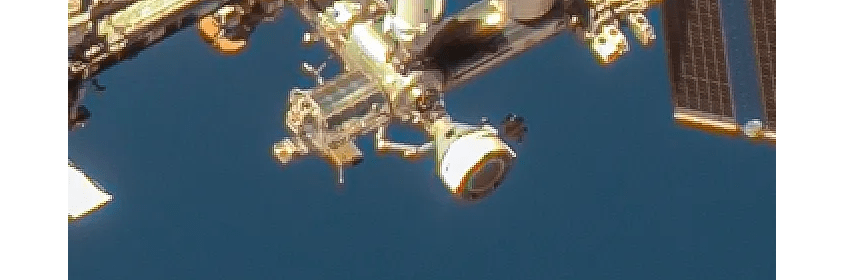
It got crowded on the International Space Station with the arrival of “Crew-2,” SpaceX’s second regular and third actual flight taking humans to the ISS (there was a test mission known as “Demo-2”). There hadn’t been eleven people on board since the Space Shuttle era.

There were other milestones as well. This was SpaceX’s first reused crew capsule to reach the orbiting platform and the first crewed mission with a reused Falcon 9 rocket. The Crew-2 astronauts themselves made history when they started boarding. This was the first time SpaceX had carried passengers from three different agencies (NASA, ESA and JAXA).

Crew-1
NASA TV/5-2-2021

The overcrowding on the ISS came to an end just a few days later with the spectacular nighttime landing of SpaceX’s Crew-1 “Resilience” capsule with four astronauts on board. They landed in the gulf of Mexico just before 3am Eastern Time. But with cameras tuned for night the scene was clearly visible in spite of the pitch dark ocean lighting.

Crew Dragon Resilience will add to its time in space on its next mission launching the privately-funded Inspiration4 crew on a multi-day Earth orbit mission targeted for September.

#####

« Older Entries