Boeing Blows Another One
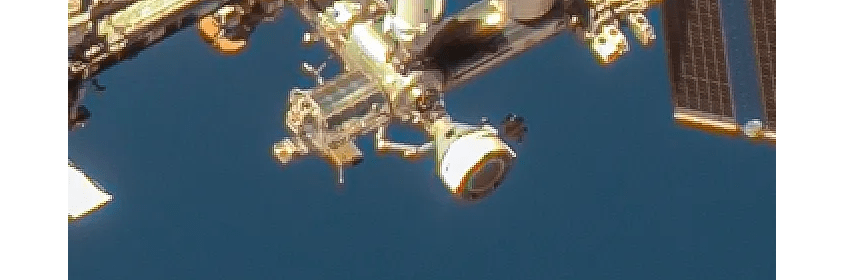
Boeing’s Starliner capsule is seen docked to the International Space Station in this zoomed-in view of an image captured by Maxar Technologies’ WorldView-3 satellite on June 7, 2024. (Image credit: Maxar Technologies via NASA)

Update Sept 7, 2024
The Starliner capsule returned to Earth safely from the International Space Station last night, without the two astronauts it took up there in June. Boeing and NASA engineers will review the vehicle’s performance on reentry as they consider the future of the program.
Two astronauts who flew to the International Space Station on Boeing’s Starliner spacecraft will return to Earth next year on a SpaceX “Crew Dragon” vehicle, their planned eight-day test flight turned into a two-thirds of a year ordeal. It is yet another of a long list of failures by the once venerated aerospace company in recent years.
NASA Administrator Bill Nelson, a former Democratic senator appointed to run the space agency by President Joe Biden, announced the decision that astronauts Barry Wilmore and Sunita Williams will remain in orbit until next February, when a SpaceX craft is scheduled to return with them on board.
The decision ends weeks of uncertainty during which Boeing and NASA were less than transparent about the situation. Boeing spent a decade developing the Starliner vehicle that transported the astronauts to the space station on June 6. During its flight to the station, several thrusters temporarily failed, and engineers identified additional helium leaks within its propulsion system.
Leaders at the agency have described intense internal debates over the past few weeks over what the thruster problems and helium leaks could mean if Wilmore and Williams departed on the spacecraft. Some former astronauts have praised the agency for taking time to run tests and evaluate data before coming to any decision.
NASA and Boeing have argued over the problems, trying to determine whether they would pose any threats if the vehicle left the station carrying the astronauts. NASA and the aerospace company are preparing to undock Starliner from the space station, and transport it back to Earth in early September with no one on board. Even that will be a risky maneuver, because the Starliner, unlike the Dragon, was never programmed to undock from the space station on autopilot.
NASA’s decision not to allow Boeing to try to return Williams and Wilmore is expected to raise questions about Starliner’s future. Boeing has been working on the vehicle for more than a decade, reporting more than $1.4 billion in losses after delays driven by software challenges, sticky valves and the spacecraft’s parachute system. There are reports Boeing would like to sell off its space business.
The decision reinforces SpaceX’s dominant role at NASA. Besides crew flights to the ISS, many of the agency’s most important efforts run through the Elon Musk-led company, including future planned moon landings, launches of research satellites and more. “SpaceX stands ready to support NASA however we can,” said a post from Gwynne Shotwell, the company’s president and operating chief, on Musk’s social-media platform X.
SpaceX has also bested Boeing by producing reuseable vehicles, both the Falcon 9 booster rockets and the Dragon crew capsules. This has greatly reduced the cost of each launch. Boeing does not appear to have a similar technology even on the drawing boards. As this is being written the Falcon is grounded due to the failure of its last mission to land as planned. That just reminds us that space is a difficult and dangerous business. But that landing did not involve a crew, and the Falcon had already successfully delivered its satellite payload into orbit. The Falcon has made more than two hundred successful landings without a mishap and the specific Falcon involved had already been used 23 times. The grounding is expected to run for only a week or two, until Space X produces a report describing the cause for the failure.
Boeing was paid twice as much as SpaceX to develop a crewed vehicle, but it was SpaceX in 2020 which completed the first test flight delivering NASA astronauts to the space station and bringing them back, building on previous cargo missions to the research facility that used a similar spacecraft. NASA officials for years have said the agency needed to have two different American vehicles capable of conducting crewed flights to the space station. Due to this Boeing failure, it still doesn’t
The NASA Inspector General as far back as 2020 questioned Boeing’s ability to produce the Space Launch System, designed to return Americans to the moon. The program is long delayed and vastly over budget. NASA also was cited for “lax oversight”.
It was also during the Trump administration that Boeing took on the task of producing a new Air Force One. That project is replacing the existing 747-200 aircraft with a pair of 747-800s. Boeing is starting with two already built aircraft it had on hand but had never delivered because its customer went bankrupt. The planes do have to be extensively modified, but four years later they are nowhere in sight.
Boeing removed a feature that protects its 787 planes during lighting strikes even after the FAA objected. Its 777 was initially grounded due to battery fires and there are new concerns about fasteners used in its construction. A new extended version, the 777X, is under test but the four plane test fleet has been grounded due to cracks in their structure.
That last problem may be indicative of a problem Boeing has when it tries to “stretch” an existing aircraft rather than design a new one. This cost reducing and time cutting strategy led to the disastrous loss of two 737-MAX aircraft, Lion Air Flight 610 in 2018 and Ethiopian Airlines Flight 302 five months later. The combined death toll was 346 lives.
The Max was introduced in response to a new fuel-efficient plane from the European manufacturer Airbus. In the Max. Boeing made a significant change in the flight control system to compensate for changes to the original 737 design to allow the attachment of larger engines. Boeing did not flag the changes to regulators or customers out of concern the FAA would require the pilots to be retrained, adding to the cost of acquiring the new aircraft.
On January 5, 2024, a panel on a two-month-old Alaska Airlines 737Max 9 jet blew off in midair. According to the National Transportation Safety Board, the panel was removed for maintenance but appeared to have been reinstalled without the bolts that secure it in place.
How does this happen? In his book, “Flying Blind: The 737 MAX Tragedy and the Fall of Boeing”, Peter Robison says the once-great company was gutted by a series of bosses who put making money ahead of
making airplanes. That is a sea-change from the company’s founders and generations of leaders who were engineers at heart.
Boeing now employs 171,000 people, including in its commercial plane, defense, services and other divisions. That makes Boeing too big to fail. And with our commercial, defense, and space industries dependent on it, the time for meaningful oversight is long overdue.
#####
 Scott Gurvey's Public Offerings