Star Stuff
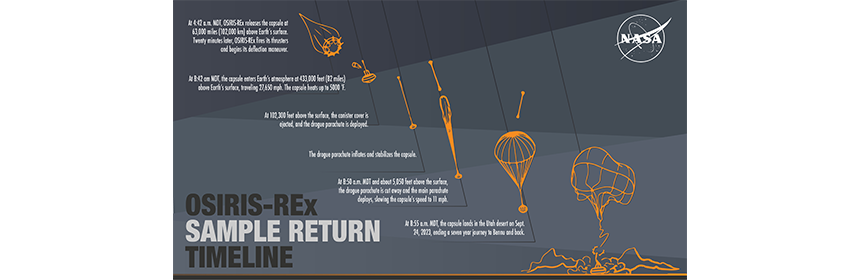
On Sunday September 24, 2023, just before noon eastern time, a sample capsule containing about one pound of the asteroid Bennu should arrive in Utah. Go ahead. Back up. Read it again. Amidst all the angst of our everyday lives, which is the usual subject of this column, we have a wonder like that to contemplate.
The capsule will have come from the OSIRIS-REx spacecraft. OSIRIS-REx was launched on September 8, 2016, flew past Earth on September 22, 2017, and rendezvoused with Bennu on December 3, 2018. It spent the next two years analyzing the surface to find a suitable site for landing.
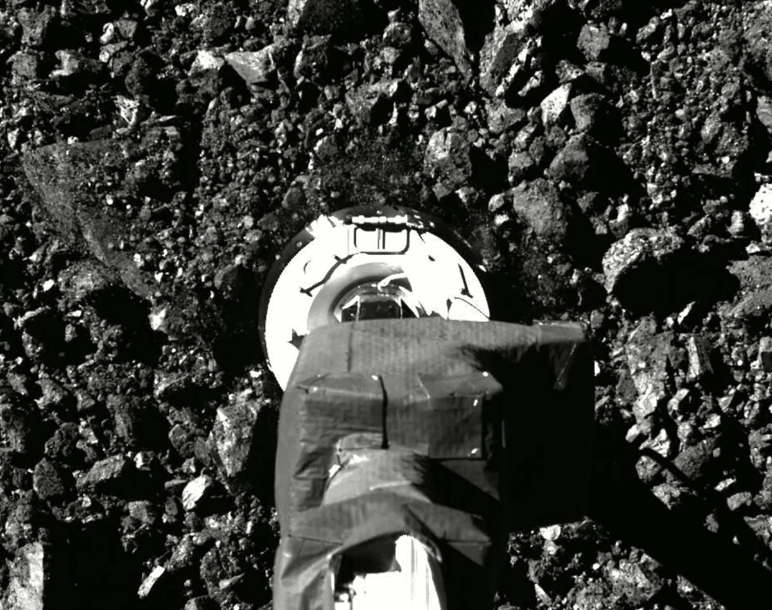
On October 20, 2020, OSIRIS-REx touched down on Bennu and successfully collected a sample. Though some of the sample escaped when the flap that should have closed the sampler head was jammed open by larger rocks, NASA is confident that they were able to retain between 400 g and over 1 kg of sample material, more than the 60 g (2.1 oz) minimum for success.
The sample capsule will be released when the spacecraft reaches an altitude of 63,000 miles above the Earth’s surface. The capsule will then be sent spinning towards the atmosphere below and will pierce Earth’s atmosphere at 10:42 a.m. EDT, coming to rest near a military base in the Utah desert. A recovery team will board four helicopters and head out into the desert to retrieve the capsule as quickly as possible to avoid contaminating the sample with Earth’s environment. Once located and packaged for travel, the capsule will be flown via helicopter to a temporary clean room on the military range, where it will undergo initial processing and disassembly in preparation for its journey by aircraft to NASA’s Johnson Space Center in Houston, where the sample will be documented and distributed for analysis to scientists worldwide.
There have been previous missions that have returned samples from outer space to Earth. Between 1969 and 1971, the Apollo program carried out six missions to the surface of the moon. The astronauts brought back a total of 842 pounds of lunar rocks, core samples, pebbles, sand, and dust from the lunar surface.
NASA’s Stardust mission, launched in 1999, flew past the comet Wild 2, collecting thousands of dust particles from the comet’s coma and returning them to Earth for laboratory analysis. Japan’s Hayabusa, launched in 2003, successfully returned samples from the asteroid 25143 Itokawa in 2010. Japan’s Hayabusa 2 returned samples from asteroid 162173 Ryugu in 2020.
If successful, OSIRIS-REx will be the first United States spacecraft to return samples from an asteroid.
All these missions have significantly contributed to our understanding of asteroids and the early solar system. The samples returned by these missions provide valuable insights into the composition, structure, and history of asteroids, as well as clues about the formation of our solar system and the origins of life on Earth.
Bennu was chosen as the target of this study because it is a “time capsule” from the birth of the Solar System. Bennu has a very dark surface and is classified as a B-type asteroid, a sub-type of the carbonaceous C-type asteroids. Such asteroids are considered primitive, having undergone little geological change from their time of formation. In particular, Bennu was selected because of the availability of pristine carbonaceous material, a key element in organic molecules necessary for life as well as representative of matter from before the formation of Earth. Organic molecules, such as amino acids, have previously been found in meteorite and comet samples, indicating that some ingredients necessary for life can be naturally synthesized in outer space.
Which doesn’t mean we will find a place we can relocate to in our neighborhood any time soon.
#####
 Scott Gurvey's Public Offerings
Pingback: It’s Back! | Scott Gurvey