The Unimportant 43

In the two years we have lived in Princeton, New Jersey I have found only one barber whose work meets with the approval of my wife Amy. And he is a one-hour drive away. Don’t ask. It’s a small price to pay for marital bliss. At least on the subject of my hair.
We have taken to making a project of it. A scenic drive and usually a stop for lunch. The latest trek produced a revelation. We had no sooner crossed the border into Pennsylvania, about ten minutes away, when we found the road lined with campaign signs. You rarely see signs in New Jersey, if you see them at all. But once over the border into Pennsylvania, you see them everywhere, pretty evenly distributed between the Republican Donald Trump and the Democrat Kamala Harris.
That’s when it hit me. I am a resident of the Unimportant 43. And I don’t like it.
You see, in the upcoming election for President of the United States, voters in Pennsylvania count. Voters in New Jersey do not. You would think in electing one person to lead the entire nation every vote would count. But that is not the fate the men who wrote our Constitution bequeathed us.
I’ve written about the Electoral College before. There are countless historical reviews describing how it came about, a question that is open for some debate. There are also countless studies proposing various ways of doing away with it, effectively or actually. I’ll avoid all of that for now. Suffice it to say the Electoral College, which actually elects the president and vice-president and whose members are selected in each state in a manner proscribed by the individual state’s legislature (U.S. Constitution, Article II, Section 1, Amendment 12, Amendment 23), will be in full force for this year’s election.
In truth, it is not the indirect manner of electing our national executive which is the problem. The problem is that the legislatures of forty-eight of the fifty states have decided to select their electors through a winner-take-all popular vote. The District of Columbia, which has had three votes since 1961, is also winner-take-all. The winner-take-all method means just what is says. A candidate who wins the popular vote by as small a margin as a single vote is awarded all that state’s electors.
For this year’s election, the consensus among the pollsters is that they can predict with confidence the Electoral College vote total in forty-three of the fifty states, and in Washington D.C. They list the other seven as Nevada, Arizona, Wisconsin, Michigan, North Carolina, George, and Pennsylvania. These are the Important Seven.
That explains the campaign signs in Pennsylvania, and the lack of campaign signs in New Jersey. It also explains why those seven states will see frequent visits by the candidates and their surrogates. And why the local television stations and billboard companies in those states will receive a bonanza of campaign dollars. And why the unimportant forty-three states will get little or nothing.
Polling is an art, not a science. In the age of the Internet the number of polls has grown exponentially. For every poll which I find reputable I also find a dozen which are poorly designed, biased, or both. You really have to shop around and find the polls you want to follow. Over the years I’ve come to have great respect for the polls taken by the University of Virginia’s Center for Politics. Professor Larry Sabato, the center’s director, publishes a newsletter and manages a website I highly recommend called Larry Sabato’s Crystal Ball.
At this point in the election cycle, they update the Electoral College map frequently. I’ve uploaded the map as of September 25, but I will not update it here and you should check online for the latest.
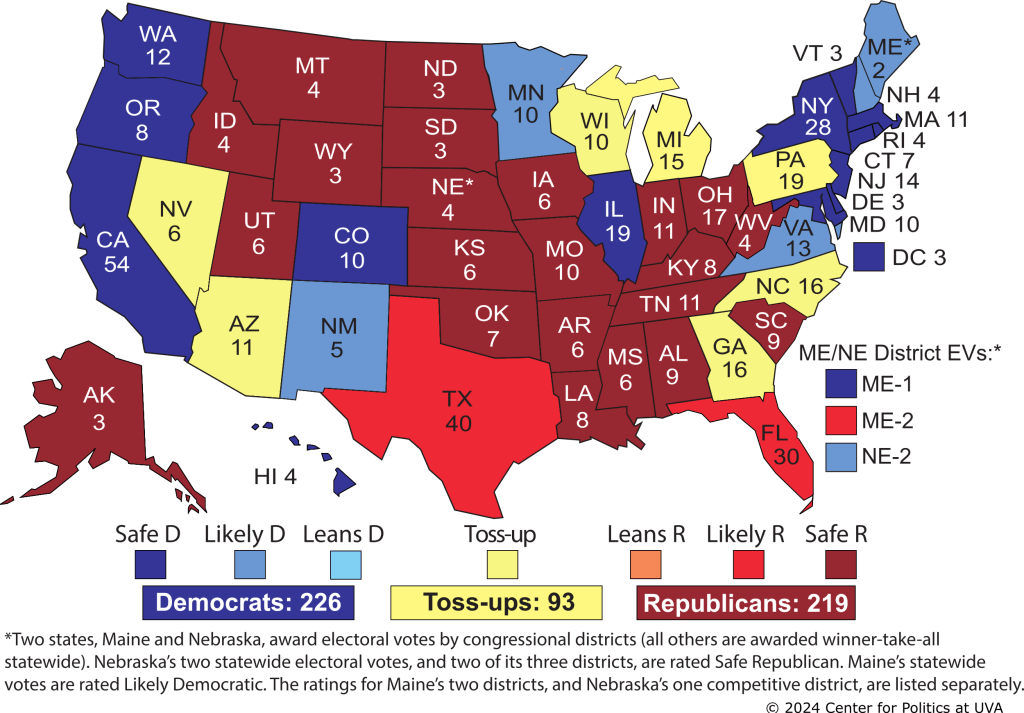
As you can see, with 270 votes needed to elect a president, the seven toss up states representing 93 votes are projected to be the determinants of this year’s election. The rest of us are just spectators.
####
 Scott Gurvey's Public Offerings
wow!! 111October 7
LikeLike
Pingback: Campaign of Hate | Scott Gurvey's Public Offerings
Pingback: Here We Go Again | Scott Gurvey's Public Offerings