Trump and Ellsberg
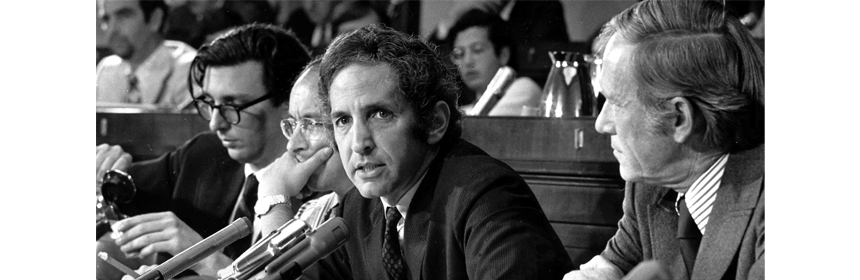
I was researching a column on the connection between Donald Trump and Richard Nixon when the news broke, Daniel Ellsberg had died at the age of ninety-two. The report was not a surprise. In March, Ellsberg had announced that he had been diagnosed with inoperable pancreatic cancer. He had been, in recent weeks, giving a series of interviews recapping the tumultuous events that made his name a household word in the 1970s and warning that those events continue to have relevance today.
Ellsberg’s words ring true. The case of Daniel Ellsberg prompted actions by Richard Nixon which triggered events eerily like the actions of Donald Trump and the events they have triggered today. The more things change, the more they stay the same.
In 1967 Ellsberg was working at the RAND Corporation, a non-partisan policy think tank and research institute. At RAND he contributed to a top-secret study of classified documents completed the next year titled, “Report of the Office of the Secretary of Defense Vietnam Task Force.” Secretary of Defense Robert McNamara created the task force for the purpose of writing an “encyclopedic history of the Vietnam War.”
The history was based on an extensive review of existing documents including military plans and reports, diplomatic communications, and internal analysis from the various national security agencies within the governments of America and its allies. Much of the source material was classified. In all there were forty-seven volumes of material. Distribution of the report was highly restricted. There were very few copies and the report itself was classified.
The Vietnam war had deeply divided America. Antiwar demonstrations were common, and some were violent. Opposition to the draft, the required military service for young men was also common as more than 58,000 American soldiers lost their lives fighting in southeast Asia.
Ellsberg, once a supporter of American involvement in Vietnam, had become dissatisfied with the war effort and disillusioned because of what he learned while working on the study. He made unauthorized copies and tried to enlist support from antiwar members of Congress, who could place the findings into the Congressional record without fear of punishment.
When that failed, Ellsberg leaked parts of the report to the New York Times, which began to publish them on June 13th, 1971. They quickly became known as the Pentagon Papers.
The Pentagon Papers revealed that four presidential administrations had lied to the public about the extent and purpose of the Vietnam War. They also exposed the covert operations and bombing campaigns in North Vietnam, Cambodia and Laos and the U.S. role in the coup against the South Vietnamese president. The papers caused a major political scandal and undermined public trust in the government.
Attempts by the government to stop publication failed with a landmark 1971 Supreme Court decision, New York Times v. United States, which established the principal that the press enjoys a “heavy presumption against” prior restraint and therefore, the Times could not be stopped from printing something in advance.
This as one of the key examples of First Amendment law I teach in my course in Media Law and Ethics at the UCLA Extension, noting that while it generally means journalists cannot be stopped from publishing something in advance, it does not shield them from facing the consequences of publication after the fact.
The release of these papers was politically embarrassing not only to those involved in the Kennedy and Johnson administrations, but also to the incumbent Nixon administration. And here, as the dramatists would say, is where the plot thickens.
They might have lost their case against the New York Times, but the government had no plan to lose against Ellsberg. The Ellsberg case seemed open and shut. Ellsberg had openly admitted to his actions and volunteered his intent. When the FBI caught up with him in June 1971, he was charged with twelve felonies and faced 115 years in jail.
Ellsberg might well have died in prison were it not for the apparent desire of President Nixon and his team to extract revenge. After losing the Pentagon Papers case, the White House created a “Special Investigations Unit,” a covert group tasked with preventing the leaking of classified information. This group, later known as “The Plumbers,” undertook as its first operation a burglary of Ellsberg’s psychoanalyst’s office in the hope of finding information that might discredit him.
Two men who would be later be among the Watergate burglars, Gordon Liddy, and Howard Hunt, carried out the burglary. They reportedly found Ellsberg’s file but dropped it on the floor. Ellsberg’s phone was also tapped. And there were reports the Plumbers planned to physically attack him. It also emerged, during Ellsberg’s trial in 1973, that the judge had earlier been offered the post of Director of the FBI, a job he coveted.
Judge Matthew Byrne, Jr., dismissed all charges against Ellsberg due to government misconduct.
So, a sure thing government prosecution under the Espionage Act was lost due to an even greater criminal act by the government itself. And a clandestine unit operating out of the White House itself lay in wait for another project. They had less than a year to wait. And this time, their criminal acts would trigger investigations into the acts of a sitting American president. And those investigations would bring him down.
#####
 Scott Gurvey's Public Offerings