Artemis II
I held off on this. Didn’t want to jinx it. Now that the Artemis II crew is back, safe and sound after a near perfect mission, I can write about the thrill once again of seeing humans reach the moon for the first time in 53 years. With all the divisiveness and strife of today’s world, it is nice, even if just for a moment, to reflect that somethings can still be achieved in the name of all mankind.
I still remember asking my parents for permission to stay home and the watch the flight of the first living thing America sent into space. It was 1961. The passenger inside the Mercury capsule was Ham, a chimpanzee. I was in grade school. Ham paved the route. Alen Shappard followed. Eight years later Apollo 11 landed on the moon.
Eight years from first flight to the moon landing in 1969. Fifty-three years from the sixth and last moon landing, Apollo 17 in 1972, to Artemis II. How did we get so distracted, and jaded, and why did we take so long?
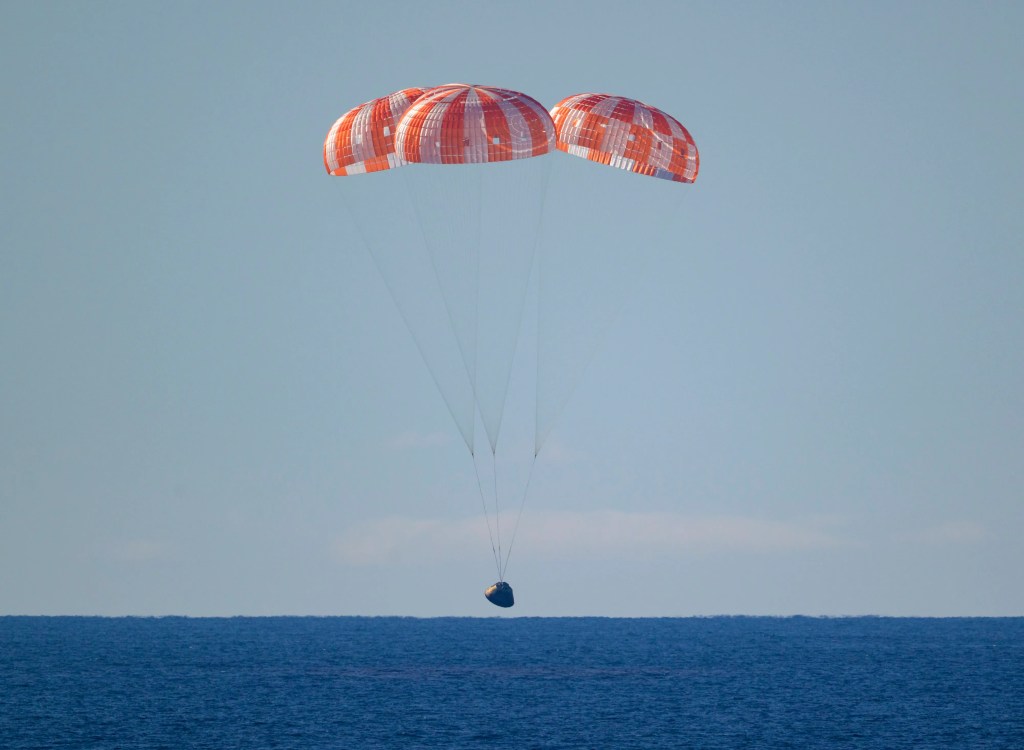
Those were the questions in my mind as I watched the splashdown in the Pacific off the coast of San Diego. And listened to the mostly mediocre coverage from the television networks. I thought of Walter Cronkite, Frank McGee, Roy Neal, and Jules Bergman. They had gravitas. This time around the reporters hadn’t even bothered to read the history, and they wouldn’t shut up.
Of course, they were not even born when Neil Armstrong first walked on the moon. I suppose they should be forgiven their ignorance. But it is hard to forgive their lack of homework.
If you follow this column, you know I frequently write about space. I’ve even published here what is thought to be the best-known photograph ever taken, the “Earthrise” photo, earth in color, taken by astronaut William Anders on the Apollo 8 mission. Apollo 8 went into lunar orbit but did not land. A copy of that photograph has hung in my office for decades.
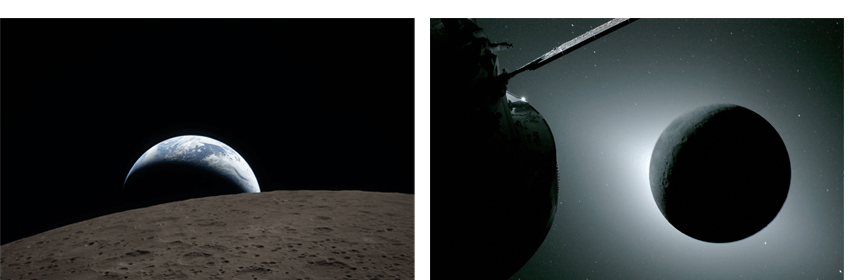
Artemis II Commander Reis Wiseman paid homage to that historic picture with what is now being called, “Earthset.” Captured on April 6, 2026, at 6:41 p.m. EDT, the image shows a crescent Earth slipping behind the rugged lunar horizon as the Orion spacecraft, named Integrity, flew over the Moon’s far side.
On the same day the Artemis II crew captured a historic total solar eclipse from a unique vantage point on the far side of the Moon. This event, lasting nearly 54 minutes, provided a perspective never before witnessed by humans, showing the Moon as a dark orb fully obscuring the Sun while revealing the solar corona and several distant planets. These are the awe-inspiring photos reproduced above.
Donald Trump made the traditional presidential call to the crew. There is an irony here. Richard Nixon, a Republican got to talk to the Apollo 11 crew after the first moon landing even though the entire program had been championed by Presidents John Kennedy and Lyndon Johnson, Democrats. Nixon cancelled the last three Apollo flights.
Trump told the Artemis II crew, “Today, you’ve made history and made all America really proud”. He emphasized that the mission was a precursor to a permanent lunar presence, saying, “We’ll plant our flag once again… we’ll establish a permanent presence on the moon”.
Empty words in my book. Trump’s FY 2027 budget request proposes a 23% decrease in NASA’s overall funding, reducing it to $18.8 billion from its current level of $24.4 billion. Despite overall cuts, funding specifically for the Artemis moon missions would increase by nearly 10% to $8.5 billion. This is intended to fully fund lunar landers, spacesuits, and transportation to ensure astronauts return to the surface by 2028.
But the “Science Mission Directorate” faces a 47% cut, dropping from $7.25 billion to $3.9 billion. This would likely lead to the termination of over 40 missions, including those focused on Earth observation, climate research, and astrophysics. No need for those egghead scientists to continue to explore the cosmos. Or to use NASA’s unique ability to look down on the earth and monitor what we are doing to the environment, a topic Trump calls a “hoax.” Endangered projects include a follow on to the fantastic space telescopes and the mission to pick up and bring back to earth soil samples still being collected by the amazing Perseverance Rover, searching for signs of ancient microbial life since landing on Mars in 2020.
This request mirrors a similar proposal for the 2026 fiscal year that was soundly rejected by Congress, which ultimately restored NASA’s funding to roughly $24.4 billion. Space advocates, including The Planetary Society, have labeled the new 2027 proposal an “extinction-level event” for space science. The final budget will be determined by Congress later this year.
I wonder if Trump realized the hypocrisy of his conversation with the astronauts. I also wonder if he realized the crew included a woman, an African American, and a Canadian. Just the kind of diversity he decries as “woke” and undesirable.
There appears to be something about viewing the entire earth with one’s own eyes that changes a person. Earth, with all its people, seems so small and insignificant. Ruth Graham of The New York Times writes about the philosophical and theological aspects of that impact. She quotes from the Book of Psalms, the Greek astronomer Ptolemy, theologian Andrew Davison of the University of Oxford, and actor William Shatner, Star Trek’s Captain Kirk, among others.
My thoughts on this subject turn to Carl Sagan’s novel Contact. The alien making first contact with a human tells our protagonist, Eleanor Arroway, that humans are newcomers and technologically backward, yet promising, often referencing the vastness of the universe to put humanity in perspective. In his screenplay for the film (Contact, 1997), three different characters ask the same question, “Are we alone?” Three other characters give the same answer, “The universe is a pretty big place. It’s bigger than anything anyone has ever dreamed of before. So, if it’s just us… seems like an awful waste of space.”
#####
 Scott Gurvey's Public Offerings